An overview of wound management, focusing on the role of moisture balance, debridement, and the different categories of wound dressings such as alginates, gauzes, hydrocolloids, and hydrogels.
Effective wound management relies on a fundamental principle: maintaining an optimal moisture balance. Whether a wound is excessively wet (high exudate) or dangerously dry, the choice of dressing determines how quickly the tissue heals and how well the body can manage debris. Wound dressings are categorized based on their material composition, their ability to absorb exudate, and their intended clinical application.
The Role of Moisture and Debridement
To understand dressing selection, one must understand two key physiological processes: wound exudate absorption and autolytic debridement.
Exudate is the fluid that leaks out of blood vessels into nearby tissues; while some moisture is necessary for cell migration, excessive exudate can macerate (soften and break down) the surrounding healthy skin. Conversely, a dry wound bed can stall healing.
Autolytic debridement is the body's natural process of using its own enzymes and moisture to liquefy and remove necrotic (dead) tissue. Many modern dressings are designed specifically to facilitate this process by creating a "moist wound environment" that keeps the wound bed hydrated enough for the body to clean itself.
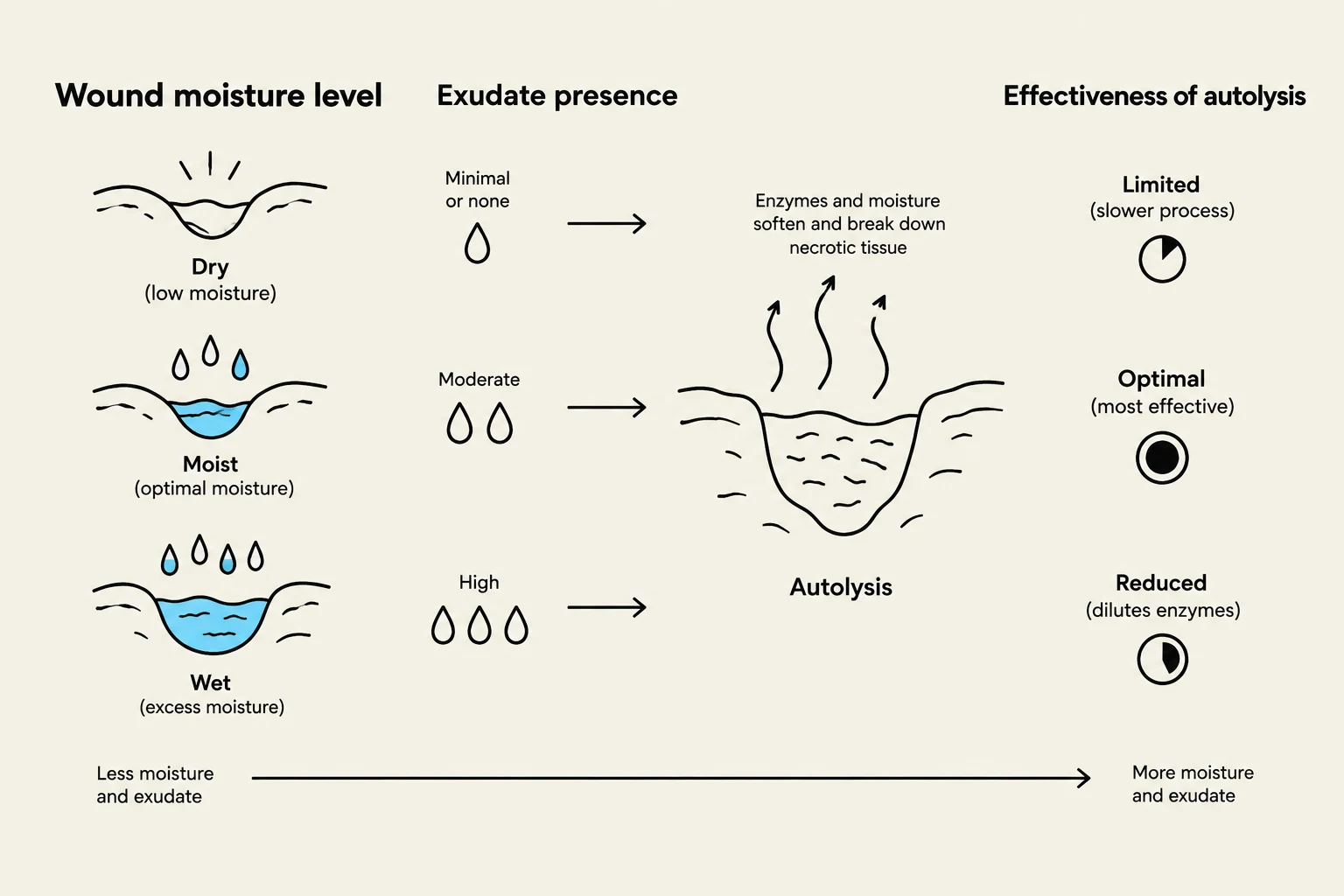
This diagram illustrates the relationship between wound moisture levels, exudate presence, and the effectiveness of autolysis, a process where enzymes and moisture break down necrotic tissue. It shows that optimal moisture and exudate levels lead to the most effective autolysis, while very dry or very wet conditions can hinder the process.
Clinical Tip: When selecting a dressing, always assess the wound's depth and the amount of drainage. A dressing that is too absorbent may dry out a wound, while one that is insufficiently absorbent may allow fluid to leak and damage surrounding skin.
Highly Absorbent Dressings: Alginates
When a wound is producing a moderate amount of fluid, alginate dressings are a primary choice. These are highly absorbent products designed to be placed directly inside the wound bed.
Alginates are unique because they function by forming a gel upon contact with wound exudate. This gelation helps maintain a moist environment while effectively "trapping" the fluid within the dressing matrix. They are typically available in sheets or as strips for easier application.
Requirement: Because they do not have an adhesive backing, they must be used with a secondary cover dressing to keep them in place.
Traditional and Structural Support: Gauzes
Gauzes are among the most common materials in clinical settings. Made of woven cotton, they are nonocclusive, meaning they allow environmental oxygen to reach the wound surface.
While they are highly absorbent, they lack the specialized gel-forming properties of alginates. However, they are incredibly versatile for structural wound management. They can be moistened with sterile saline to create a moist packing for deep wounds, or used to apply pressure to a site.
Primary Uses:
Hemostasis: Applying pressure to stop bleeding.
Surgical Care: Managing newly created surgical incisions.
Deep Wounds: Filling or packing deep wound cavities.
Comparison of Gauze and Hydrocolloid wound dressings, illustrating their properties regarding oxygen permeability, structure, and exudate handling.
Occlusive and Rehydrating Solutions
For wounds that require a different moisture balance, clinicians turn to hydrocolloids and hydrogels.
Hydrocolloid Wafer Dressings
Hydrocolloid wafer dressings consist of an adhesive-backed pad made of hydroactive materials. Unlike gauze, these are more occlusive, meaning they create a seal that prevents environmental oxygen from reaching the wound gel. They possess mild to moderate absorptive properties, absorbing excess exudate into their matrix to maintain a consistent moist surface.
Indications:
Wound Depth: Used for partial-thickness or shallow full-thickness wounds.
Debridement: They are excellent for facilitating minor autolytic debridement.
Safety Note: These should only be applied to noninfected wounds.
Hydrogels
If a wound is too dry, hydrogels are the preferred solution. These are hydrophilic polymer products containing a very high percentage of water. They are available in two main forms: transparent sheets or tube gels.
The primary function of a hydrogel is to rehydrate dry wound beds and maintain a moist environment. Beyond hydration, they provide a cooling sensation that can significantly reduce wound pain.
Applications:
Wound Types: Partial-thickness wounds and minor burns.
Chronic Wounds: Pressure ulcers (stages 2–4).
Specialized Sites: Skin graft donor sites.
Note: When using sheet-form hydrogels, a cover dressing like gauze is often required to secure the product.
Diagram illustrating the different depths of wounds: partial-thickness, deeper partial-thickness, and full-thickness, showing their relation to the epidermis, dermis, and subcutaneous tissue.
Exam Prep: Remember the distinction in occlusion.
Gauze = Nonocclusive (Oxygen enters)
Hydrocolloid = Occlusive (Oxygen is blocked)
Hydrogel = Rehydrating (Adds moisture)
Summary Table of Dressing Applications
Dressing Type
Primary Function
Moisture Environment
Key Indication
Alginate
High absorption
Moist (via gelation)
Moderately draining, nontunneling wounds
Gauze
Absorption/Pressure
Nonocclusive
Hemostasis, surgical incisions, deep packing
Hydrocolloid
Mild absorption/Occlusion
Moist (occlusive)
Partial/shallow full-thickness, noninfected
Hydrogel
Rehydration
Moist (adds water)
Dry wounds, burns, pressure ulcers
Keep reading for free.
Create an account to finish this reading and make it part of your study routine.