Understanding Barriers and Facilitators to Physical Activity
This content explores the various factors that act as barriers or facilitators to physical activity, including intrapersonal, interpersonal, community, environmental, accessibility, operational, and policy levels. It also discusses facilitators such as social and psychological support, and environmental and logistical
Why do some people find it effortless to integrate movement into their daily lives, while others struggle to find even twenty minutes for a walk? The answer lies in the complex interplay between physiological, behavioural, and psychological factors. Our ability to remain active is not merely a matter of "willpower"; rather, it is shaped by two primary opposing forces: barriers and facilitators.
A barrier is any factor or situation that negatively influences or prevents an individual from being active. Conversely, a facilitator is any factor or situation that supports, encourages, or makes physical activity easier to integrate into daily life. To effectively promote health and physical literacy, we must understand how these forces operate across different levels of human experience.
The Multi-Layered Nature of Barriers
The hierarchy of barriers from individual to systemic levels, illustrating policy, community/environmental, interpersonal, and intrapersonal factors.
Barriers are rarely isolated; they often exist in layers, ranging from the internal thoughts of an individual to the broad systemic policies of a nation.
Intrapersonal Barriers: The Internal Struggle
Intrapersonal barriers are internal to the individual. These include cognitive beliefs (how we think about our abilities), a lack of confidence, low motivation, and low energy levels. Psychological factors such as the fear of injury or poor planning can also stall progress. Perhaps most commonly, individuals cite time constraints—the feeling that school, work, or family obligations leave no room for movement.
Interpersonal Barriers: The Social Context
Our social environment plays a massive role in our activity levels. Interpersonal barriers occur in the space between people, such as low peer support or, more severely, social harassment and bullying. For children, the influence of parents is particularly critical; research suggests that parental influence is one of the most important factors in a child's engagement with sport.
Community and Environmental Barriers
The world around us can either invite or repel movement. Community barriers include land-use planning, infrastructure, and travel distance. For example, those living in non-urban or rural areas often face significant inequities and report higher levels of poor accessibility compared to those in large cities.
Environmental barriers specifically refer to the physical conditions of a location, such as unpredictable or extreme weather events and the general built environment.
Accessibility and Operational Barriers
Even if a person is motivated, practical hurdles can stand in the way:
Accessibility Barriers: These include high costs of participation and a lack of reliable transportation.
Operational Barriers: These relate to the limitations of specific facilities, such as a lack of specialized equipment or insufficient staffing.
Policy Barriers: The Systemic Level
At the highest level, policy barriers are systemic factors that restrict movement opportunities. Examples include early school or work start times that do not allow for adequate physical activity windows.
💡 Exam Tip: Categorizing Barriers
When analyzing a scenario, ask yourself: "Is this problem inside the person (Intrapersonal), between people (Interpersonal), or part of the system/environment (Community/Policy/Operational)?" This distinction is vital for identifying the correct type of facilitator needed to solve the problem.
Facilitators: Bridging the Gap
Facilitators are the tools we use to mitigate barriers and bridge the gap between inactivity and a healthy lifestyle.
Social and Psychological Support
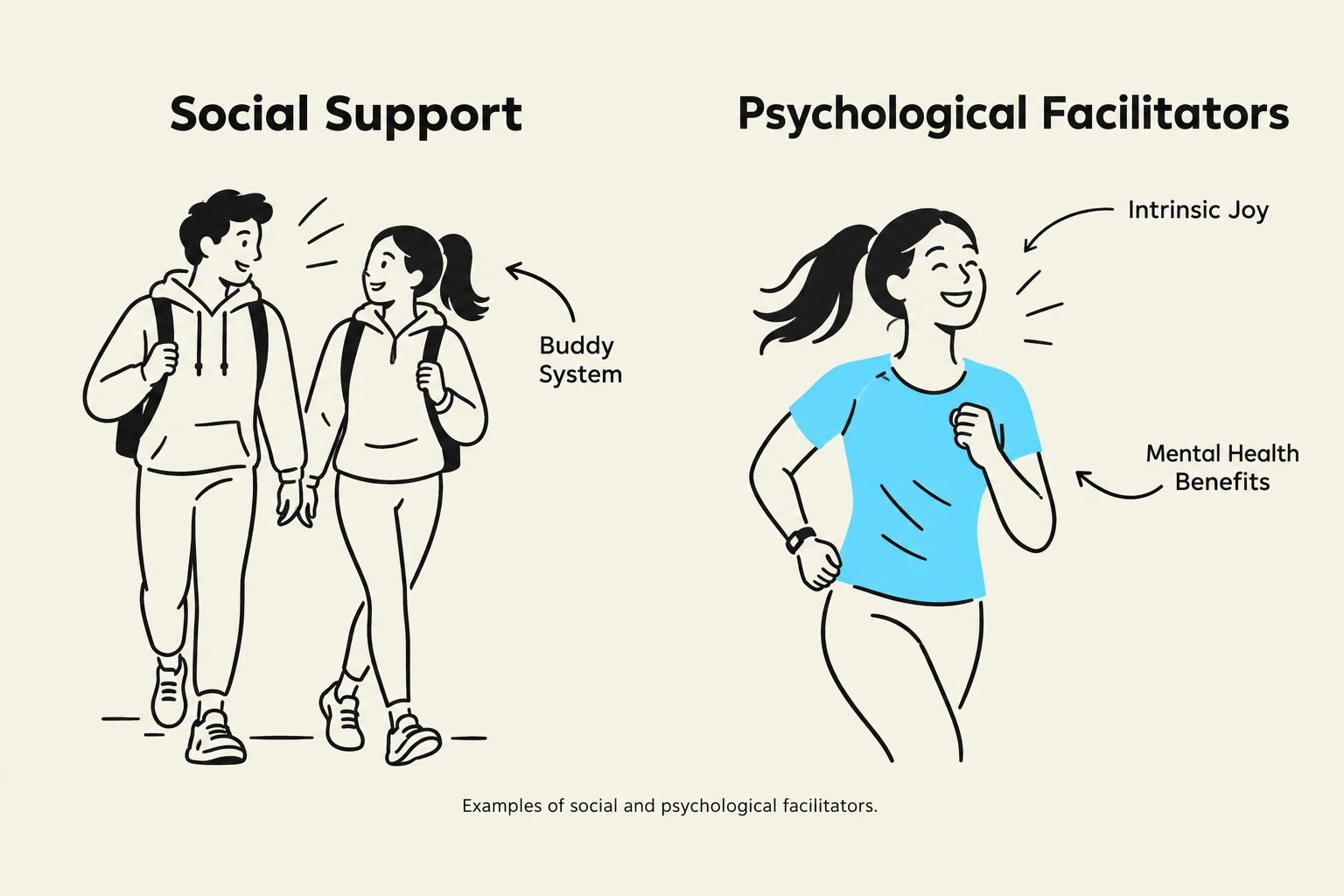
This illustration depicts social support, exemplified by a buddy system, and psychological facilitators, such as intrinsic joy and mental health benefits derived from activities like running.
One of the most effective facilitators is social support. This can take the form of a "buddy" system, engaging in activities with friends, or having supportive role models. Role models are powerful; for instance, teachers who are physically active themselves have been shown to influence their preschool students to achieve higher step counts during PE classes.
Psychological facilitators include finding a genuine love for a specific sport, seeking movement for the sake of mental health improvements, or focusing on the desire for functional movement.
Environmental and Logistical Strategies
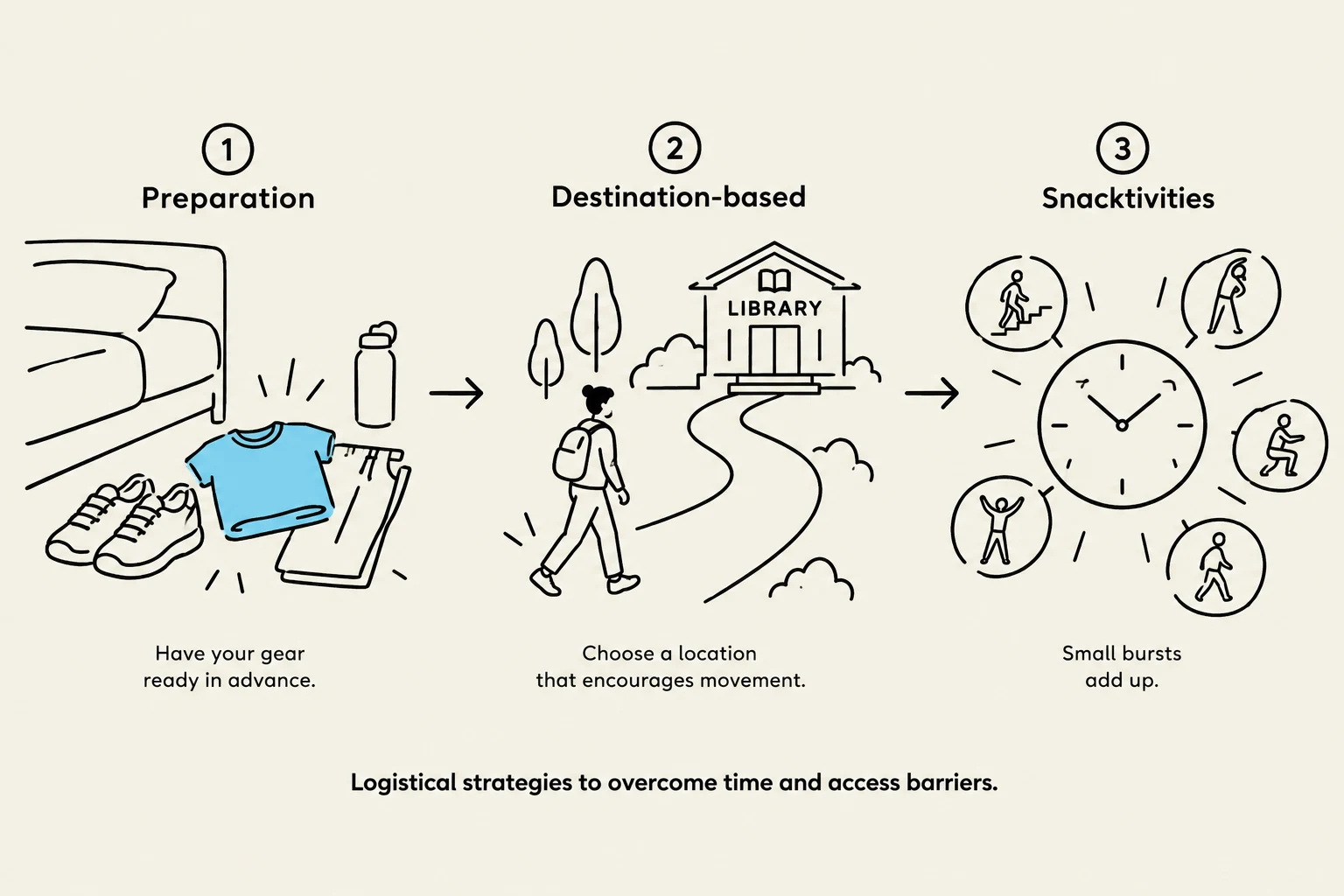
Logistical strategies to overcome time and access barriers, including preparation, choosing a destination that encourages movement, and incorporating small bursts of activity.
Sometimes, the best way to overcome a barrier is through clever logistics:
Preparation: Having equipment ready (e.g., laying out workout clothes the night before).
Destination-based movement: Having a specific "destination" for a walk to provide purpose.
"Snacktivities": Utilizing short, manageable bursts of movement throughout the day rather than waiting for a single long block of time.
Implications for Educators and Advocates
For those entering the field of physical education, understanding these dynamics is essential for fostering physical literacy. A key concept in overcoming barriers is the integration of movement into daily routines so that it becomes as habitual as brushing one's teeth.
Educators must be cautious about how they manage behavior. For example, taking away recess as a punishment is often counterproductive. Instead of denying movement, educators should strategically apply facilitators to mitigate barriers across the intrapersonal, interpersonal, and systemic levels.
📝 Reflection Exercise
Think about your own life. Can you identify one barrier you faced as a child and one facilitator you use as an adult? How did your geographical context (rural vs. urban) influence these experiences?
Keep reading for free.
Create an account to finish this reading and make it part of your study routine.