An overview of the human cardiovascular system, including its components (heart, blood vessels, blood), the cardiac cycle, hemodynamics, and common cardiovascular disorders like atherosclerosis and hypertension.
The human body is a marvel of interconnected biological systems, each working in concert to maintain life. Among these, the cardiovascular system serves as the essential transport network, ensuring that every cell receives the resources it needs to function while efficiently removing the waste products of metabolism. Understanding how this system operates—and how it can fail—is fundamental to the study of human physiology and health.
The Components of the Transport System
The cardiovascular system is composed of three primary elements: the heart, the blood vessels, and the blood. Together, they facilitate a continuous loop of circulation that supports everything from cellular growth to temperature regulation.
Blood: The Medium of Exchange
Blood acts as the vehicle for transport. It carries oxygen from the lungs to the body's tissues and transports carbon dioxide from the tissues back to the lungs to be exhaled. Beyond gas exchange, blood delivers nutrients from the digestive tract to individual cells and carries waste products to the kidneys for excretion as urine. It also serves as a highway for hormones traveling from endocrine glands to their target organs.
Blood Vessels: The Network of Pathways
To move blood throughout the body, a vast network of vessels is required, each with a specialized role:
Arteries: These vessels carry blood away from the heart to various organs and tissues.
Capillaries: These are tiny, microscopic vessels that branch off from the arteries. They are the actual site of exchange, where oxygen and nutrients pass into the cells and waste products enter the bloodstream.
Veins: Once the blood has delivered its cargo and collected waste, veins return the deoxygenated blood back to the heart.
Together, these vessels control peripheral circulation by dilating (widening) or constricting (narrowing) in response to various bodily needs.
The Heart: The Biological Pump
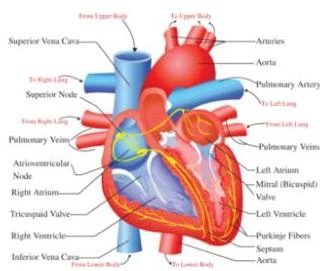
The heart is the engine of the cardiovascular system, functioning as a pump that drives the entire circulation process. Its anatomy is divided into a left side and a right side, each serving a specific purpose in the pulmonary and systemic circuits.
Diagram of the human heart showing its chambers, valves, and major blood vessels.Source: snapgalleria/Shutterstock
The left side of the heart (comprising the left atrium and left ventricle) receives highly oxygenated blood from the lungs and pumps it out through the aorta to the rest of the body. The right side of the heart (the right atrium and right ventricle) receives deoxygenated blood from the body and pumps it back to the lungs via the pulmonary artery to be re-oxygenated.
The Cardiac Cycle
The heart does not pump in a single, continuous stream; instead, it operates through regular, rhythmic phases of contraction and relaxation known as the cardiac cycle. This cycle consists of two distinct phases:
Systole: The phase where the heart muscle contracts and blood is pumped out of the heart. During systole, blood pressure in the vessels increases.
Diastole: The phase where the heart muscle relaxes, allowing blood to flow into the heart chambers. During diastole, blood pressure drops.
The rate of this cycle is highly responsive to the body's state. During periods of exercise, emotional excitement, or stress, the heart speeds up, completing the cardiac cycle more quickly.
Exam Tip: Remember that most of the "speed up" during stress comes from shortening the diastolic period. If the heart rate is chronically too high, the heart may not have enough time to rest, which can eventually decrease the heart's overall strength and the volume of blood it can pump.
Hemodynamics and Stress
The efficiency of the cardiovascular system is often measured by concepts such as cardiac output (the volume of blood pumped by the heart) and blood pressure. Blood pressure is influenced by how hard the heart pumps and the peripheral resistance offered by the blood vessels.
The cardiovascular system is deeply integrated with the nervous and endocrine systems. During a stress response, the sympathetic nervous system triggers the release of catecholamines (epinephrine and norepinephrine), which cause the heart rate to increase and blood vessels to constrict, thereby increasing blood pressure. While this is helpful for immediate "fight or flight" situations, chronic activation of these pathways can lead to long-term damage.
Cardiovascular Disorders
Disorders of the cardiovascular system can stem from congenital defects (present at birth) or from cumulative "wear and tear" caused by lifestyle factors such as diet, smoking, and chronic stress.
Atherosclerosis and Arteriosclerosis
One of the most significant threats to cardiovascular health is atherosclerosis. This condition is characterized by the buildup of cholesterol and other substances on the arterial walls, forming "plaques". These plaques narrow the arteries, reducing blood flow and interfering with the delivery of nutrients to cells. Damaged arterial walls can also become sites for blood clots, which may completely obstruct a vessel. While often discussed alongside arteriosclerosis (the hardening of the arteries), atherosclerosis specifically refers to this plaque-driven narrowing.
Clinical Consequences
When blood flow is compromised, several serious conditions can arise:
Angina Pectoris: Chest pain resulting from reduced blood flow to the heart muscle.
Myocardial Infarction: Commonly known as a heart attack, this occurs when blood flow to a part of the heart is completely blocked, causing tissue damage.
Aneurysm: A potentially dangerous bulge in an arterial wall that can rupture.
Hypertension: High blood pressure, which is often a result of repeated stress or lifestyle factors and can lead to coronary artery disease.
Other vascular issues include phlebitis, which is the inflammation of a vein.
Clinical Connection: It is important to note that many cardiovascular issues are linked to other systemic failures. For example, diabetes is associated with a thickening of the arteries due to waste buildup in the blood, which significantly increases the risk of coronary heart disease.
Keep reading for free.
Create an account to finish this reading and make it part of your study routine.