Explores the unique chemical and biological properties of water, including its role in lubrication, heat regulation, and as a solvent. It also covers chemical reactions involving water and the pH scale, acids, bases, and buffer systems for maintaining homeostasis.
In the study of biology, understanding the chemical foundation of life is essential. Molecules are generally categorized into two groups: inorganic molecules, which do not contain carbon (such as water and salt), and organic molecules, which serve as the building blocks of living things and possess a carbon backbone with attached hydrogen atoms. While organic molecules like carbohydrates, lipids, and proteins are vital, water—an inorganic molecule—is perhaps the most critical component for human survival, making up approximately 60% to 80% of the human body.
The Unique Chemistry of Water
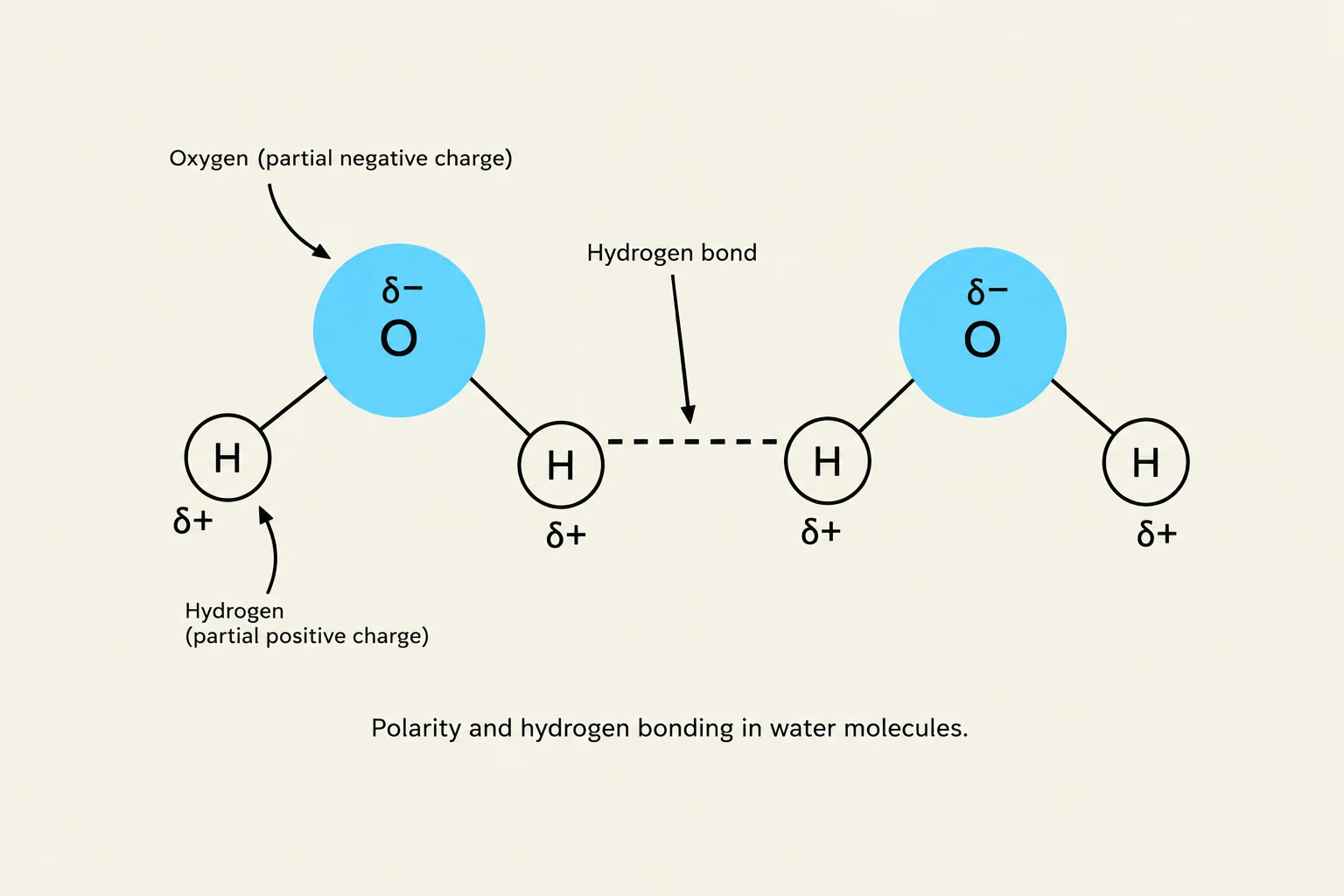
Polarity and hydrogen bonding in water molecules.
Water (H2O) is a remarkable molecule due to its structure. It is formed by polar covalent bonds, where electrons are shared unequally between the oxygen and hydrogen atoms. This unequal sharing creates a slight charge imbalance, allowing water molecules to attract one another through hydrogen bonds.
While an individual hydrogen bond is relatively weak, the collective strength of millions of these bonds in a body of water provides significant stability. These bonds are responsible for the unique physical properties that allow life to thrive.
Biological Properties of Water
The ability of water to form hydrogen bonds leads to several critical biological functions:
Lubrication and Cushioning
Because hydrogen bonds create an inward pull between water molecules, water can surround and suspend organs within body cavities. This provides buoyancy, which cushions organs against impact and prevents them from being damaged during sudden movements or jolts. Additionally, water acts as a lubricant, reducing friction as organs (such as those in the abdominal pelvic cavity) brush past one another.
Heat Sink and Homeostasis
Water acts as a highly effective heat sink due to its high heat capacity. Temperature is a measure of molecular motion; for water's temperature to rise, the energy added must first be used to break the hydrogen bonds before the molecules can move faster. This allows water to absorb significant amounts of heat without a rapid change in temperature, which is fundamental for maintaining homeostasis (a stable internal environment).
Evaporative Cooling
When water transitions from a liquid to a gas, it undergoes a phase change that requires breaking hydrogen bonds. As these bonds break, energy is released, which cools the surface from which the water evaporates. In humans, this is the mechanism behind sweating; as sweat evaporates from the skin, it helps lower body temperature.
The Universal Solvent
Water is an exceptional solvent for hydrophilic ("water-loving") substances. These include ions and polar molecules that can interact with water's charges to form a solution. Conversely, nonpolar substances like oils or candle wax are hydrophobic ("water-fearing") and do not dissolve in water because they cannot form these essential interactions.
Chemical Reactions: Synthesis and Decomposition
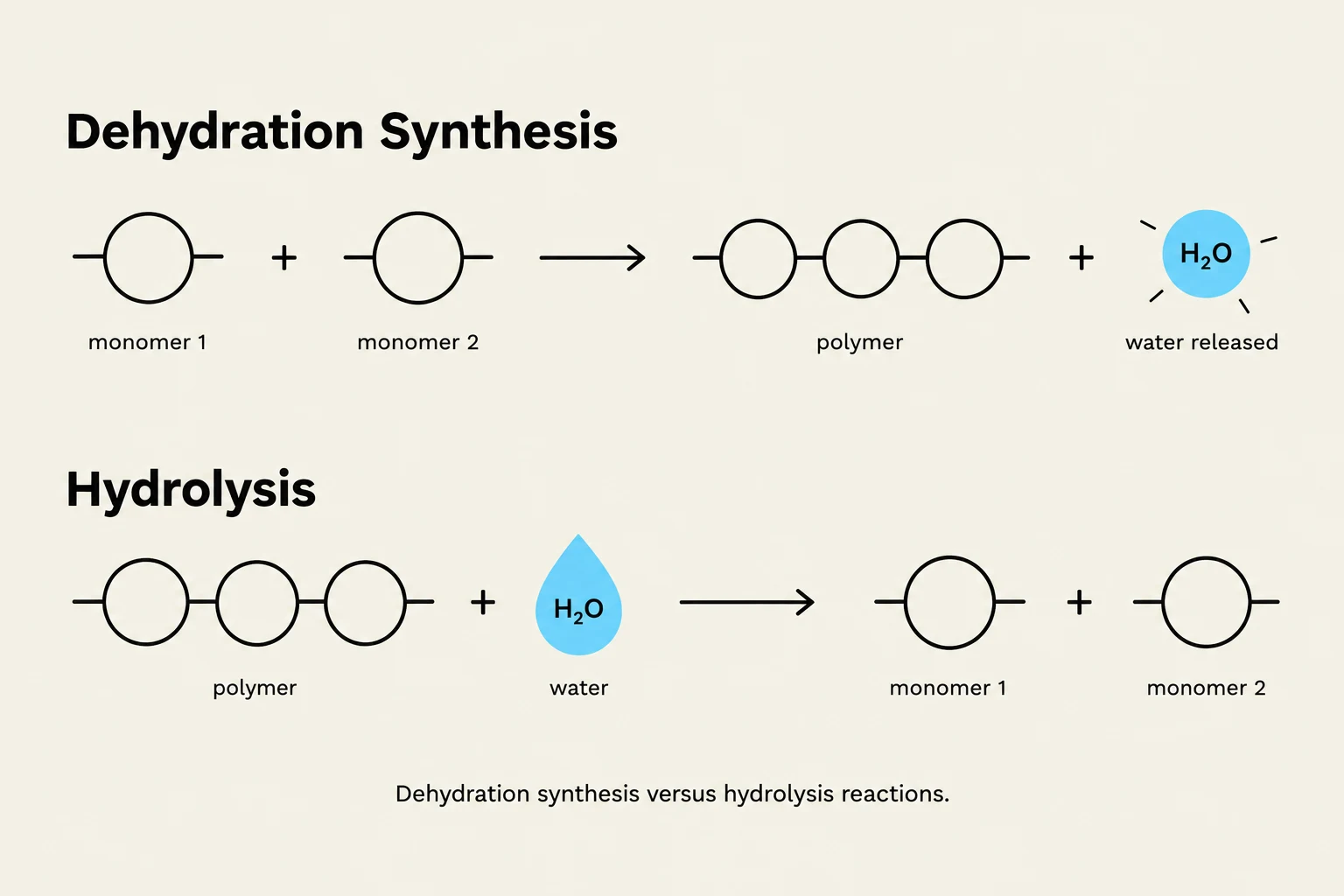
Diagrams illustrating dehydration synthesis and hydrolysis reactions, showing the formation and breakdown of polymers.
Water is not just a passive background for life; it is an active participant in chemical reactions. Two key processes involve the addition or removal of water:
Dehydration Synthesis: This is a building process (synthesis) where small units called monomers are joined to create larger molecules called polymers. During this reaction, a water molecule is lost (dehydrated) to allow a new covalent bond to form between the monomers.
Hydrolysis: This is a decomposition reaction where a large polymer is broken down into smaller subunits. In this process, water is added (hydro) to break the existing chemical bonds.
Exam Tip: To remember these, look at the names. Dehydration means "removing water" to build something up. Hydrolysis means "splitting with water" to break something down.
The pH Scale and Hydrogen Ion Concentration
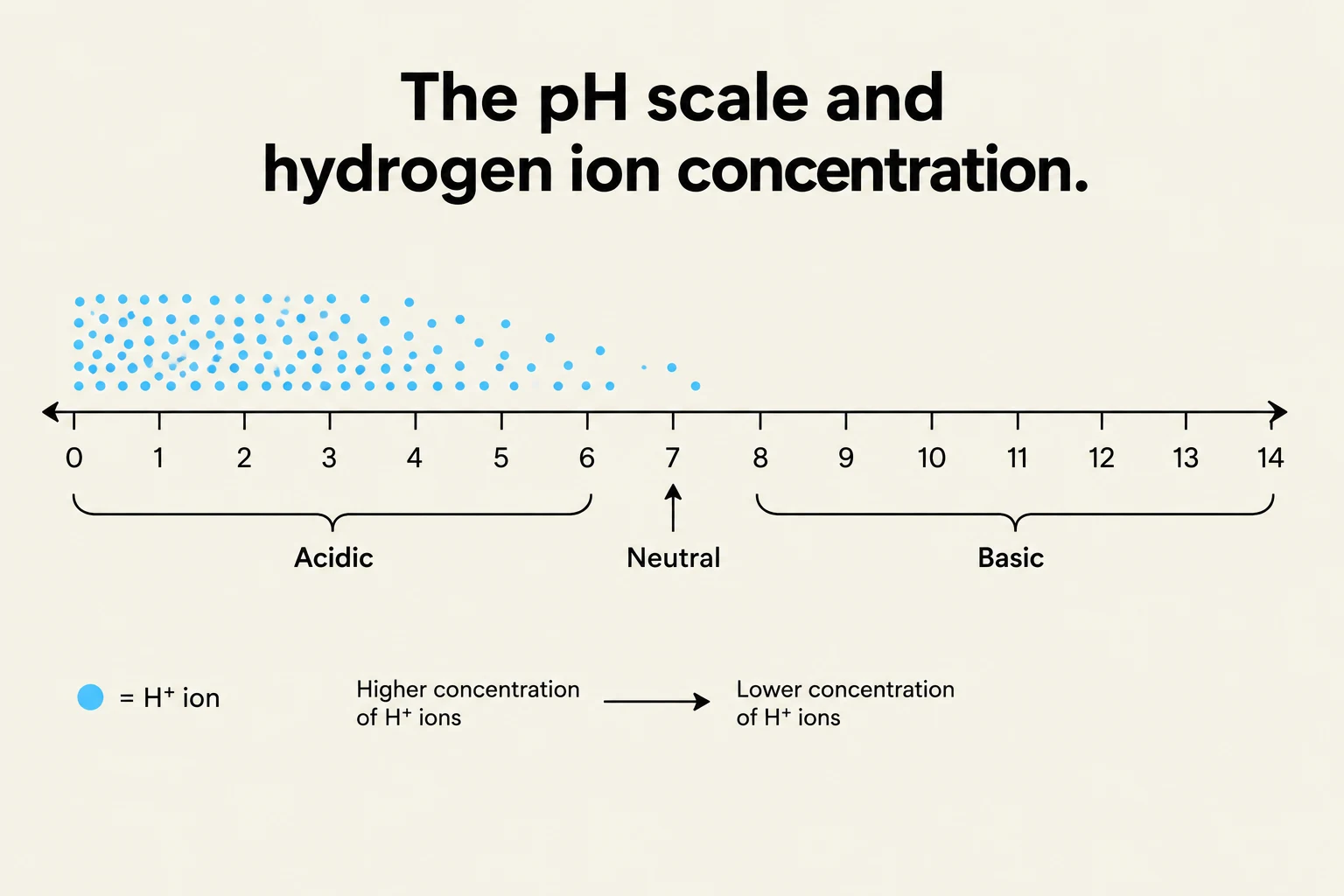
The pH scale illustrates the acidity or basicity of a solution, with lower numbers indicating acidity (higher hydrogen ion concentration) and higher numbers indicating basicity (lower hydrogen ion concentration). A pH of 7 is considered neutral.
The pH scale is used to measure the concentration of hydrogen ions ($H^+$) in a solution. A hydrogen ion is simply a hydrogen atom that has lost its electron, leaving it with a positive charge.
The relationship between pH and hydrogen ion concentration is expressed by the following logarithmic equation:
pH=−log[H+]
The scale typically ranges from 0 to 14:
Acids: These are hydrogen ion donors that increase the [H+] concentration, resulting in a pH less than 7 (e.g., lemon juice, coffee, or battery acid).
Bases (Alkaline): These are hydrogen ion acceptors that decrease the [H+] concentration, resulting in a pH greater than 7 (e.g., bleach or ammonia).
Neutral: A pH of 7 represents a neutral solution, such as pure distilled water.
Crucial Concept: Because the scale is logarithmic, each single-unit change in pH represents a tenfold change in hydrogen ion concentration. For example, a solution with a pH of 5 is 100 times more acidic than a solution with a pH of 7 (10×10=100).
Maintaining Balance: Buffers
For human cells to function properly, the body must maintain a very specific, near-neutral pH (the blood pH is very close to 7). If the internal environment becomes too acidic or too basic, cells can fail.
To prevent this, the body uses buffers. A buffer is a substance composed of both an acid and a base that can interact in a reversible reaction to stabilize pH. If the body becomes too acidic, the buffer acts as a base to soak up excess $H^+$ ions; if the body becomes too basic, the buffer acts as an acid to release $H^+$ ions.
A primary example in the human body is the bicarbonate buffer system in the blood. This system uses carbonic acid and bicarbonate to sense and adjust hydrogen ion levels, ensuring the blood stays within the narrow range required for life.
Keep reading for free.
Create an account to finish this reading and make it part of your study routine.