Explains the biological process of photosynthesis, including the light-dependent reactions and the Calvin cycle, which convert solar energy into chemical energy in the form of glucose.
Photosynthesis is the fundamental biological process that converts solar energy into chemical energy, providing the foundation for life on Earth. By capturing light through specialized pigments, plants, algae, and certain bacteria (photoautotrophs) can transform inorganic carbon dioxide and water into energy-rich organic molecules like glucose.
The overall chemical reaction for photosynthesis can be summarized as:
6CO2+6H2O+energy⟶C6H12O6+6O2
The Chloroplast: The Site of Energy Conversion
In eukaryotic cells, photosynthesis takes place within a specialized organelle called the chloroplast. The structure of the chloroplast is highly organized to facilitate the two distinct stages of photosynthesis: the light-dependent reactions and the Calvin cycle.
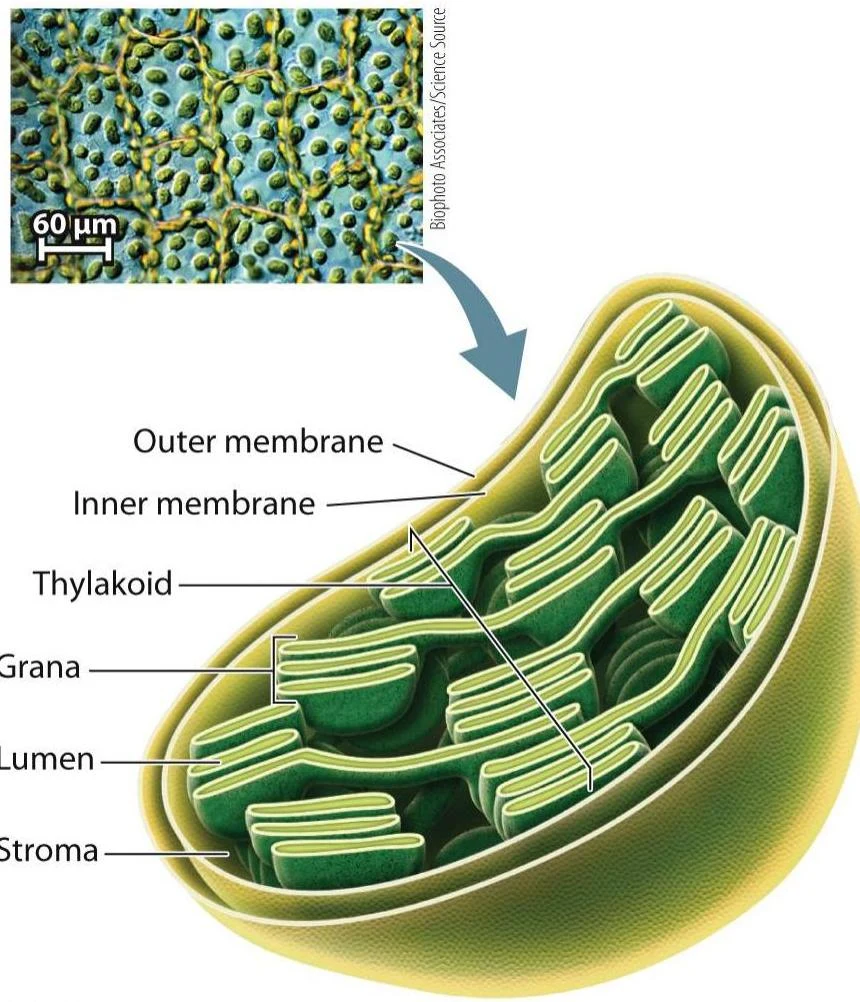
Diagram illustrating the structure of a chloroplast, a plant organelle responsible for photosynthesis. The image shows the outer and inner membranes, thylakoids, grana (stacks of thylakoids), lumen (space within thylakoids), and stroma (fluid-filled space).
The chloroplast contains an internal membrane system composed of flattened, sac-like structures called thylakoids. These thylakoids are often stacked into columns known as grana. The space enclosed within the thylakoid is called the lumen, while the fluid-filled space surrounding the thylakoids is the stroma.
Light Absorption and Pigments
To initiate the process, the plant must absorb photons—particles of light energy. This absorption is performed by pigments embedded within the thylakoid membranes.
Chlorophyll and Accessory Pigments
The primary pigment involved in photosynthesis is chlorophyll. While chlorophyll is the main driver of light absorption, plants also utilize accessory pigments to broaden the spectrum of light they can capture. These accessory pigments help funnel energy toward the reaction centers, increasing the efficiency of the process.
The Light-Dependent Reactions
The first stage of photosynthesis, known as the light reactions, occurs in the thylakoid membranes. The goal of this stage is to convert light energy into chemical energy in the form of two key molecules: ATP and NADPH.
Photosystems I and II
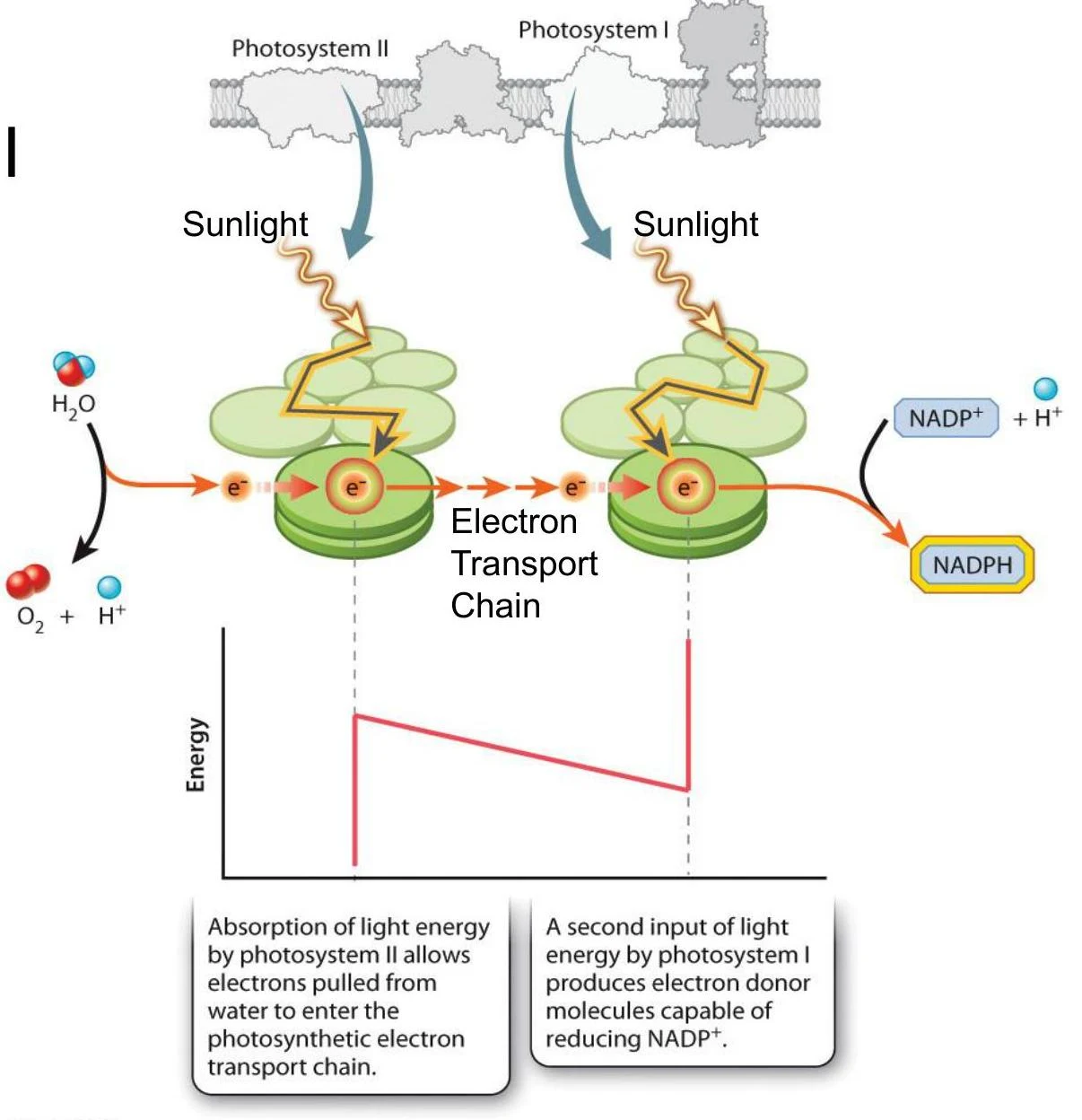
The light reactions rely on two multi-protein complexes called photosystems: Photosystem II (PSII) and Photosystem I (PSI).
Photosystem II: This system initiates the process by absorbing light, which triggers the splitting of water molecules (H2O). This "water-splitting" releases electrons, protons ($H^+$), and oxygen (O2) as a byproduct.
Photosystem I: This system receives electrons from the transport chain and uses light energy to further energize them, ultimately facilitating the reduction of NADP+ to NADPH.
The Photosynthetic Electron Transport Chain and Linear Electron Flow
As electrons move from PSII to PSI, they travel through a series of membrane proteins known as the photosynthetic electron transport chain. This movement is often referred to as linear (non-cyclic) electron flow.
Diagram illustrating the process of photosynthesis, showing the roles of Photosystem II and Photosystem I in the electron transport chain, water splitting, and NADPH production.
ATP and NADPH Formation
The movement of electrons through the transport chain provides the energy necessary to pump protons ($H^+$) into the thylakoid lumen, creating a proton gradient.
Photophosphorylation: As protons flow back out of the lumen into the stroma through the enzyme ATP synthase, the energy released is used to create ATP from ADP. This specific process of creating ATP using light energy is called photophosphorylation.
NADPH Production: At the end of the electron transport chain, the electrons are transferred to NADP+, reducing it to NADPH.
Exam Tip: Remember that the light reactions produce the "fuel" (ATP and NADPH) required for the next stage, but they do not produce the actual sugar (carbohydrate).
The Calvin Cycle: Building Carbohydrates
The second stage of photosynthesis is the Calvin cycle, which takes place in the stroma of the chloroplast. Unlike the light reactions, the Calvin cycle does not directly require light, though it will shut down in the absence of light because it relies on the ATP and NADPH produced by the light reactions.
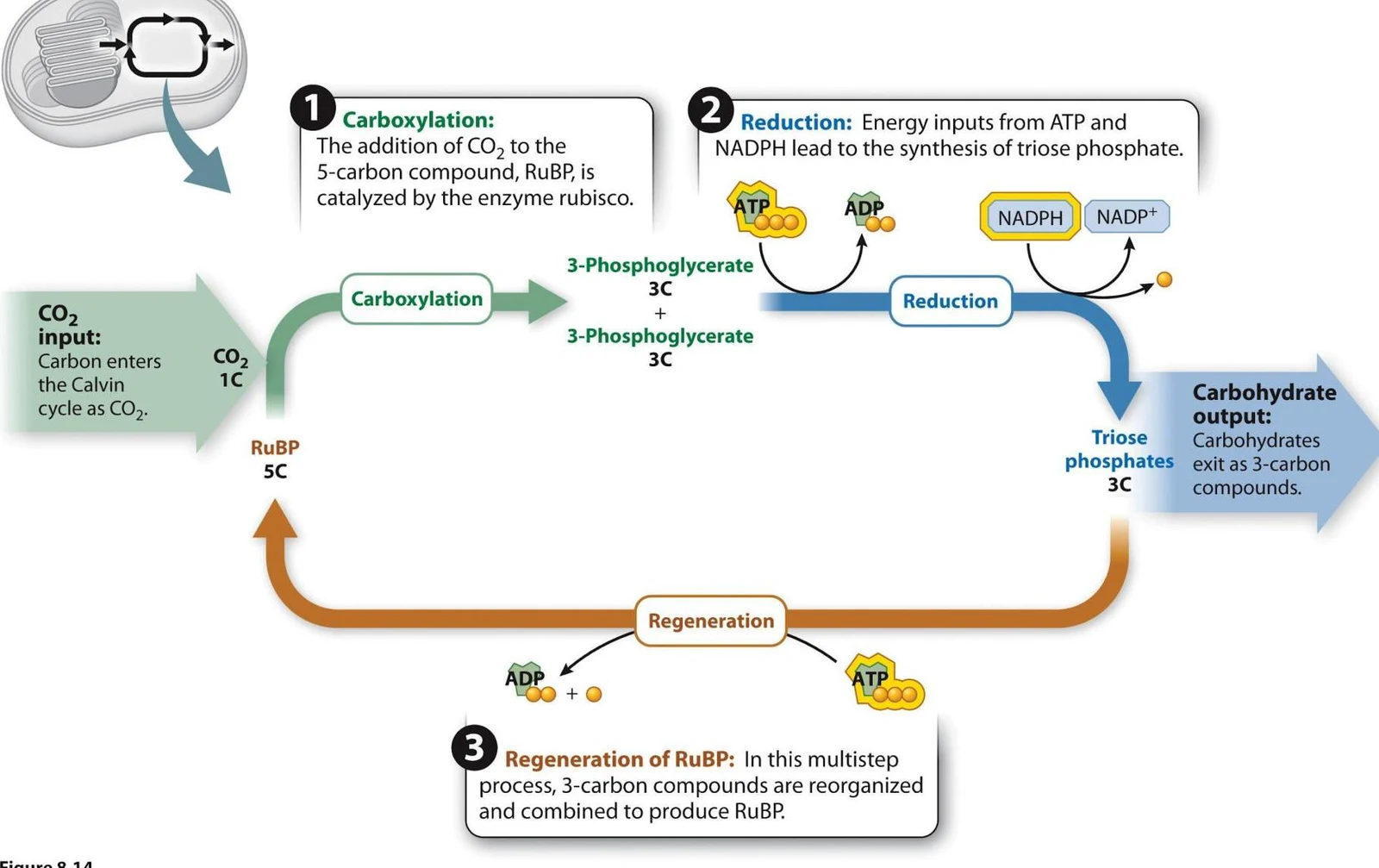
The Calvin cycle can be divided into three main functional phases:
1. Carbon Fixation (Carboxylation)
In this phase, inorganic carbon dioxide (CO2) is "fixed" into an organic molecule. An enzyme called rubisco catalyzes the reaction between CO2 and a five-carbon sugar called RuBP (ribulose bisphosphate). This results in the formation of a six-carbon intermediate that quickly splits into two 3-carbon molecules called 3-phosphoglycerate.
2. Reduction
During the reduction phase, the energy stored in ATP and the reducing power of NADPH (both from the light reactions) are used to convert the 3-carbon molecules into a high-energy sugar called triose phosphate (specifically glyceraldehyde 3-phosphate, or G3P).
3. Regeneration of RuBP
To keep the cycle running, the starting molecule, RuBP, must be remade. In this multistep process, some of the triose phosphate molecules are used to reorganize and regenerate RuBP, a process that also requires additional ATP.
Diagram illustrating the Calvin cycle, a series of biochemical reactions in photosynthesis.
Summary of Carbohydrate Production
The primary product of the Calvin cycle is the triose phosphate sugar, G3P. It is important to note that the cycle must turn multiple times to produce significant amounts of sugar; for example, to produce one molecule of G3P, the cycle must turn three times.
Once produced, these carbohydrates have several possible fates:
They can be used immediately for cellular energy.
They can be converted into glucose and other organic compounds.
Excess carbohydrates can be converted into starch and stored in the chloroplast for use during the night when light is unavailable.
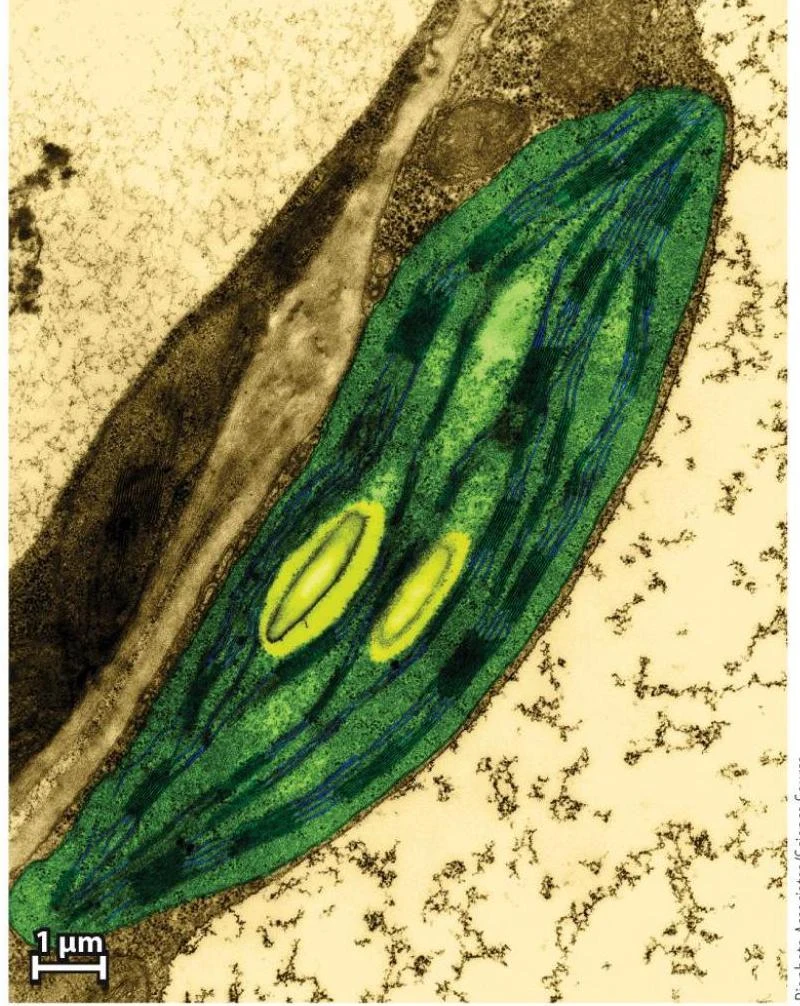
This is a transmission electron micrograph of a chloroplast, showing its internal structure including grana and stroma.
Keep reading for free.
Create an account to finish this reading and make it part of your study routine.