


Imagine your body is a high-performance engine. For that engine to run smoothly, the fuel must be of a specific quality, and the temperature must stay within a narrow range. In biological terms, one of the most critical "qualities" that must be maintained is the acidity or alkalinity of your internal fluids. This balance is known as pH homeostasis. If your internal environment deviates too far from a neutral state, your cells cannot function, which can lead to physiological failure.
Understanding pH and Hydrogen Ions
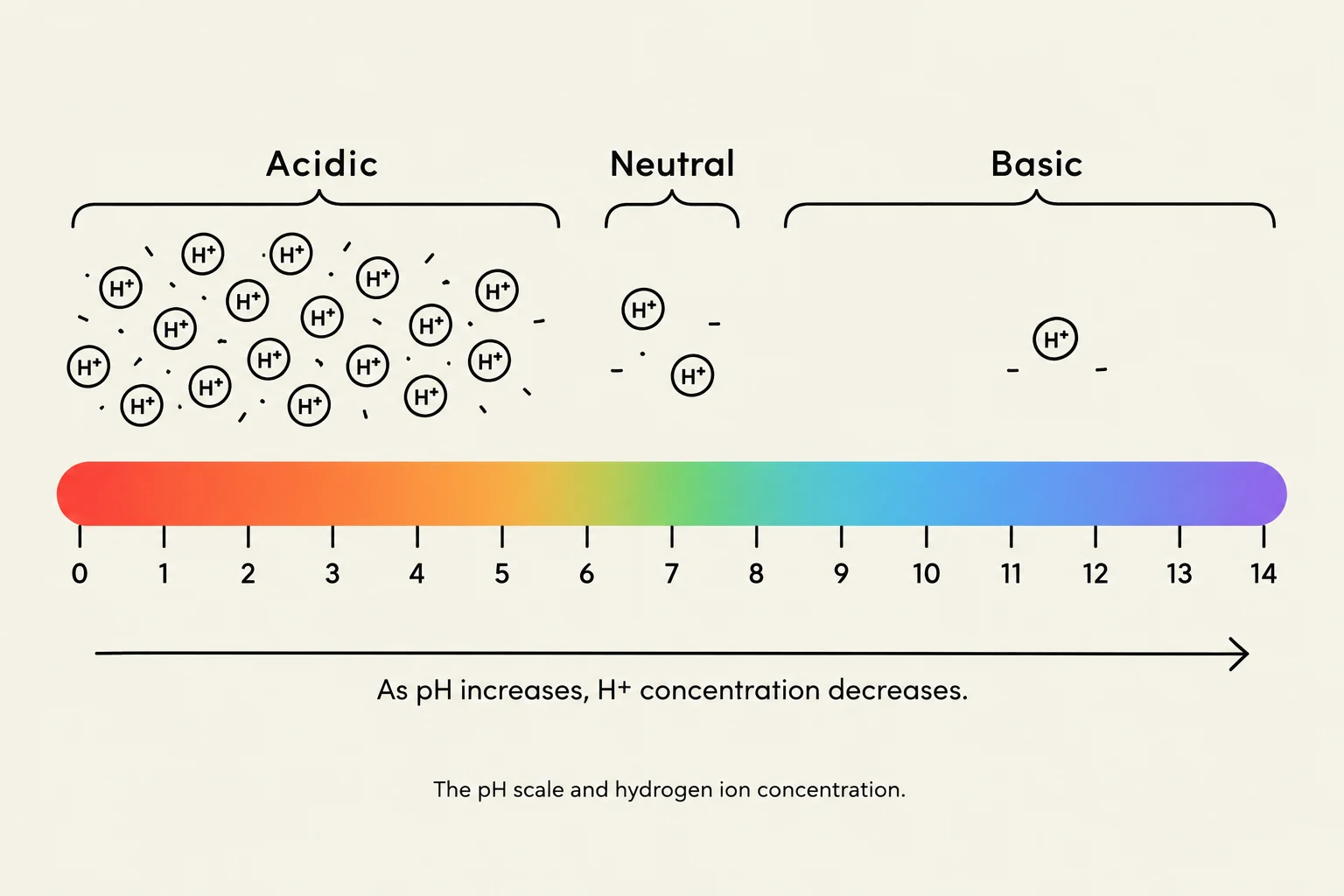
To understand how the body maintains balance, we must first understand what we are measuring. The term pH is a mathematical expression used to measure the concentration of hydrogen ions ($H^+$) in a solution.
A hydrogen ion is essentially a hydrogen atom that has lost its electron, leaving it with a single positive proton. The more hydrogen ions present in a liquid, the more acidic that liquid becomes.
The pH scale typically ranges from to :
- Neutral (pH 7): Pure water is the standard for neutrality.
- Acidic (pH < 7): Substances like coffee, lemon juice, or battery acid have high concentrations of hydrogen ions.
- Basic/Alkaline (pH > 7): Substances like bleach or baking soda have lower concentrations of hydrogen ions.
Exam Tip: The Logarithmic Scale The pH scale is logarithmic, meaning every single unit change on the scale represents a tenfold change in hydrogen ion concentration. For example, a solution with a pH of is not just "two steps" different from a pH of ; it is actually times more acidic ().
Keep reading for free.
Create an account to finish this reading and make it part of your study routine.
Continue reading freeAlready have an account? Log in
Updated