Nucleotides, Nucleic Acids, and ATP: The Molecular Foundations of Life
Explore the fundamental building blocks of life: nucleotides. Learn about their structure, their role in forming DNA and RNA, and how ATP serves as the cell's energy currency. This guide also covers the function of enzymes in biological reactions.
In the complex world of biology, everything from the way your muscles contract to the way your body stores instructions for building a protein comes down to chemistry. At the heart of this chemistry are organic molecules known as nucleotides. These small, specialized units serve as the fundamental building blocks for the most important molecules in your cells: the genetic blueprints known as nucleic acids and the universal energy currency known as adenosine triphosphate (ATP).
The Anatomy of a Nucleotide
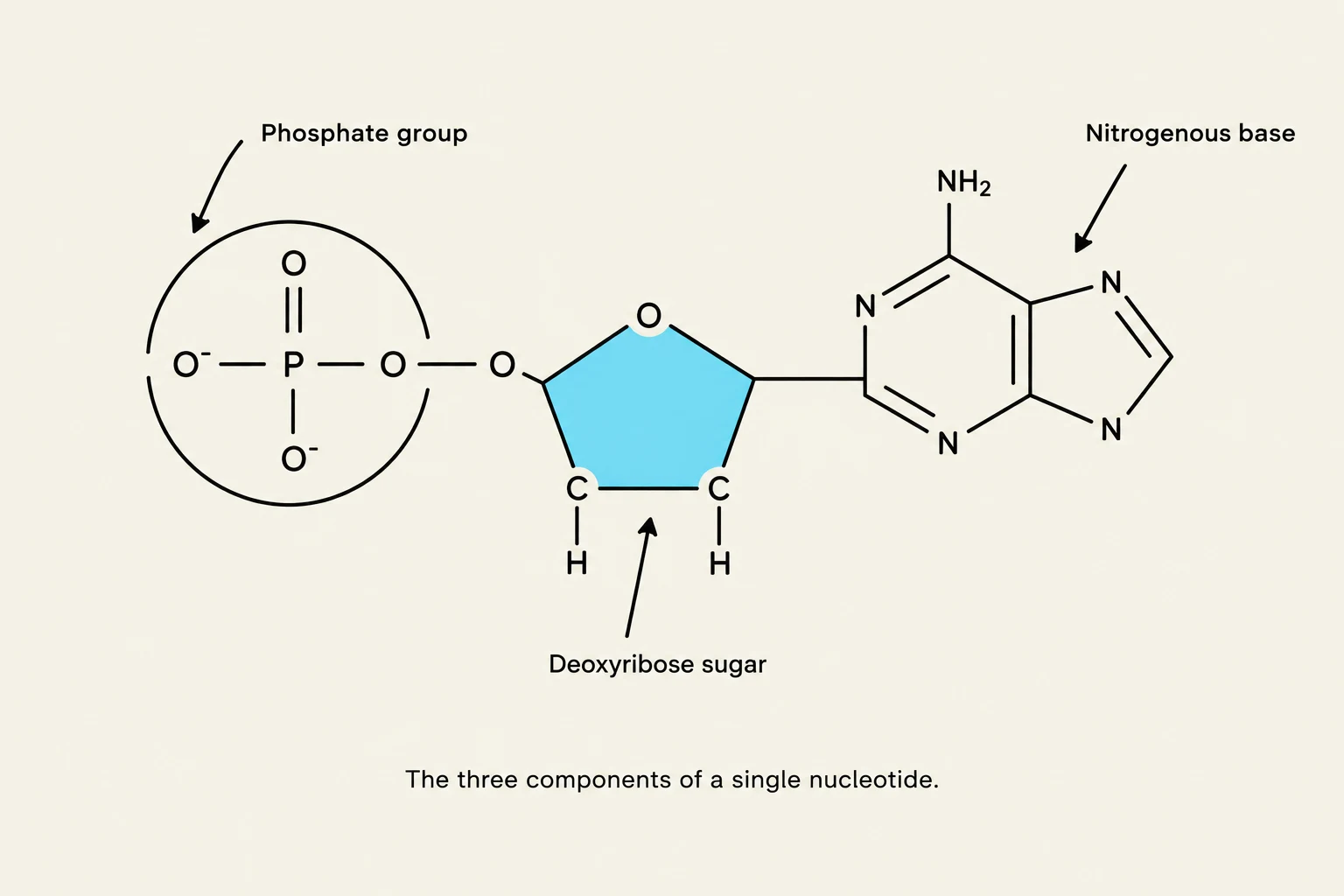
The three components of a single nucleotide: a phosphate group, deoxyribose sugar, and a nitrogenous base.
A nucleotide is an organic compound composed of three essential subunits joined by strong covalent bonds. To understand how they function, it helps to visualize them as a three-part assembly:
A Pentose Sugar: This is a five-carbon monosaccharide that acts as the central piece of the molecule. Depending on the type of nucleotide, this sugar will be either ribose or deoxyribose.
A Phosphate Group: This group contains phosphorus, oxygen, and hydrogen. In the nucleotide structure, the phosphate group attaches to the 5' carbon of the pentose sugar.
A Nitrogen-containing Base: This base attaches to the 1' carbon of the sugar. These bases are the "letters" of the genetic code.
Categorizing Nitrogenous Bases
Nitrogenous bases are classified into two structural groups based on their ring shapes:
Purines: These are larger, double-ring structures. There are two main purines: adenine and guanine.
Pyrimidines: These are smaller, single-ring structures. They include cytosine, thymine (found only in DNA), and uracil (found only in RNA).
Exam Tip: Remembering the Bases
A helpful mnemonic to distinguish between the two is looking for the letter "Y." The word pyramidine contains a "y," as does cytosine and thymine. Since these words have a "y," they belong to the single-ring pyrimidine group. The purines (adenine and guanine) do not have a "y".
Nucleic Acids: DNA and RNA
This illustration compares the structures of DNA and RNA, highlighting their double helix and single strand forms, sugar components (deoxyribose vs. ribose), and base pairings, including the substitution of uracil for thymine in RNA.
When many nucleotides are linked together through dehydration synthesis—a reaction where a molecule of water is released as a new covalent bond forms—they create long chains called polymers. In the context of nucleotides, these polymers are nucleic acids.
Deoxyribonucleic Acid (DNA)
DNA is the molecule responsible for storing long-term genetic information. It is characterized by:
Sugar: It uses deoxyribose.
Structure: It forms a double helix, which looks like a twisted ladder.
Bonding: While the "sides" of the ladder (the sugar-phosphate backbone) are held together by covalent bonds, the "rungs" (the nitrogenous bases) are held together by hydrogen bonds between complementary pairs.
In DNA, the pairing is strict: Adenine always pairs with Thymine, and Guanine always pairs with Cytosine. The specific sequence of these bases forms genes, which are the molecular codes instructing cells how to build proteins.
Ribonucleic Acid (RNA)
RNA is a "helper" molecule that manifests the genetic code. Unlike DNA, RNA is typically single-stranded.
Sugar: It uses ribose.
Bases: It uses adenine, guanine, and cytosine, but replaces thymine with uracil.
Function: A key form is messenger RNA (mRNA), which carries instructions from the DNA in the nucleus to the ribosomes in the cytoplasm, where proteins are actually built.
Adenosine Triphosphate (ATP): The Energy Currency
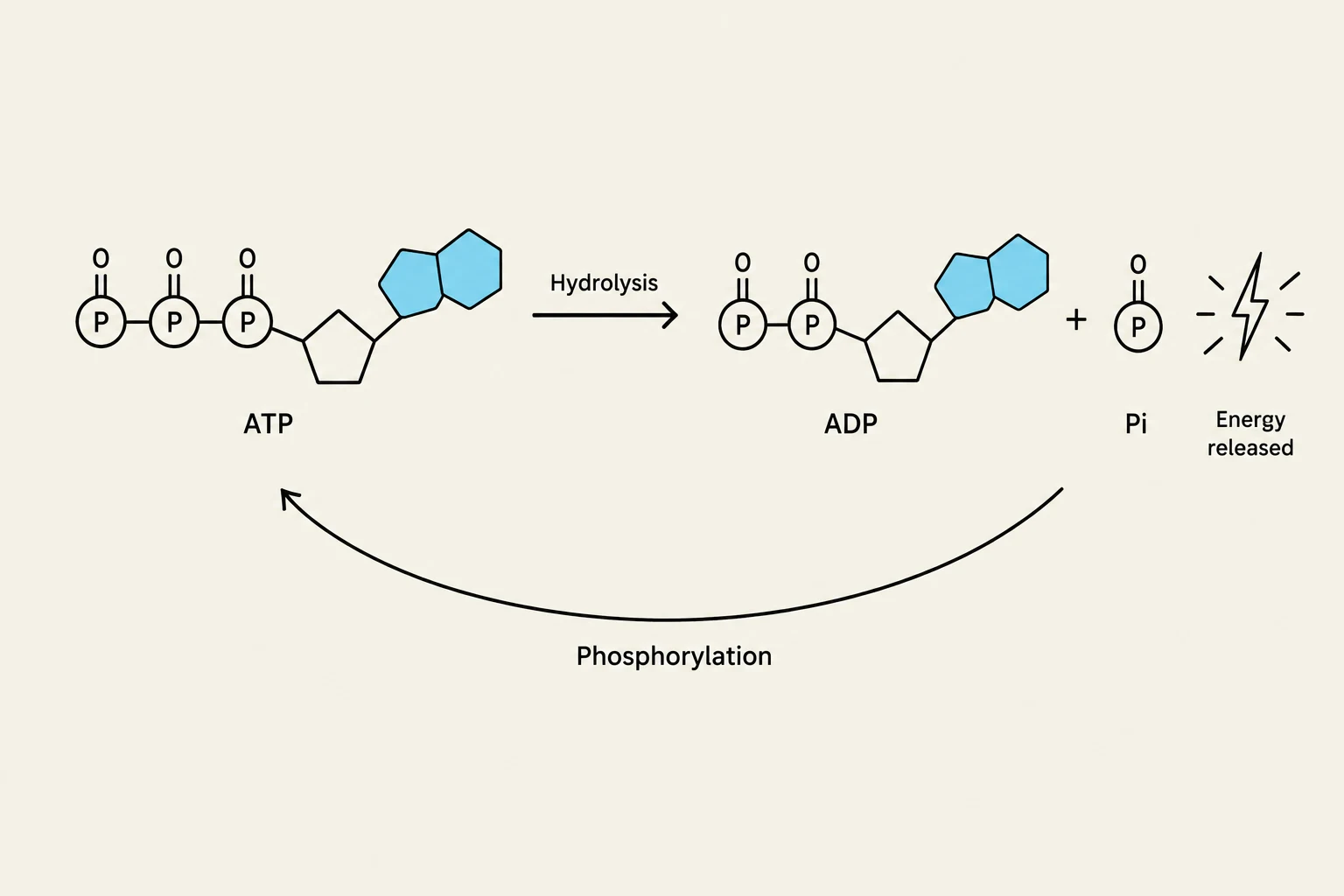
The diagram illustrates the hydrolysis of ATP to ADP and inorganic phosphate (Pi), releasing energy. The reverse process, phosphorylation, regenerates ATP.
While DNA and RNA use nucleotides to store information, the body uses a specialized nucleotide called Adenosine Triphosphate (ATP) to manage energy.
ATP consists of one ribose sugar, one adenine base, and three phosphate groups. The energy is stored within the covalent bonds that link these three phosphate groups together. Because these bonds are high-energy, breaking them releases the power needed for muscle contraction, transport, and chemical synthesis.
Energy Transfer: Hydrolysis and Phosphorylation
The body manages energy through two reversible processes:
Hydrolysis: To release energy, the cell performs hydrolysis, adding a water molecule to break the bond of the third phosphate group. This results in adenosine diphosphate (ADP), an inorganic phosphate (Pi), and a burst of usable energy.
ATP+H2O→ADP+Pi+energy
Phosphorylation: To "recharge" the molecule, the cell performs phosphorylation, which is the addition of a phosphate group back to ADP to reform ATP. This requires an input of energy, often derived from the breakdown of food.
Worked Example: Glucose Activation
When glucose enters a cell, it is often "activated" so it can be used. The cell transfers a phosphate group from ATP to the glucose molecule, creating glucose phosphate and leaving behind ADP. This makes the glucose more reactive and ready for metabolism.
The Role of Enzymes in Biological Reactions
None of these processes—the synthesis of DNA or the breakdown of ATP—would happen fast enough to sustain life without enzymes. Enzymes are proteins that act as biological catalysts, meaning they speed up chemical reactions by lowering the activation energy (the "threshold" energy needed to start a reaction).
How Enzymes Work: The Induced-Fit Model
Enzymes are highly specific; they only work with certain reactants, called substrates. The process follows these steps:
Binding: The substrate enters the active site, a specialized, indented region on the enzyme with a unique shape.
The Complex: The enzyme and substrate form an enzyme-substrate complex. During this time, the enzyme undergoes "induced fit," slightly changing its shape to grip the substrate more tightly, which stresses its chemical bonds.
Reaction: The enzyme facilitates the reaction, resulting in the formation of a product.
Synthesis: Linking two substrates together to form one product.
Decomposition: Breaking one substrate apart into two products.
Release: The products are released, and the enzyme returns to its original shape, ready to repeat the process.
Keep reading for free.
Create an account to finish this reading and make it part of your study routine.