An overview of androgens, focusing on testosterone's role in male sexual development, reproductive health, and systemic metabolic processes. Covers synthesis, regulation via the HPG axis, spermatogenesis, pubertal changes, erythropoietic effects, and clinical applications including hypogonadism treatment and adverse dr
Androgens are a vital class of steroid hormones that serve as the primary drivers of male sexual development and physiological function. While they are produced in both males and females, their role in males is central to the expression of secondary sex characteristics, the regulation of reproductive health, and various systemic metabolic processes. Understanding the delicate balance of these hormones is essential for clinical practice, particularly when managing conditions like hypogonadism or addressing the side effects of androgenic therapies.
The Biology of Androgens and Testosterone
Androgens are endogenous hormones synthesized in the testes, ovaries, and the adrenal cortex. In the male body, the most significant androgen is testosterone.
Synthesis and Production
The primary site of testosterone production in men is the Leydig cells, located within the testes. Under normal physiological conditions, a man produces between 2.5 and 10 mg of testosterone daily.
The lifespan of testosterone production follows a predictable trajectory:
Peak Production: Reaches its maximum around age 17.
Stability: Remains relatively steady from age 30 to 40.
Decline: Gradually decreases with age, reaching approximately half of its peak levels by age 80.
The Hypothalamic-Pituitary-Gonadal Axis
The regulation of testosterone is not autonomous; it is governed by a negative feedback control loop involving the anterior pituitary gland. The anterior pituitary releases two key gonadotropins:
Luteinizing Hormone (LH): Stimulates the Leydig cells to produce testosterone.
Follicle-Stimulating Hormone (FSH): Plays a critical role in supporting the reproductive process.
When testosterone levels in the bloodstream rise, they signal the pituitary gland to suppress the release of FSH and LH. This reduction in gonadotropins decreases the stimulus for further testosterone formation, maintaining the hormone within a narrow, healthy range.
Reproductive Function and Spermatogenesis
A fundamental role of androgens is the facilitation of spermatogenesis—the production of sperm. This process occurs within the seminiferous tubules of the testes.
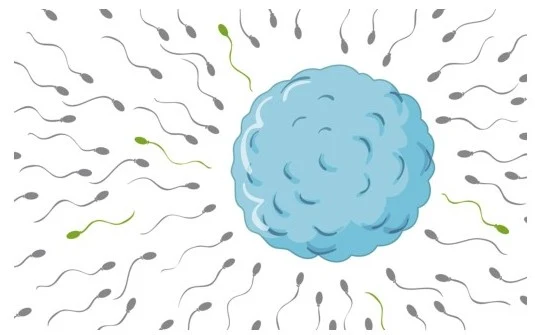
Illustration of sperm cells approaching an egg cell.
Once produced, sperm must undergo a maturation process as they travel through the epididymis and the vas deferens. Because androgens are required to drive these processes, a significant androgen deficiency can lead to sterility.
Systemic Physiological Effects
Beyond the reproductive system, androgens exert profound "anabolic" and systemic effects on the body.
Pubertal Transformation
During puberty, increased androgenic activity triggers a cascade of physical changes, including:
Physical Growth: Enlargement of the testes, penis, and scrotum; increased height and weight through skeletal muscle and bone growth.
Secondary Characteristics: Appearance of pubic, axillary, and body hair; development of a beard; and deepening of the voice due to larynx enlargement.
Dermatological Changes: Increased activity of sebaceous glands, which can lead to acne.
[!IMPORTANT]
Clinical Note: Epiphyseal Closure
While androgens promote bone growth, they also accelerate epiphyseal closure (the closing of the growth plates in bones). This means that excessive androgenic activity can lead to a decrease in final adult height.
Erythropoietic and Metabolic Effects
Androgens stimulate the synthesis of erythropoietin (EPO), a hormone that promotes the production of red blood cells (RBCs). This explains why men typically exhibit higher hematocrit (HCT) levels than women. However, this effect carries a clinical risk, as elevated RBC production can increase the risk of thrombosis (blood clots).
Androgens in Females
While often discussed in a male context, females also produce androgens via the ovaries (regulated by LH) and the adrenal cortex (regulated by adrenocorticotropic hormone).
In females, the ovaries and adrenal glands secrete preandrogens—hormone precursors that are subsequently converted into active testosterone in peripheral tissues. In a healthy female, these hormones help maintain libido.
However, pathologies such as adenomas, carcinomas, or hyperplasias can cause an overproduction of these hormones. This leads to virilization, a condition where females develop male-pattern physical characteristics, such as:
Clitoral growth.
Excessive facial and body hair.
Deepening of the voice.
[!WARNING]
Virilization Warning
In females, the physical changes associated with virilization can potentially be irreversible.
Clinical Applications and Safety
Androgens are used pharmacologically to treat various conditions, but they require careful monitoring due to their complex side effect profile.
Therapeutic Uses
Male Hypogonadism: Replacement therapy using testosterone or testosterone esters (e.g., testosterone enanthate or cypionate).
Delayed Puberty: Used in specific cases to trigger developmental milestones.
Catabolic States: Certain androgens, like oxandrolone, are used to treat wasting syndromes (cachexia) associated with AIDS or trauma.
Adverse Drug Reactions (ADRs)
The use of exogenous androgens is associated with several significant risks:
Hepatotoxicity: 17-alpha-alkylated oral androgens are particularly known for causing liver toxicity, including cholestatic hepatitis and potential hepatocellular carcinoma.
Dyslipidemia: Androgens can increase LDL ("bad" cholesterol) and decrease HDL ("good" cholesterol), increasing cardiovascular risk.
Prostate Health: Androgens can promote the growth of prostate cancer; therefore, they are contraindicated in patients with a known diagnosis.
Psychological Effects: While minimal in healthy individuals, those who are psychologically unbalanced may experience increased aggression.
Practice Check
Question 1: A nurse is providing medication teaching to a 12-year-old male patient with hypogonadism. Which statement, made by the patient, indicates an understanding of the prescribed medication, testosterone enanthate?
A. “I will grow significantly taller while taking this medication.”
B. “Sexual changes in my body will occur within 4 to 6 months.”
C. “I will come to the clinic every 4 weeks for shots of testosterone.”
D. “If the medication causes stomach upset, I can take it with food.”
Answer:C. Testosterone enanthate is a long-acting parenteral preparation typically administered every 2–4 weeks. (Note: Option A is incorrect because androgens can actually accelerate epiphyseal closure, potentially limiting height).
Question 2: A male patient is prescribed a transdermal testosterone gel [AndroGel]. It is most appropriate for the nurse to teach the patient to do what?
A. Apply the gel to the genital area every morning.
B. Leave the patch in contact with the skin for 24 hours.
C. Avoid showering or swimming after gel application.
D. Keep the treated area covered with clothing.
Answer:C. Patients using testosterone gels should avoid showering or swimming for 5–6 hours after application to ensure effective dosing. (Note: Option A is incorrect as gels should never be applied to the scrotum).
Keep reading for free.
Create an account to finish this reading and make it part of your study routine.