Working in a laboratory environment involves constant exposure to biological, chemical, and physical hazards. Because these hazards have the potential to cause significant harm or illness, safety is considered a "right to know" for all personnel. To manage these risks, regulatory frameworks and standardized safety protocols are implemented to ensure that every individual understands the nature of the materials they handle and how to respond when things go wrong.
Understanding WHMIS 2015 and GHS
The Workplace Hazardous Material Information System (WHMIS) 2015 is a federally legislated program in Canada designed to minimize injuries and illnesses caused by hazardous materials. It is aligned with the Globally Harmonized System (GHS), which provides an international standard for chemical classification and communication.
Under this system, hazards are classified into 31 different categories, which are broadly divided into two groups:
Physical Hazards: These relate to the properties of the substance, such as flammability, reactivity, or how it reacts with other materials.
Health Hazards: These relate to the biological impact on the human body, such as carcinogenicity (cancer-causing potential) or respiratory sensitization.
Hazard Communication Tools
To ensure information is conveyed quickly and accurately, WHMIS 2015 utilizes several standardized tools:
Pictograms: These are graphic symbols enclosed in a red diamond border. They provide immediate visual identification of the type of hazard present.
Signal Words: These indicate the severity of the hazard. "Danger" is used for high-risk hazards, while "Warning" is used for less severe hazards.
Hazard Statements: Standardized phrases that describe the specific nature of the hazard (e.g., "Fatal if inhaled").
Precautionary Statements: These provide advice on how to minimize exposure, covering prevention, response, storage, and disposal.
This diagram illustrates the Globally Harmonized System (GHS) of Classification and Labelling of Chemicals, showing how GHS classification, pictograms, signal words, and hazard statements work together to communicate chemical hazards.
Exam Tip: Remember that "Danger" is always more severe than "Warning." If a question asks you to identify the signal word for a high-risk chemical, look for "Danger."
Labels and Safety Data Sheets (SDS)
Information is also communicated through labels and detailed documentation. There are two main types of labels:
Supplier Labels: These are provided by the manufacturer and come attached to the product.
Workplace Labels: These are used when a product is decanted into a different container or if a chemical is produced on-site.
For the most comprehensive information, personnel must consult the Safety Data Sheet (SDS). An SDS is a 16-section document provided by suppliers that contains exhaustive details on chemical properties, first-aid measures, handling procedures, and emergency response protocols.
Engineering Controls and Laboratory Equipment
The most effective way to mitigate risk is through the "Hierarchy of Control". Engineering controls are the highest level of control because they isolate the hazard from the worker through design.
Chemical Fume Hoods
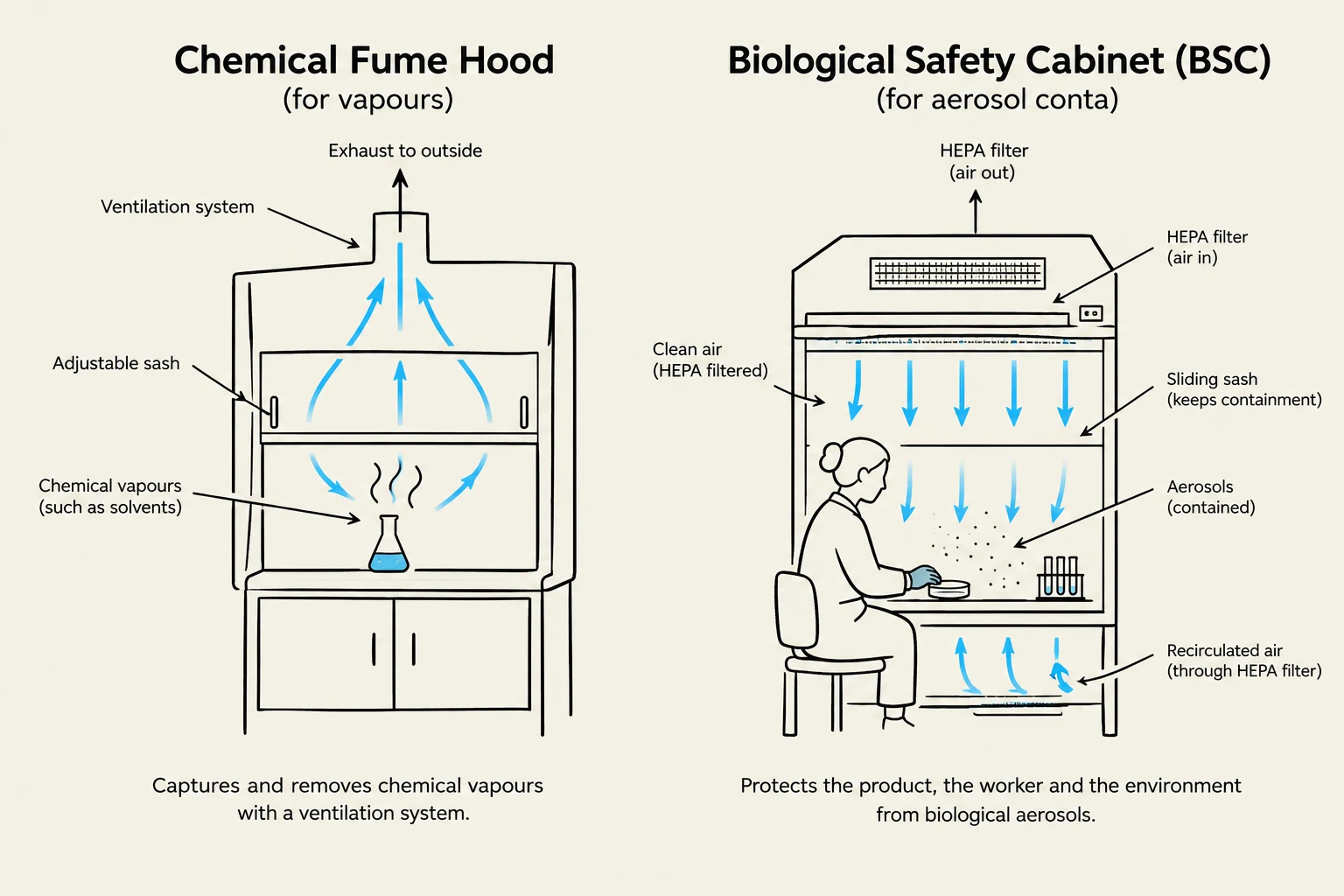
Chemical fume hoods are essential engineering controls designed to protect workers from toxic vapours by isolating them through controlled airflow. To use them safely, you must:
Ensure the exhaust fan is running.
Keep the sash (the sliding glass window) as low as possible to maintain the protective barrier.
Important Distinction: Fume hoods are designed for chemical vapours. They do not protect against aerosols. If you are working with biological hazards that might create aerosols, a Biological Safety Cabinet (BSC) must be used instead.
Diagrams illustrating the function of a chemical fume hood and a biological safety cabinet, highlighting their respective uses in laboratory safety for handling vapours and aerosols.
Compressed Gases and Cryogenics
Physical hazards also include the management of specialized equipment:
Compressed Gases: These must always be secured in an upright position and used with an appropriate regulator.
Cryogenic Hazards: Materials at extremely low temperatures require specialized insulated gloves and eye protection to prevent severe skin damage or "cold burns".
Emergency Response Procedures
Even with strict protocols, emergencies can occur. Knowing how to respond immediately can prevent a minor incident from becoming a catastrophe.
Chemical Spill Response
If a chemical spill occurs, follow these steps:
Notify others in the immediate area.
Turn off ignition sources if the spilled material is flammable.
Use appropriate PPE before attempting cleanup.
Apply adsorbents (like spill pillows or powder) starting from the perimeter and moving toward the center of the spill to prevent the liquid from spreading.
Chemical Splashes and First Aid
If a chemical makes contact with a person, immediate action is required:
Eye Contact: Flush the eyes at an eye wash station for at least 15 minutes.
Skin Contact: For large splashes, use an emergency shower immediately.
Documentation: Always report all incidents to a supervisor and ensure they are documented, regardless of how minor they seem.
Fire Safety
To fight a fire, you must understand the "Fire Triangle": heat, fuel, and oxygen. Removing any one of these will extinguish the fire. When using a fire extinguisher, remember the PASS acronym:
Pull the pin.
Aim at the base of the fire.
Squeeze the trigger.
Sweep from side to side.
This illustration details the PASS technique for using a fire extinguisher, which stands for Pull, Aim, Squeeze, and Sweep. It also outlines the steps for responding to a chemical splash: Rinse, Remove contaminated clothing, Report the incident, and Seek help from an eyewash station or safety shower.
Warning: Never attempt to extinguish a fire if you are not confident in your ability, if the fire is spreading rapidly, or if you do not know what type of material is burning.
Summary Table of Fire Classes
Class
Material Type
Examples
A
Combustibles
Wood, paper, cloth
B
Flammable Liquids/Gases
Alcohols, oils, paints
C
Electrical Equipment
Motors, instruments
D
Combustible Metals
Potassium, sodium, magnesium
K
Cooking Oils
Fats and oils in kitchens
Keep reading for free.
Create an account to finish this reading and make it part of your study routine.