This article provides a guide to solving common problems involving linear and angular motion, vector resolution, and projectile mechanics in the context of athletic performance.
In the study of human movement, understanding how an athlete moves through space and how forces influence that motion is essential for performance enhancement and injury prevention. To master these calculations, we must distinguish between kinematics—the description of motion (position, velocity, acceleration)—and kinetics—the study of the forces that cause that motion. This article provides a guide to solving common problems involving linear and angular motion, vector resolution, and projectile mechanics.
Linear Kinematics: Velocity and Acceleration
Linear kinematics describes the motion of a system where all parts move in the same direction at the same speed, often referred to as translation. When solving these problems, the most critical distinction is between distance and displacement.
Average Velocity
While speed is simply the distance traveled over time, average velocity (v) is defined as the change in displacement divided by the change in time. Because displacement is a vector, velocity must include a direction.
v=ΔtΔd
Exam Tip: If a problem asks for "speed," use total distance. If it asks for "velocity," use the straight-line displacement from the start point to the end point.
Average Acceleration
Acceleration (a) is the rate at which velocity changes over a specific time interval. If the time interval (Δt) becomes infinitesimally small, we transition from calculating average acceleration to calculating instantaneous acceleration.
a=Δtvf−vi
Where vf is the final velocity and vi is the initial velocity.
This diagram illustrates the difference between total path length (distance) and displacement (straight-line distance) using a swimmer's path.
Worked Example: Swimmer Acceleration
A swimmer increases their velocity from 1.7 m/s to 2.9 m/s in 0.5 seconds. What is their average acceleration?
Identify variables: vi=1.7 m/s, vf=2.9 m/s, Δt=0.5 s.
Apply formula:
a=0.52.9−1.7a=0.51.2=2.4 m/s2
Angular Kinematics: Rotational Motion
Not all athletic movement is linear. Many movements, such as a tennis serve or a gymnast's rotation, involve angular kinematics, where the body rotates around a center point.
Angular Velocity and Acceleration
Angular velocity (ω) describes the rate of rotation, typically measured in degrees per second (deg/s) or radians per second (rad/s). Angular acceleration (α) is the change in angular velocity over time.
ω=ΔtΔθ
α=Δtωf−ωi
Worked Example: Racquet Velocity
A tennis athlete accelerates her initial racquet velocity of 300 deg/s by 100 deg/s2 for 0.03 seconds. What is her new racquet velocity?
Identify variables: ωi=300 deg/s, α=100 deg/s2, Δt=0.03 s.
Calculate change in velocity: Δω=α⋅Δt=100⋅0.03=3 deg/s.
Find final velocity: ωf=300+3=303 deg/s.
Projectile Motion and Vector Resolution
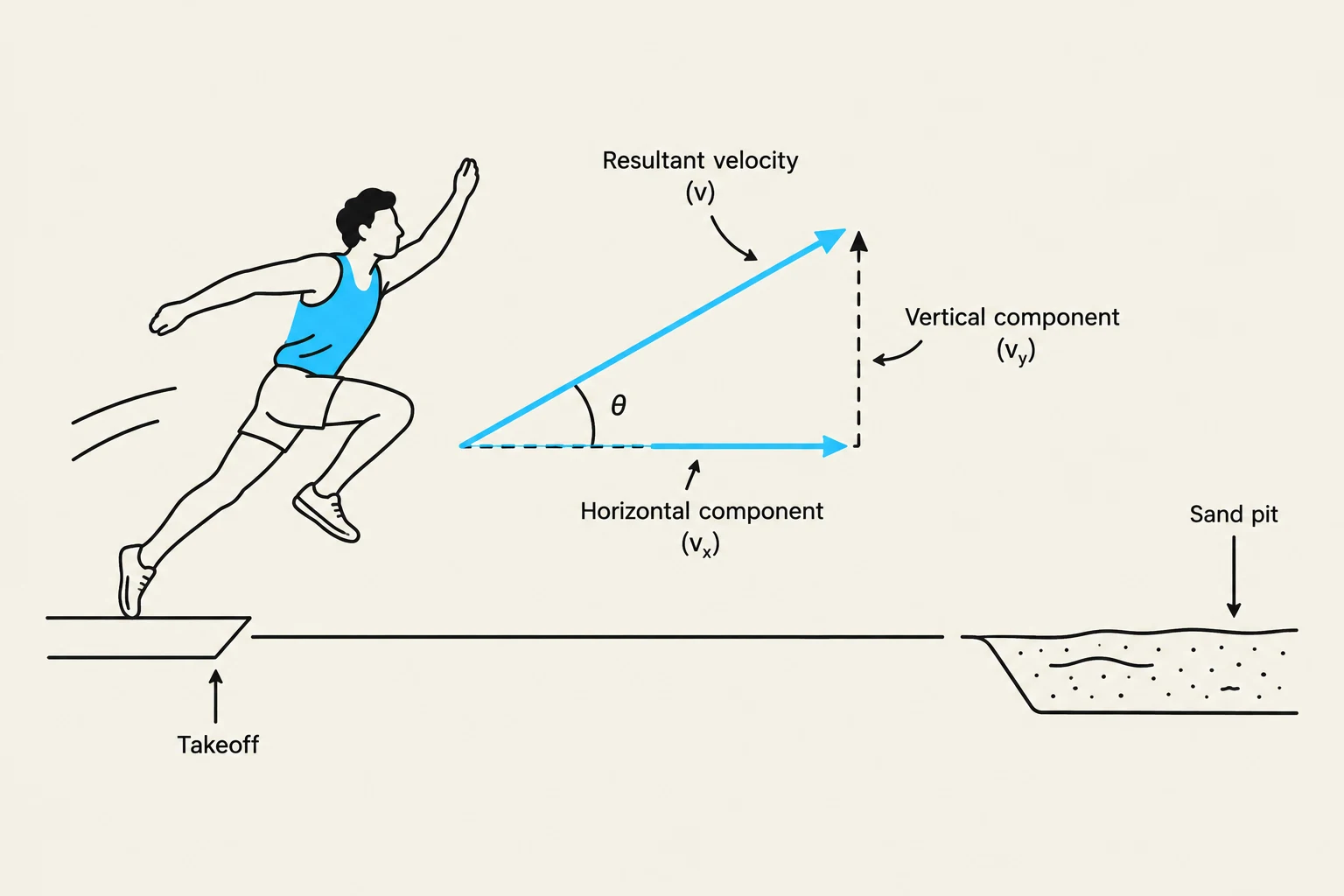
When an athlete performs a jump or a throw, they often move at an angle (θ) relative to the horizontal. This is known as the takeoff angle. To solve these problems, you must use vector resolution to break the resultant velocity (v) into two perpendicular components: horizontal and vertical.
Decomposing the Resultant Velocity
The resultant velocity is the actual speed and direction of the athlete at the moment of takeoff. We use trigonometry to find the components:
Horizontal Velocity (vx): The speed moving forward.
vx=v⋅cos(θ)
Vertical Velocity (vy): The speed moving upward.
vy=v⋅sin(θ)
Illustration of projectile motion, showing the takeoff, resultant velocity, and its horizontal and vertical components, leading to a sand pit.
Worked Example: Long Jumper Takeoff
A long jumper leaves the ground at an angle of 25∘ with a resultant velocity of 9 m/s. Calculate the horizontal and vertical velocities.
Horizontal (vx):vx=9⋅cos(25∘)≈8.16 m/s
Vertical (vy):vy=9⋅sin(25∘)≈3.80 m/s
Vertical Motion and Gravity
Once the athlete is in the air, their vertical motion is governed by gravity (g≈9.81 m/s2). This affects their time of flight and their peak height (the maximum vertical displacement achieved).
When calculating the motion of a diver or a jumper, remember that the vertical velocity will decrease due to gravity until it reaches zero at the peak of the jump, and then increase as they descend.
Summary of Problem-Solving Steps for Vectors
When faced with complex problems involving multiple directions (such as forces or velocities), follow these steps to ensure accuracy:
Break down all vectors into their x (horizontal) and y (vertical) components.
Summate all x components and all y components separately.
Solve for the resultant vector using the sum of the components.
By mastering these kinematic and kinetic relationships, you can quantitatively analyze athletic performance and understand the physical limits of human movement.
Keep reading for free.
Create an account to finish this reading and make it part of your study routine.