Explore the sophisticated sensory capabilities of infants, including vision, hearing, touch, taste, and smell, and their crucial role in early brain development, language acquisition, and social connection.
For many years, it was believed that newborns entered the world with very limited sensory capabilities. However, modern research has revealed that infants possess a far more sophisticated sensory capacity than previously thought. From the moment they are born, infants are actively processing information through vision, hearing, smelling, tasting, touch, and motion to make sense of their new environment.
Understanding these sensory milestones is crucial for educators and caregivers, as these early experiences lay the foundation for brain development, language acquisition, and social connection.
The Developing Brain: Building the Foundation
The rapid sensory improvements seen in the first year of life are not accidental; they are driven by profound changes in the architecture of the brain. As an infant interacts with the world, their nervous system undergoes three critical processes:
Synaptogenesis: The creation of new connections (synapses) between neurons.
Pruning: The process where the brain eliminates extra or unused connections to increase efficiency.
Myelination: The coating of neural fibers with a fatty substance called myelin, which speeds up the transmission of electrical signals.
Together, these processes allow the infant to move from reflexive responses to more complex, intentional behaviors.
This illustration depicts the progression of neural development, showing three stages: Synaptogenesis (rapid synapse creation), Peak Connectivity (high synaptic density), and Pruning (weakening and removal of unused connections), leading to a more efficient neural network.
Study Tip: If you are asked to explain why an infant's reaction time improves over the first year, focus your answer on myelination. While synaptogenesis creates the "wiring," myelination provides the "insulation" that makes the signals travel faster.
Vision: From Blurry to Bright
Vision is one of the most dynamic senses to develop in early infancy. At birth, an infant's visual acuity—their ability to see fine details at a distance—is quite low. In fact, a newborn's vision is approximately 40 times worse than that of a normal-sighted adult.
However, the rate of improvement is staggering. By 6 months of age, vision has improved to the point where it is only eight times worse than an adult's. This rapid growth is driven by the neurological processes mentioned above.
What do infants look at?
Infants do not scan the world like adults do. Instead, their visual attention follows a specific developmental trajectory:
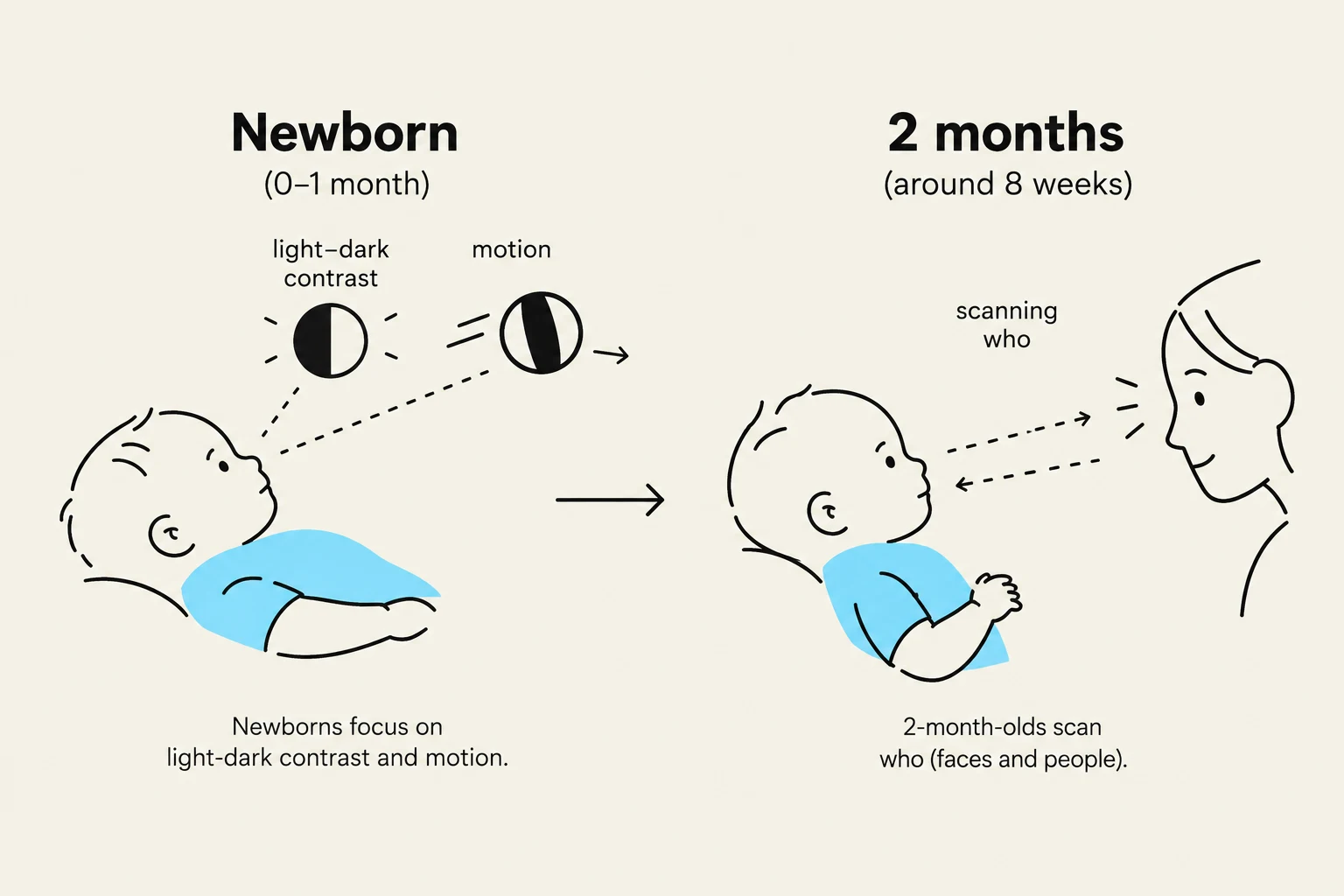
Initial Stage: Newborns primarily scan for light-dark contrast and are highly attentive to motion.
2 Months: Infants begin to scan entire objects to identify what they are.
3 to 4 Months: Research suggests babies begin to find and pay attention to complex pattern recognition.
The Importance of Faces
While infants are attracted to contrast and motion, they show a profound face preference. They do not find all faces equally interesting; rather, they clearly prefer attractive faces and, most importantly, they prefer the mother’s face from the earliest hours of life.
By 6 months, this visual interest evolves into reciprocal eye gaze, a key component of active social communication with parents. It is important to note that infants with visual limitations, such as cataracts, may face significant challenges in identifying faces later in life.
This illustration shows the visual development of infants, from newborns focusing on light-dark contrast and motion to 2-month-olds scanning faces and people.
Hearing and Language Acquisition
Unlike vision, auditory acuity is highly developed at birth. Newborns can hear nearly as well as adults do. While they may require high-pitched noises to be quite loud to be heard, they are capable of locating the direction of certain sounds from birth.
Sound Discrimination
Infants are "citizens of the world" in terms of sound. They can initially distinguish sound contrasts in any human language. This ability follows a specific pattern:
1 Month: Infants can discriminate between single syllables (e.g., "pa" vs. "ba").
6 Months: They can distinguish between two-syllable words (e.g., "bada" vs. "baga").
The "Fade" Effect: Around 6 months, the ability to distinguish sounds from all languages begins to fade, as the brain specializes in the sounds it hears most frequently in its environment.
Furthermore, infants are capable of recognizing melody patterns by 6 months of age. They also show a preference for the mother's voice, a skill they actually begin to learn while still in the womb.
Touch, Taste, and Smell
While vision and hearing often get the most attention, other senses are equally vital for early development:
Smelling and Tasting: Newborns possess a highly sensitive sense of smell with nearly unlimited variations. They also react differently to each basic taste, which is an essential part of their early sensory exploration.
Touch and Motion: This is considered the best-developed of all senses in infants. Gentle social touching is not just a comfort; it is a critical requirement for healthy early brain development.
Safety Note: Abusive Head Trauma
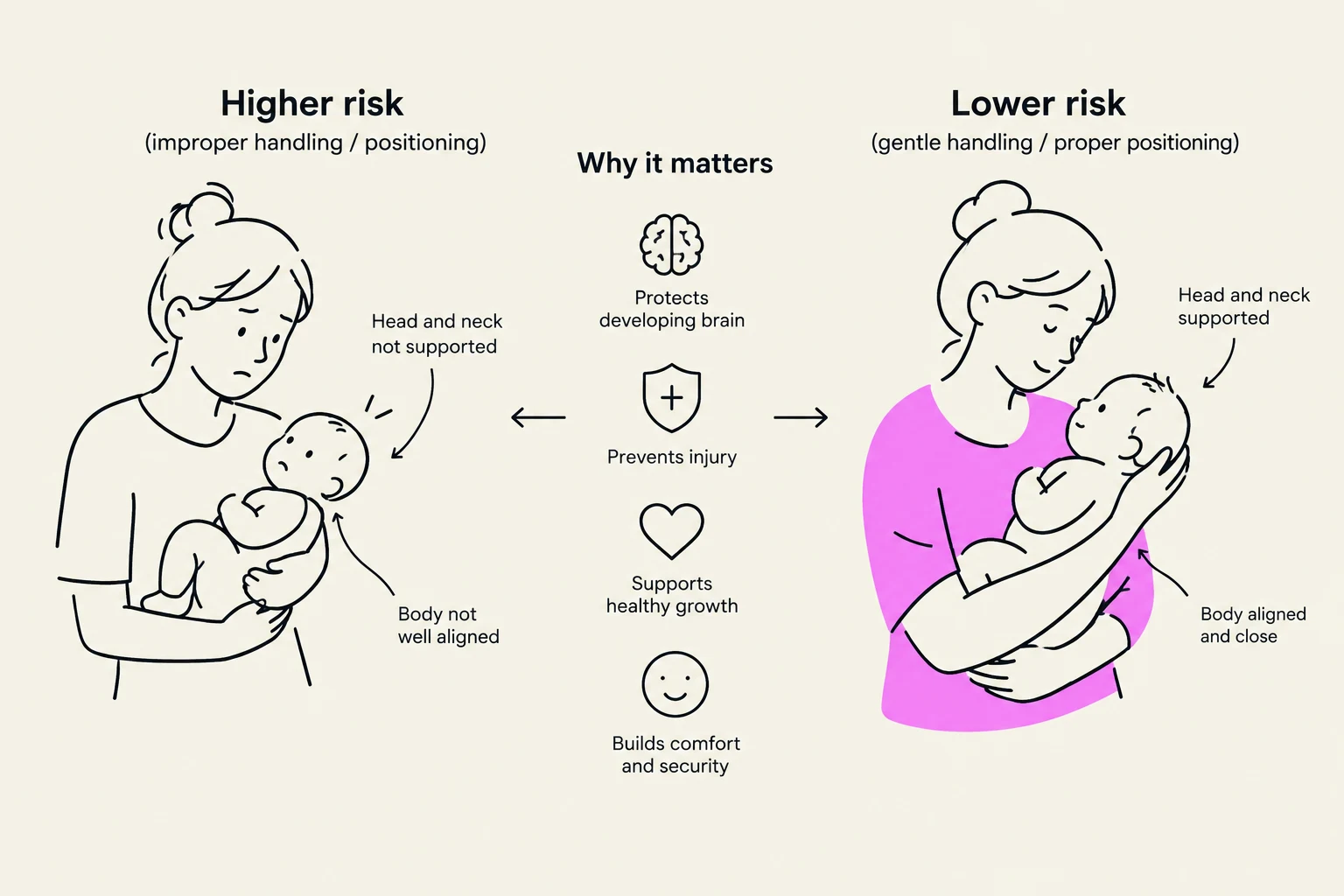
Because infants are in such a rapid state of physical and neurological development, they are extremely vulnerable to injury. Caregivers must be aware of the risks of Abusive Head Trauma (AHT), formerly known as Shaken Baby Syndrome. The delicate nature of the developing brain makes it highly susceptible to damage from improper handling or shaking.
Illustration comparing higher risk (improper handling/positioning) and lower risk (gentle handling/proper positioning) of a baby, highlighting why proper handling matters for protection, injury prevention, healthy growth, and comfort.
Critical Safety Reminder: Always use proper positioning and handling techniques. When holding a newborn, ensure their head and neck are supported to prevent injury.
Keep reading for free.
Create an account to finish this reading and make it part of your study routine.