An exploration of effective communication strategies and the developmental and therapeutic roles of play in pediatric healthcare settings. Covers content and social character of play, developmental functions, and selecting appropriate toys.
In the pediatric setting, communication and play are not merely "extras"—they are essential clinical tools. For a child, play is their primary way of learning about the world, practicing social skills, and processing the stress of illness. For the healthcare professional, observing play provides a window into a child's physical, intellectual, and social development. Understanding how to communicate effectively across different developmental stages and how to utilize play as an assessment and therapeutic tool is fundamental to providing high-quality pediatric care.
Effective Communication Strategies
Communicating with children requires a shift in perspective. Unlike adults, children are highly sensitive to tone, body language, and the perceived intent of the caregiver. To build rapport and reduce anxiety, professionals should follow several key guidelines:
Physical Presence: Always approach the child at their eye level.
Language Choice: Use simple, concrete words. Avoid metaphors that can be misunderstood. For example, instead of saying a child is being "put to sleep" (which may trigger fears of death), explain that a medicine will help them "rest" or "sleep like they do at night".
Empowerment through Choice: Offer limited, meaningful choices to provide a sense of control (e.g., "Would you like your blood pressure taken on your left arm or your right arm?").
Validation: Always validate a child's feelings. Avoid dismissive phrases like "be a big kid" or "stop crying".
Clinical Tip: Avoid "Why" Questions
When communicating with children, avoid asking "Why are you in the hospital?" This can cause unnecessary distress or guilt. Instead, focus on the present and the immediate care being provided.
Creative Communication Techniques
When standard conversation fails, healthcare providers can use more creative, less threatening methods to gauge a child's thoughts and feelings:
Third-Person Techniques: Asking a child how "the boy in the bed" feels can make discussing scary topics less defensive.
Storytelling and Books: Using stories to probe a child's thinking or using books as a therapeutic tool.
Rating Games: Using visual scales, such as a series of faces ranging from sad to happy, to help a child quantify their pain or emotions.
Sentence Completion: Providing a prompt like, "The thing I like most about my parents is..." to uncover underlying thoughts.
This diagram illustrates three creative communication techniques: third-person questioning, storytelling, and rating scales, all aimed at fostering greater self-expression, understanding, and connection in children.
The Content and Social Character of Play
Play is categorized by its content (what the child is doing) and its social character (how the child interacts with others).
Content of Play
The complexity of play increases as a child develops:
Unoccupied Behavior: Aimless exploration, such as daydreaming or fiddling with clothes.
Sense-Pleasure Play: Activities that stimulate the senses, such as bouncing, swinging, or handling sand and water.
Skill Play: Repetitive actions used to master a task, like putting blocks in and out of a box.
Dramatic or Pretend Play: Acting out roles and using props, which is highly prevalent in preschool-aged children.
Social Character of Play
As children grow, their social interactions evolve through specific stages:
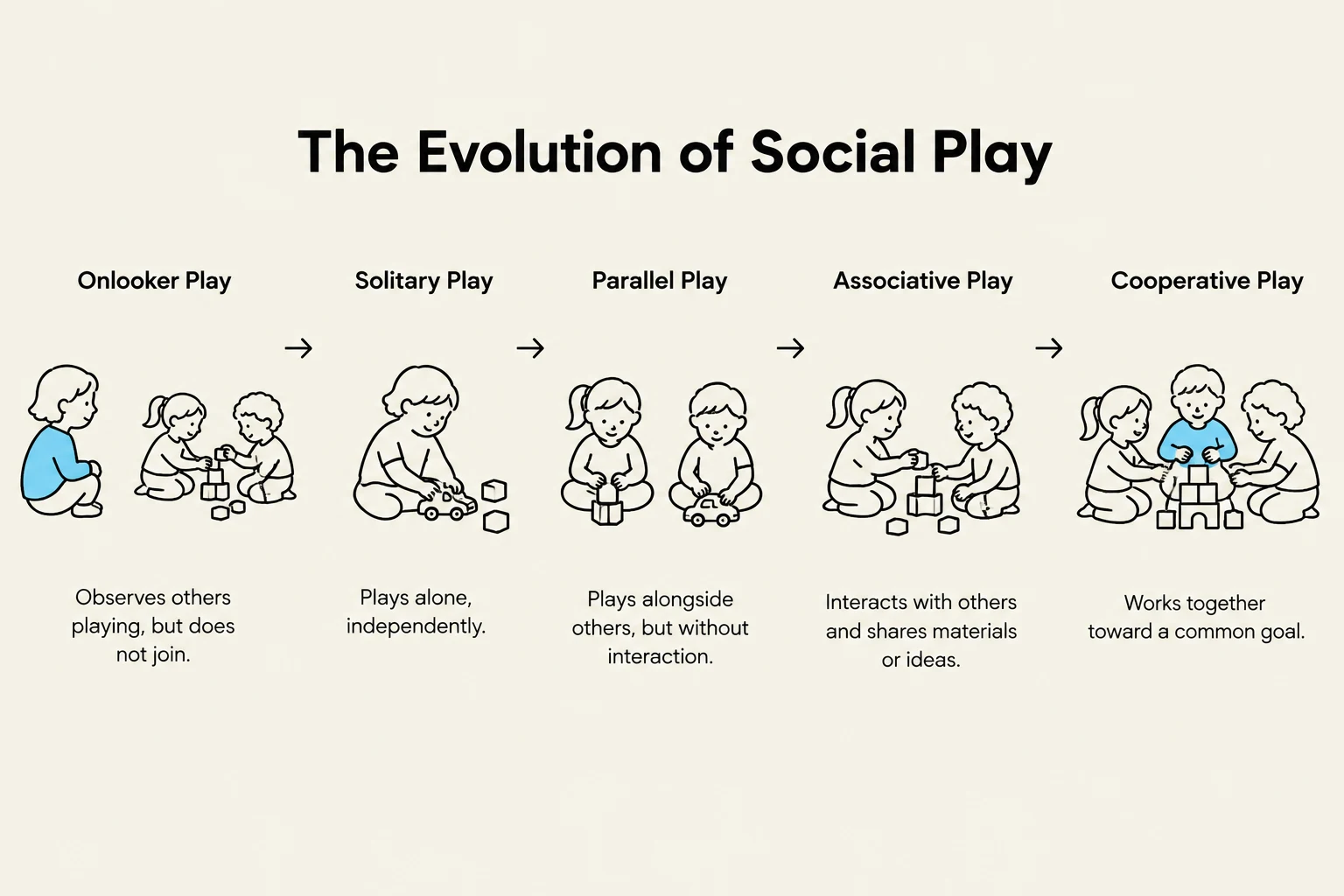
Onlooker Play: The child watches others play but does not join in.
Solitary Play: The child plays alone with toys that are different from those used by nearby peers.
Parallel Play: Characteristic of toddlers; children play independently but side-by-side with similar toys, without influencing one another.
Associative Play: Children engage in similar activities and share materials, but there is no organized group goal or division of labor.
Cooperative Play: Organized play where children work together toward a common goal, such as playing a formal game or dramatizing a situation.
The evolution of social play in children, from onlooker play to cooperative play.
Developmental Functions and Therapeutic Value
Play serves several critical functions that support a child's holistic growth:
Sensorimotor Development: Primarily in infancy, play allows for exploration through tactile, auditory, and visual stimulation.
Intellectual Development: Through manipulation of objects, children learn about colors, shapes, sizes, and problem-solving.
Socialization: Play teaches children how to establish relationships, follow social norms, and learn the concept of "give and take".
Self-Awareness: Children learn to regulate their own behaviors and understand their place in the world.
Therapeutic Play and Medical Assessment
In a hospital setting, play takes on a specialized role. Medical play (such as a "Teddy Bear Clinic") allows children to use medical tools on toys, which can reduce the trauma of their own procedures and help them process what is happening to them.
Healthcare professionals must distinguish between directed play (specific instructions provided by the adult) and spontaneous play (freely chosen by the child). It is vital to remember that if an adult exerts too much control, the activity ceases to be play, and the child may lose the educational and therapeutic benefits of self-determined activity.
Selecting Developmentally Appropriate Toys
Toys can be used as both assessment tools and distractions, but they must be chosen carefully based on the child's age, diagnosis, and safety needs.
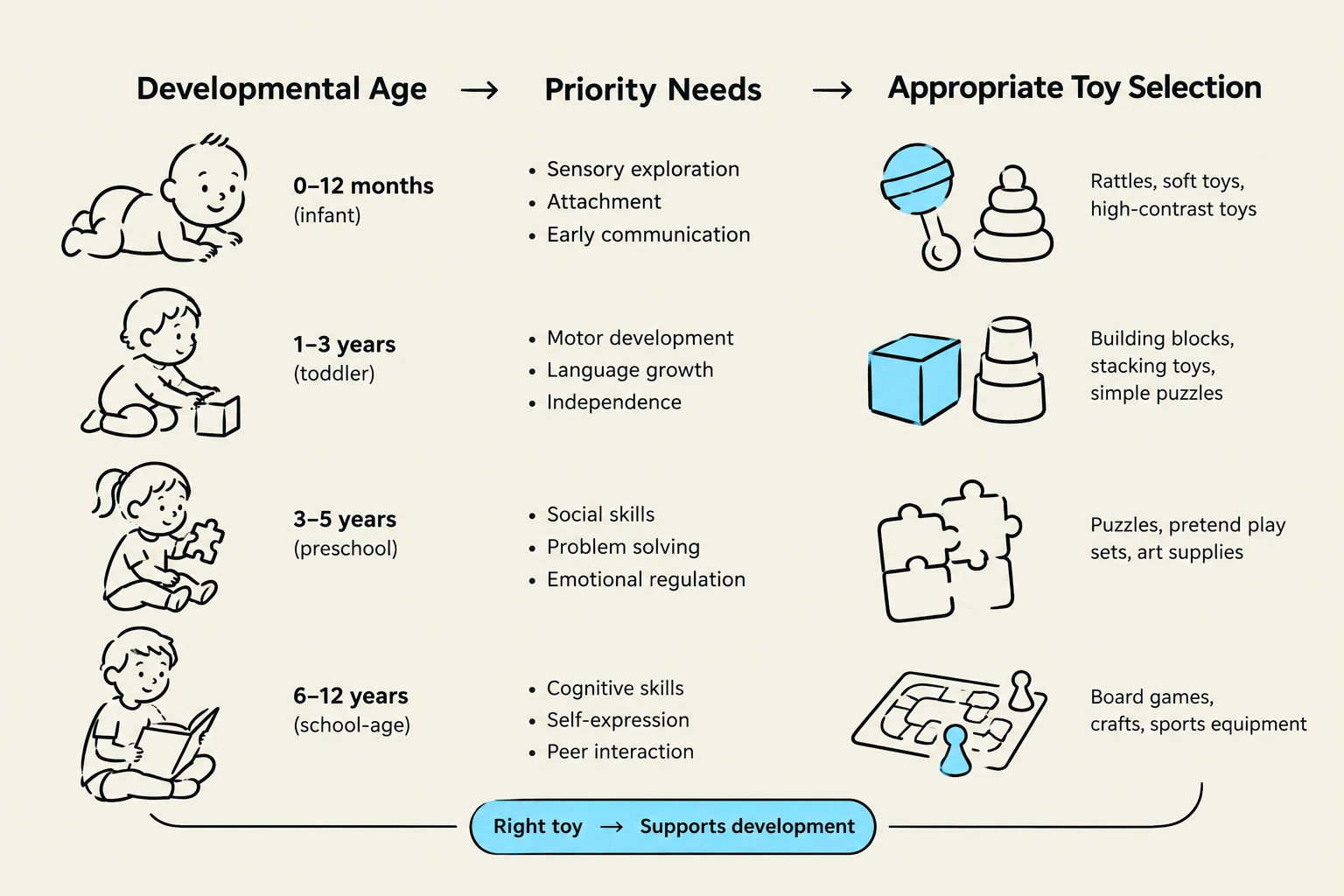
Age Group
Developmental Focus
Toy Examples
Infant
Sensory stimulation & Trust
Soft textures, rattles, colorful mobiles
Toddler
Exploration & Independence
Blocks, push toys, familiar security objects
Preschool
Mastery & Imagination
Pretend play props, make-believe kits
School Age
Logic & Peer Interaction
Board games, sports, video games
Safety Warning: Choking Hazards
Always be mindful of the size of toy parts. Small pieces pose a significant choking hazard, especially for younger children. Additionally, consider the child's diagnosis; for example, a child with a contagious rash might benefit from a handheld electronic game that can be easily contained in a plastic bag for hygiene.
This chart illustrates the relationship between developmental age, priority needs, and appropriate toy selection for children from infancy to school age.
Keep reading for free.
Create an account to finish this reading and make it part of your study routine.