Explore the fundamental process of cellular respiration, detailing its three main stages: glycolysis, the citric acid cycle, and oxidative phosphorylation. Understand how cells convert nutrients into ATP, the energy currency of life, and learn about anaerobic metabolism and its role when oxygen is limited.
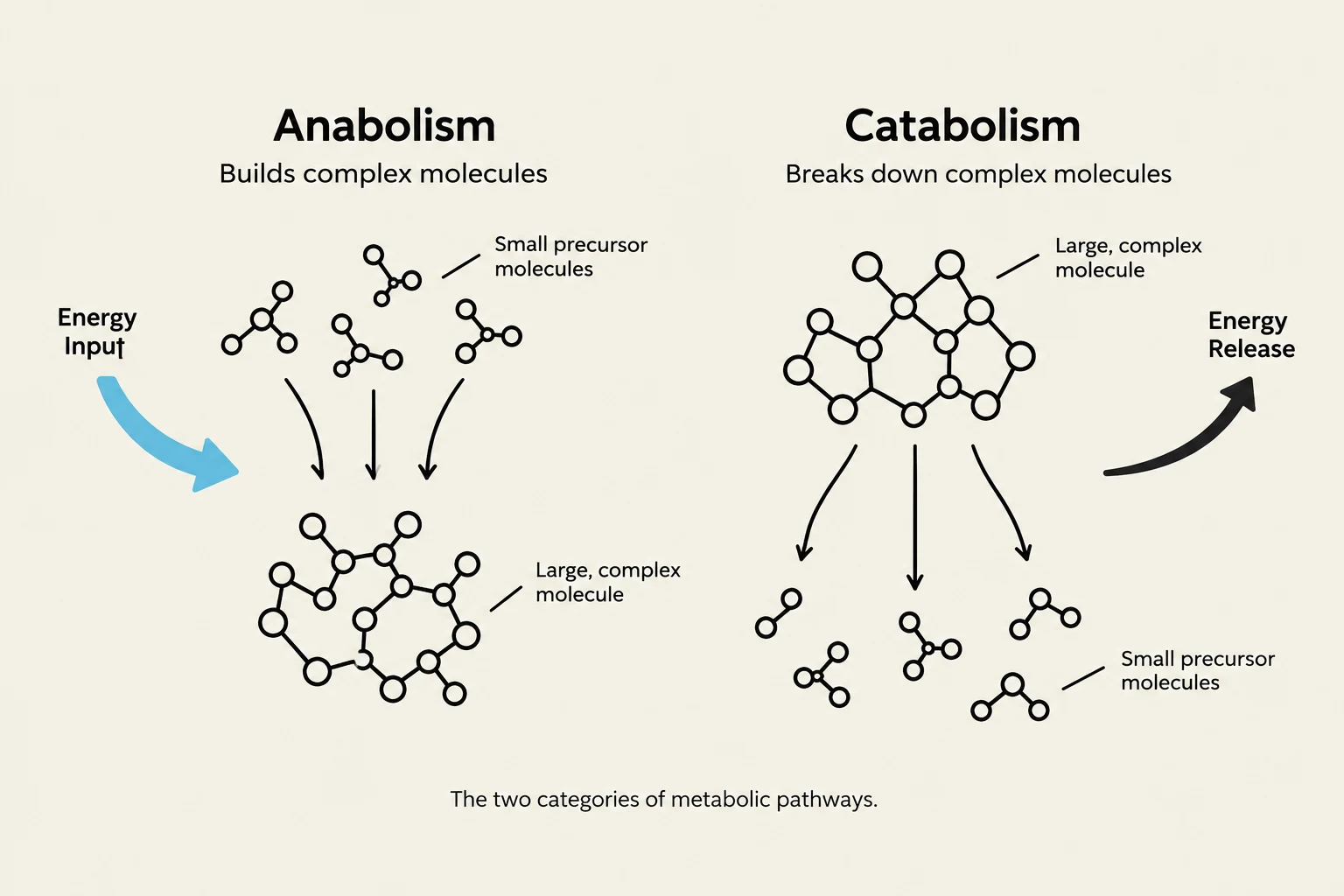
Metabolism is the sum of all chemical reactions within a cell, functioning like a complex road map of interconnected pathways. These pathways are generally divided into two categories: anabolism, which builds complex molecules from simpler ones and consumes energy, and catabolism, which breaks down complex molecules to release energy.
This diagram illustrates the two categories of metabolic pathways: anabolism, which builds complex molecules with energy input, and catabolism, which breaks down complex molecules with energy release.
Cellular respiration is a primary catabolic process. It is an aerobic process—meaning it requires oxygen—that extracts energy from nutrients like glucose to produce ATP (adenosine triphosphate). ATP serves as the cell's "energy shuttle," providing the necessary power for mechanical work (like muscle contraction), transport work (moving solutes), and chemical work (building bonds).
The Three Stages of Cellular Respiration
To extract energy efficiently, the cell does not break glucose down in one violent explosion. Instead, it uses a series of controlled, exergonic reactions. This process is summarized in three main stages: glycolysis, the citric acid cycle, and oxidative phosphorylation.
1. Glycolysis: The Sugar Split
Glycolysis occurs in the cytosol of the cell. The term literally means "splitting of sugar". This stage is unique because it does not require oxygen to function.
The process involves two distinct phases:
Energy Investment Phase: The cell actually spends 2 ATP to phosphorylate the glucose molecule, making it reactive.
Energy Payoff Phase: The sugar is cleaved and oxidized. Through substrate-level phosphorylation—a process where an enzyme transfers a phosphate group directly from a substrate to ADP—the cell produces 4 ATP.
The Net Yield of Glycolysis (per glucose):
2 Pyruvate molecules
2 ATP (net gain)
2 NADH (high-energy electron carriers)
2. The Citric Acid Cycle (TCA Cycle)
Before the products of glycolysis can enter the next stage, pyruvate must be transported into the mitochondrial matrix. Here, pyruvate undergoes an irreversible conversion into Acetyl CoA, releasing CO2 in the process.
The Citric Acid Cycle is a continuous loop of reactions that fully oxidizes the acetyl group. For every single molecule of glucose, the cycle turns twice (once for each pyruvate).
The Net Yield of the Citric Acid Cycle (per glucose):
2 ATP (via substrate-level phosphorylation)
6 NADH
2 FADH2
CO2 (released as waste)
3. Oxidative Phosphorylation: The Energy Powerhouse
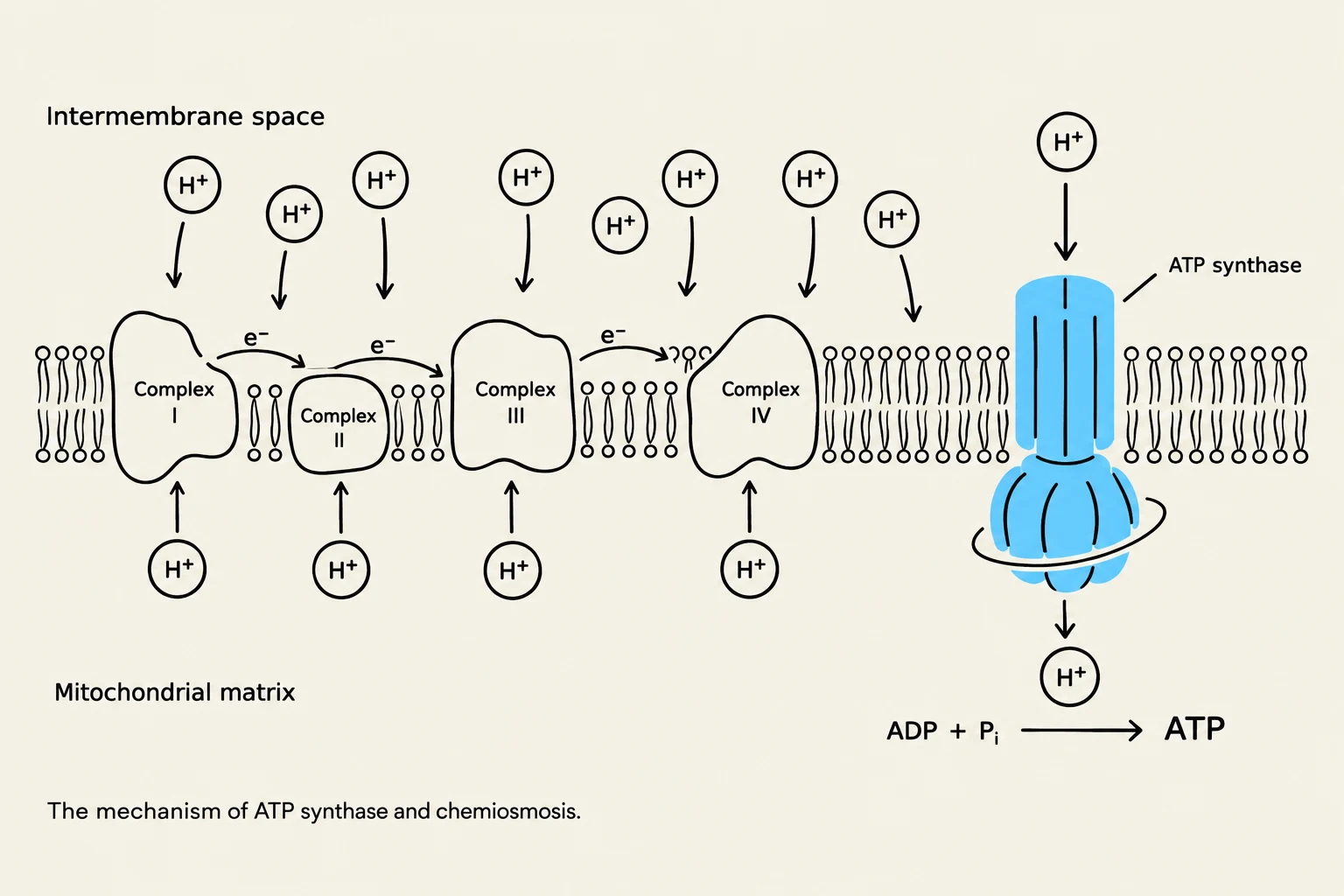
Diagram illustrating the process of ATP synthase and chemiosmosis within a mitochondrion, showing the movement of protons (H+) across the inner mitochondrial membrane to generate ATP from ADP and Pi.
The final and most productive stage occurs in the inner mitochondrial membrane. This stage is known as oxidative phosphorylation because it couples the oxidation of electron carriers with the phosphorylation of ADP to create ATP. It consists of two tightly linked components: the Electron Transport Chain (ETC) and chemiosmosis.
The Electron Transport Chain (ETC)
The cell utilizes coenzymes—organic molecules that act as electron shuttles—to carry high-energy electrons to the ETC. The two primary coenzymes are NADH (the "full" shuttle) and FADH2.
As these coenzymes donate electrons to the protein complexes of the ETC, the electrons move through a series of redox reactions, losing energy at each step. This released energy is used by the protein complexes to pump hydrogen ions ($H^+$) from the mitochondrial matrix into the intermembrane space. This creates a steep electrochemical gradient, often called a proton-motive force. At the very end of the chain, oxygen acts as the final electron acceptor, combining with electrons and $H^+$ to form water (H2O).
Chemiosmosis and ATP Synthase
The $H^+$ ions "want" to move back into the matrix to balance the gradient, but they can only pass through a specialized protein called ATP synthase.
As $H^+$ ions flow through ATP synthase, they cause a portion of the protein to spin like a molecular turbine. This mechanical rotation provides the energy necessary to join an inorganic phosphate (Pi) to ADP, synthesizing ATP.
Exam Tip: Yield Calculations
While the theoretical maximum yield is often cited as 36 to 38 ATP per glucose, the actual biological yield is typically closer to 30–32 ATP. This is because the efficiency of NADH varies; for example, cytoplasmic NADH used in glycolysis may yield only 1.5 to 2.5 ATP depending on the shuttle used to enter the mitochondria.
Regulation: Allosteric Control
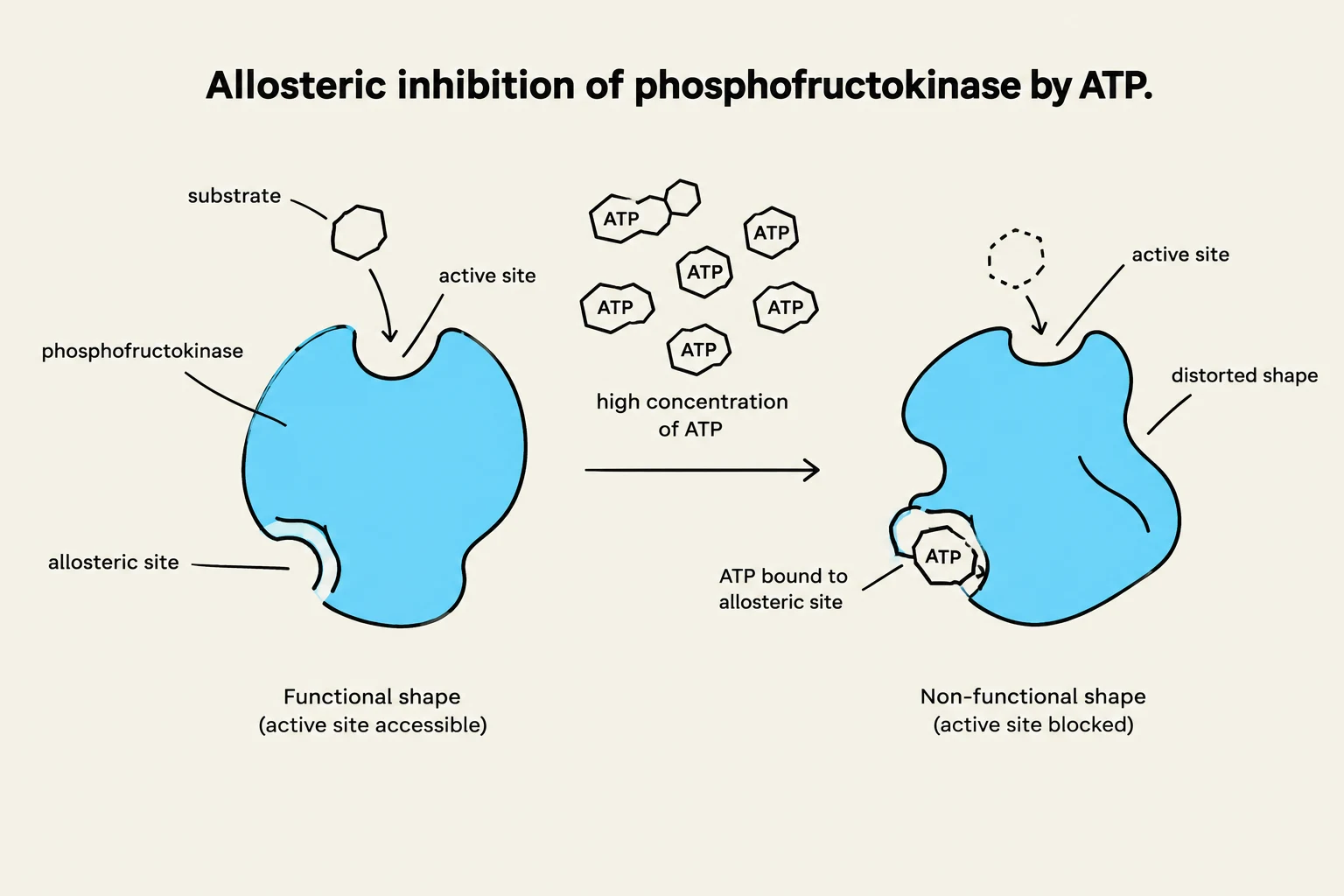
Diagram illustrating the allosteric inhibition of phosphofructokinase by ATP, showing how high concentrations of ATP bind to the allosteric site, distorting the enzyme's shape and blocking its active site, thus rendering it non-functional.
Cells are efficient; they do not produce ATP if they already have an abundance. This is managed through allosteric control and negative feedback.
An enzyme like phosphofructokinase (a key regulator of glycolysis) acts as a sensor.
Inhibition: When ATP levels are high, ATP binds to an allosteric site on the enzyme, changing its shape and slowing down the pathway. Citrate (from the Citric Acid Cycle) can also inhibit this enzyme.
Stimulation: Conversely, high levels of AMP (signaling low energy) can stimulate the enzyme to speed up production.
Anaerobic Metabolism: Fermentation
When oxygen is unavailable (such as during intense, heavy exercise), the electron transport chain cannot function because there is no oxygen to accept the electrons. Without the ETC, NADH cannot be converted back into NAD+. Since NAD+ is required for glycolysis to continue, the cell must find another way to regenerate it.
This is achieved through fermentation, which allows glycolysis to continue producing a small amount of ATP (2 net ATP) anaerobically.
Lactic Acid Fermentation: Pyruvate is converted into lactate (lactic acid). This occurs in human muscle cells during anaerobic exercise. This process is reversible; once oxygen is available, lactate can be converted back to pyruvate.
Alcohol Fermentation: Common in yeast, pyruvate is converted into ethanol and CO2.
Clinical Note: Exercise Physiology
During heavy exercise, muscles transition from aerobic metabolism to anaerobic glycolysis. This produces lactate, contributing to "oxygen debt" that must be repaid post-exercise to re-convert lactate back into pyruvate or glucose.
Summary of Energy Yields
To visualize the total process, we can look at the breakdown of a single glucose molecule: