Carbohydrates, Lipids, and Metabolism: An Educational Overview
Explore the fundamental processes of how the human body acquires, stores, and utilizes energy through carbohydrates, lipids, and metabolic pathways. This guide covers glucose homeostasis, lipid classification, cellular respiration, and hormonal regulation.
Understanding how the human body acquires, stores, and utilizes energy is fundamental to mastering biochemistry and physiology. This process is governed by the interplay of carbohydrates, lipids, and complex metabolic pathways. While carbohydrates provide the rapid energy required for immediate cellular tasks, lipids offer a high-density reservoir for long-term storage. The orchestration of these fuels is managed by a sophisticated network of hormones and enzymatic reactions that ensure homeostasis.
Carbohydrates: The Primary Fuel Source
Carbohydrates are categorized based on their molecular complexity. They serve as the body's preferred and fastest-acting energy source.
Monosaccharides, Disaccharides, and Polysaccharides
Monosaccharides: These are the simplest sugars, including glucose (the primary blood sugar), fructose, and galactose.
Disaccharides: Formed when two monosaccharides bond, common examples include sucrose (table sugar) and lactose (milk sugar).
Polysaccharides: These are long chains of sugar molecules. In plants, these include starch (energy storage) and cellulose (structural component). In humans, the only polysaccharide synthesized by the body is glycogen, which serves as our primary storage molecule.
Glucose Homeostasis: Glycogenesis vs. Glycogenolysis
The cycle of glucose homeostasis via insulin and glucagon.
The body must maintain steady blood glucose levels through two opposing processes regulated by hormones:
Glycogenesis: When blood glucose is high (the absorptive state), the hormone insulin promotes the synthesis of glycogen for storage in the liver and muscles.
Glycogenolysis: During fasting or high-demand states, the hormone glucagon triggers the breakdown of stored glycogen back into glucose to raise blood sugar levels.
Exam Tip: Remember that Insulin is the "storage" hormone (lowers blood sugar), while Glucagon is the "mobilization" hormone (raises blood sugar).
Lipids: High-Density Energy Storage
When carbohydrate stores are depleted or when energy intake exceeds immediate needs, the body turns to lipids.
Classification of Lipids
Lipids are diverse structures categorized into three main groups:
Simple Lipids: Fats and oils.
Compound Lipids: Such as phospholipids (essential for cell membranes) and glycolipids.
Derived Lipids: Such as steroids, including cholesterol, which is vital for membrane integrity and hormone production.
Fatty Acids and Metabolism
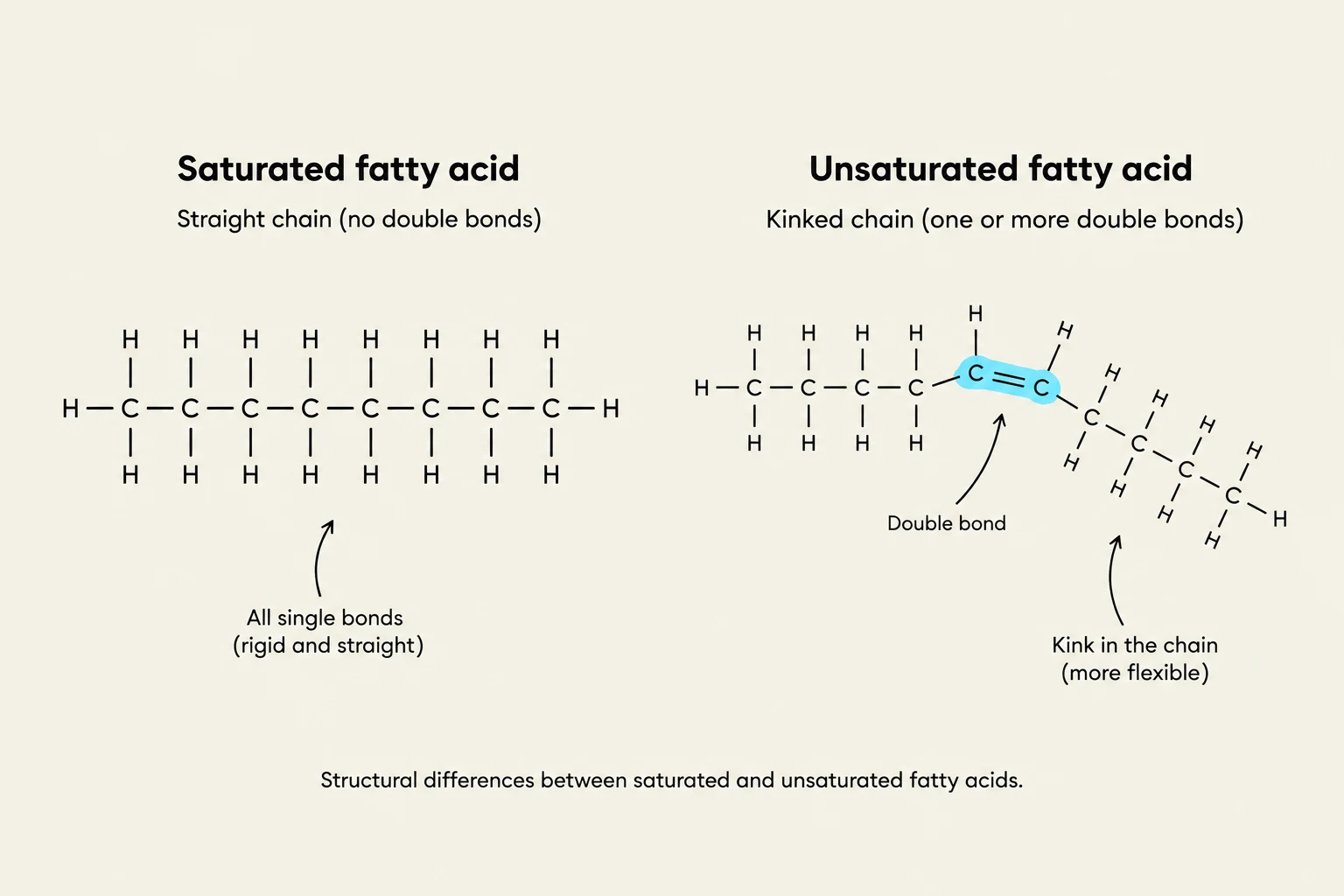
Structural differences between saturated and unsaturated fatty acids, illustrating the presence or absence of double bonds and their effect on chain shape.
Fatty acids are the building blocks of many lipids. They are classified by their chemical bonds:
Saturated Fats: Contain no double bonds between carbon atoms, typically making them solid at room temperature.
Unsaturated Fats: Contain one or more double bonds.
To utilize these fats for energy, the body performs beta-oxidation, a process that breaks down fatty acids into Acetyl CoA. The synthesis of new fats is known as lipogenesis, whereas the breakdown of fats for energy is called lipolysis.
The Mechanics of Metabolism
Metabolism is the sum of all chemical reactions in the body, divided into two functional directions:
Anabolic Pathways: "Building up" processes that require energy to create complex molecules (e.g., protein synthesis).
Catabolic Pathways: "Breaking down" processes that release energy by degrading molecules (e.g., digestion).
Cellular Respiration and ATP Production
The diagram illustrates the three main stages of cellular respiration: glycolysis, the Krebs cycle, and the electron transport system, occurring within the cell and its mitochondrion to produce ATP.
The ultimate goal of metabolism is the production of Adenosine Triphosphate (ATP), the universal energy currency of the cell. This occurs through cellular respiration, which follows three main stages:
Glycolysis: Occurs in the cytosol. It breaks down one glucose molecule into two molecules of pyruvate, yielding a small amount of ATP.
Krebs Cycle (Citric Acid Cycle): Occurs in the mitochondria. It processes Acetyl CoA to produce electron carriers, specifically NADH and FADH2.
Electron Transport System (ETS): Occurs in the inner mitochondrial membrane. This stage uses oxygen to drive oxidative phosphorylation, producing the vast majority of the cell's ATP.
Anaerobic Metabolism: Fermentation
If oxygen is unavailable, the cell cannot proceed through the Krebs cycle or ETS. Instead, it relies on fermentation to regenerate NAD+, which is necessary to keep glycolysis running:
Lactic Acid Fermentation: Converts pyruvate into lactic acid (common in muscle cells during intense exercise).
Alcohol Fermentation: Converts pyruvate into ethanol and CO2 (common in yeast).
Hormonal Regulation and Metabolic Disorders
Metabolism is not a static process; it is constantly adjusted by the endocrine system to meet the body's changing needs.
Key Regulatory Hormones
Thyroid Hormone (TH): Increases the overall basal metabolic rate.
Cortisol: A stress hormone that increases glucose availability to ensure the body has fuel during "fight or flight" scenarios.
Growth Hormone (GH): Influences protein synthesis and the metabolism of fats.
Clinical Implications and Disorders
When metabolic pathways are disrupted, serious clinical conditions can arise:
Diabetes Mellitus: A disorder of glucose homeostasis. If the body cannot use glucose effectively, it may turn to extreme fat breakdown, leading to the production of ketones. An accumulation of these can result in ketoacidosis, a life-threatening drop in blood pH.
Phenylketonuria (PKU): A genetic disorder involving the inability to metabolize certain amino acids.
Urea Cycle Disorders: Disruptions in the body's ability to process nitrogenous waste.
Maple Syrup Urine Disorder: A metabolic error affecting the breakdown of specific amino acids.
Summary Table: Energy Yield Comparison
Fuel Source
Speed of Breakdown
Relative Energy Yield
Carbohydrates
Fastest
Lower per gram
Lipids (Fats)
Slowest
Highest per gram
Note: While fats provide more energy per gram, carbohydrates are the body's "first responder" for energy.
Keep reading for free.
Create an account to finish this reading and make it part of your study routine.