Canadian Workplace Legal Framework: Rights, Discrimination, and Employer Responsibilities
An overview of Canadian employment law, covering constitutional rights, human rights legislation, discrimination, harassment, reasonable accommodation, and employer obligations in the workplace.
Navigating the legal landscape of a Canadian workplace requires an understanding of how various layers of law—from constitutional rights to specific provincial regulations—interact to protect both the employer and the employee. The goal of this legal framework is to balance the needs of the employer with the fundamental rights of the worker, ensuring a fair, safe, and equitable environment for all.
The Foundation: Constitutional and Human Rights
The bedrock of Canadian law is the Canadian Charter of Rights and Freedoms, which establishes the basic rights for all citizens. While the Charter provides the foundation, specific Human Rights Legislation is implemented through jurisdiction-specific laws that prohibit discrimination in employment and the delivery of services.
A critical component of this is the Employment Equity Act, which applies specifically to federally regulated employers. This Act aims to remove barriers and promote equality for four designated groups:
Women
Aboriginal peoples/First Nations
Visible minorities
Persons with disabilities
Understanding Discrimination
In a legal context, discrimination is defined as any distinction, exclusion, or preference based on a prohibited ground that impairs a person's right to full and equal recognition of their human rights. Prohibited grounds include race, religion, age, and sexual orientation.
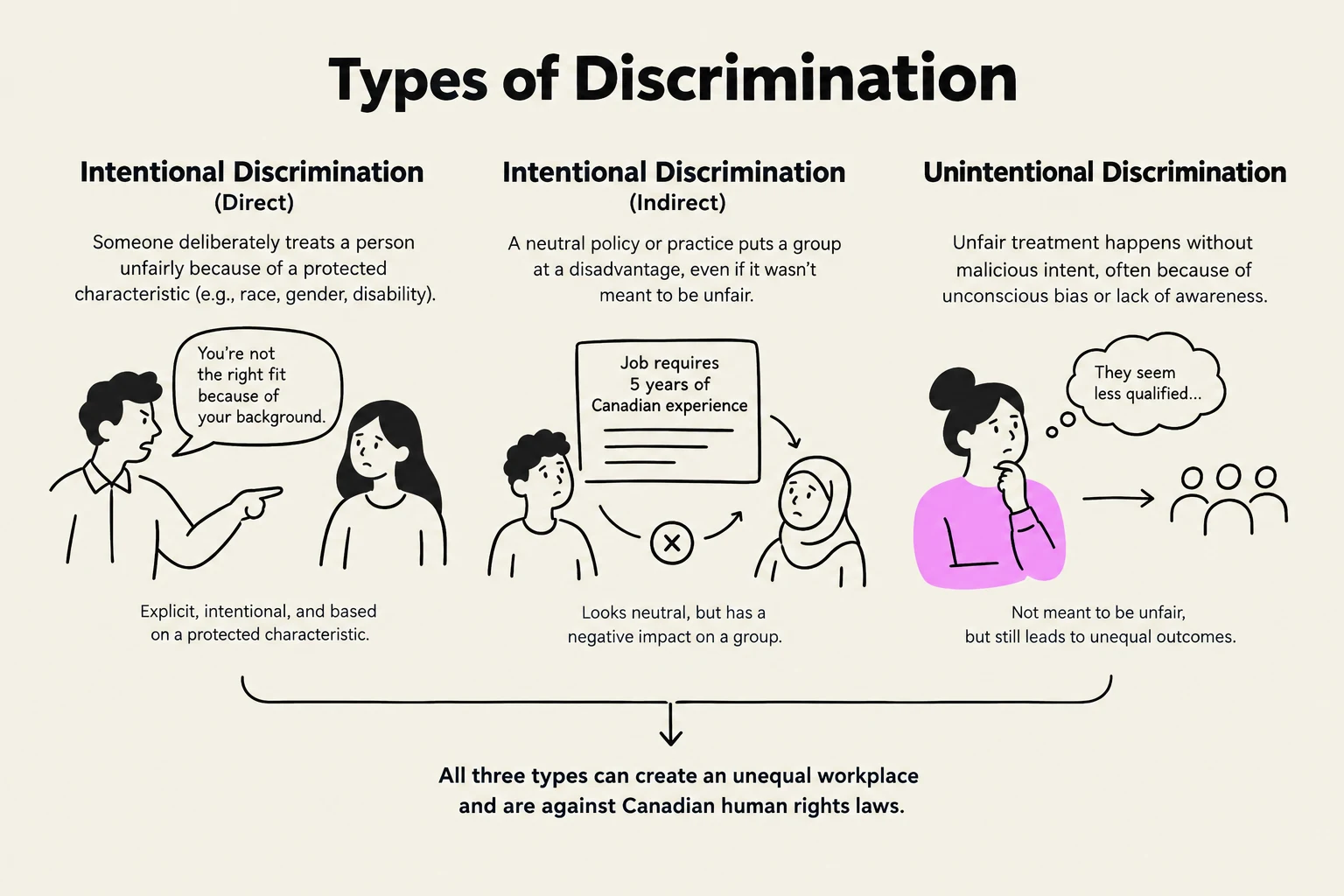
Discrimination is not always overt; it is categorized into two main types:
Intentional Discrimination: This includes direct unequal treatment or indirect treatment (such as discrimination by association).
Unintentional Discrimination: Also known as systemic or constructive discrimination, this is often embedded in seemingly neutral policies that have an adverse impact on specific groups. Examples include job evaluation systems that are not gender-neutral or strict height/weight requirements that lack a functional necessity.
This illustration depicts three types of discrimination: intentional direct, intentional indirect, and unintentional. It explains how each type can lead to unequal outcomes and violate human rights laws.
Reasonable Accommodation and BFOR
Employers are legally required to provide reasonable accommodation—adjusting policies or practices so that no individual is disadvantaged based on human rights grounds. However, this duty is not absolute; it is limited by the concept of undue hardship, which occurs when the financial or practical costs of an accommodation make it impossible for the employer to implement.
A requirement that might otherwise seem discriminatory may be legally defensible if it qualifies as a Bona Fide Occupational Requirement (BFOR). To prove a BFOR, an employer must satisfy three criteria:
Rationale: The policy must be based on a legitimate, work-related purpose.
Good Faith: The decision-makers must honestly believe the requirement is necessary.
Reasonable Necessity: It must be impossible to accommodate the employee without causing undue hardship.
Exam Tip: If a question asks whether a policy is discriminatory, first check if it is a BFOR. If it is a BFOR, the employer must still prove they attempted reasonable accommodation up to the point of undue hardship.
Harassment and Employer Responsibility
Under Occupational Health and Safety Law, employers have a legal responsibility to protect employees from harassment, which includes unwelcome behavior from clients or customers. Harassment is defined as behavior that demeans, humiliates, or embarrasses a person that a reasonable person should have known was unwelcome.
Sexual Harassment is a specific subset of this behavior and is categorized into two forms:
Sexual Coercion: Harassment of a sexual nature that results in a direct consequence to the worker's employment status or tangible job benefits.
Sexual Annoyance: Conduct that is hostile or offensive but has no direct link to job benefits or losses.
This diagram illustrates the employer's responsibility cycle, which involves establishing policies, communicating them to employees, and receiving feedback and concerns.
To mitigate liability, employers must implement robust policies. An effective policy should include clear definitions, information for victims, employee rights and responsibilities, and strict penalties for retaliation against complainants.
Employment Standards, Contracts, and Common Law
The terms of employment are governed by different legal instruments depending on the nature of the workplace:
Instrument
Description
Employment Contract
A direct agreement between an individual employer and employee specifying conditions.
Collective Agreement
A legally binding agreement between an employer and a union, establishing minimum terms for unionized staff.
Employment Standards Legislation
Laws (provincial or federal) that establish minimum entitlements like wages, overtime, and vacation.
While contracts can exceed the minimums set by the Employment Standards Act, the "principle of greater benefit" applies—meaning the employee is entitled to whichever standard is higher.
Finally, Common Law plays a vital role through jurisprudence (precedents set by judges). In cases of wrongful dismissal, judges use precedents like Bardal v. Globe and Mail to determine "reasonable notice." This is not a fixed formula but is decided based on the character of employment, length of service, age, and availability of similar work.
Employee Privacy and Surveillance
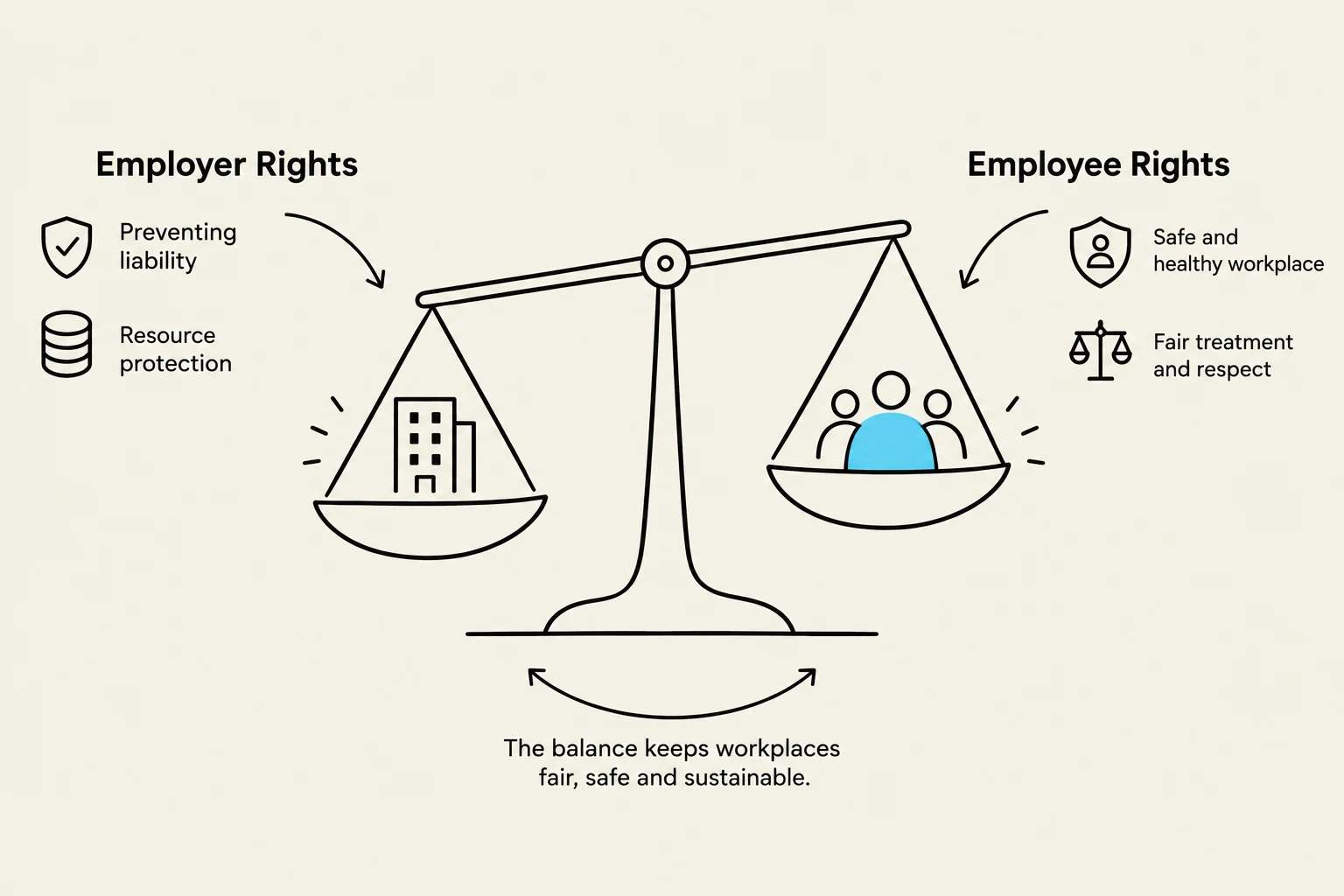
In the modern workplace, a tension exists between an employer's right to protect the company and an employee's right to privacy.
Employer Rights: Employers may use surveillance to prevent theft, vandalism, or to ensure company resources are not abused.
Employee Rights: Employees have a right to control information about themselves and freedom from interference in their personal lives.
To balance these, employers should implement written Internet and Email Usage Policies and ensure that any video surveillance is used only when reasonable alternatives are not available, and that employees are made aware of its presence.
This illustration depicts the balance between employer rights, such as preventing liability and resource protection, and employee rights, including a safe and healthy workplace and fair treatment. The text emphasizes that this balance is crucial for maintaining fair, safe, and sustainable workplaces.
Keep reading for free.
Create an account to finish this reading and make it part of your study routine.