Canadian 24-Hour Movement Guidelines for Children and Youth
This guide outlines the Canadian 24-Hour Movement Guidelines for children and youth (ages 5-17), focusing on physical activity, sedentary behavior, sleep, and their impact on overall well-being. It details recommendations for moderate-to-vigorous activity, light activity, screen time limits, and sleep duration, while a
For children and youth in Canada, health is not defined by a single activity, but by the balance of how they spend every hour of their day. The Canadian 24-Hour Movement Guidelines provide a holistic framework designed to optimize physical, mental, and social well-being. Rather than focusing solely on exercise, these guidelines emphasize a synergy between physical activity, sedentary behavior, and sleep. Understanding these pillars is essential for educators, parents, and health professionals aiming to support the next generation.
Physical Activity Requirements: The "Sweat" and "Step"
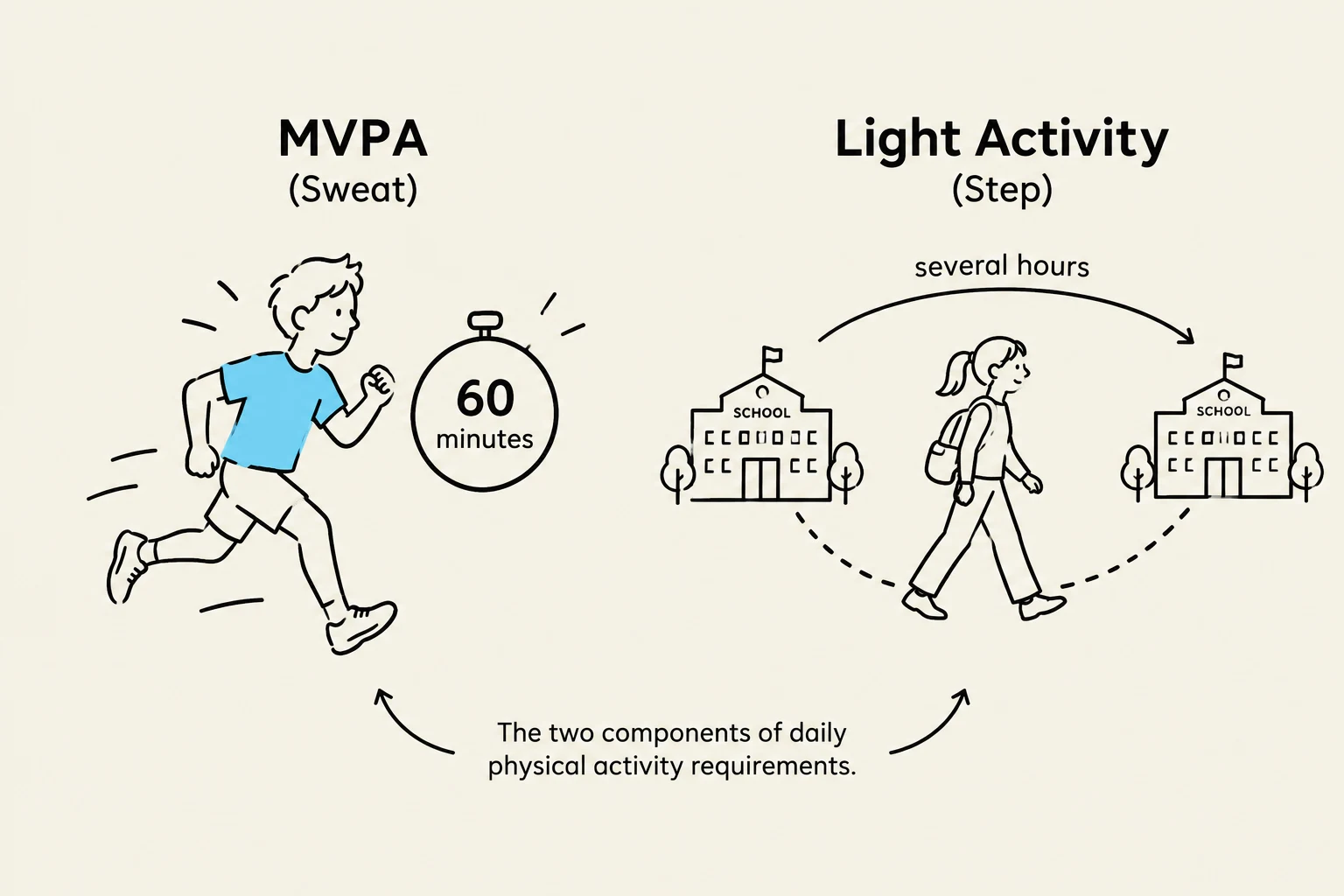
This illustration depicts two components of daily physical activity requirements: MVPA (Moderate-to-Vigorous Physical Activity) which involves sweating for 60 minutes, and Light Activity, such as walking for several hours between school buildings.
Physical activity for children and youth (aged 5–17 years) is categorized into two primary types of movement: moderate-to-vigorous activity and light activity.
Moderate to Vigorous Physical Activity (MVPA)
Often referred to as "Sweat," this requires an accumulation of at least 60 minutes per day of moderate to vigorous aerobic activity. To ensure comprehensive development, the guidelines specify that:
Muscle-strengthening activities should be incorporated at least 3 days per week.
Bone-strengthening activities (such as jumping or climbing) should also occur at least 3 days per week.
Light Physical Activity
The "Step" component involves several hours of various structured and unstructured light physical activities throughout the day. This includes activities like walking between classes or standing during tasks.
Exam Tip: When discussing physical activity, remember it is often called the "golden thread" of the wellness wheel because it has the potential to impact every dimension of health, including mental, social, and physical health.
Sedentary Behavior and Screen Time Recommendations
Sedentary behavior, or "Sit" time, is a critical component of the 24-hour cycle. The guidelines aim to minimize the negative impacts of prolonged inactivity by focusing on two main areas:
Recreational Screen Time: This should be limited to no more than 2 hours per day.
Sitting Duration: Children should avoid extended periods of sitting and instead break up sedentary time with movement.
Current data suggests a significant struggle in this area. According to the 2024 ParticipACTION Report Card, only 27% of children and youth currently meet the recommended screen time guidelines.
The Impact of Digital Access and Role Modeling
Research highlights several social and environmental factors that influence these behaviors:
Household Dynamics: Children in households with screen time restrictions tend to engage in less screen-based behavior. Conversely, higher parenting stress and lower household income are linked to increased screen time in infants and toddlers.
Digital Access: Smartphone ownership rises sharply by age 12. Furthermore, the presence of screens in bedrooms is consistently linked to increased screen viewing.
Role Modeling: Parental behavior plays a major role; approximately half of teens report that their parents are sometimes distracted by their phones during social interactions.
Sleep: The Foundation of Recovery
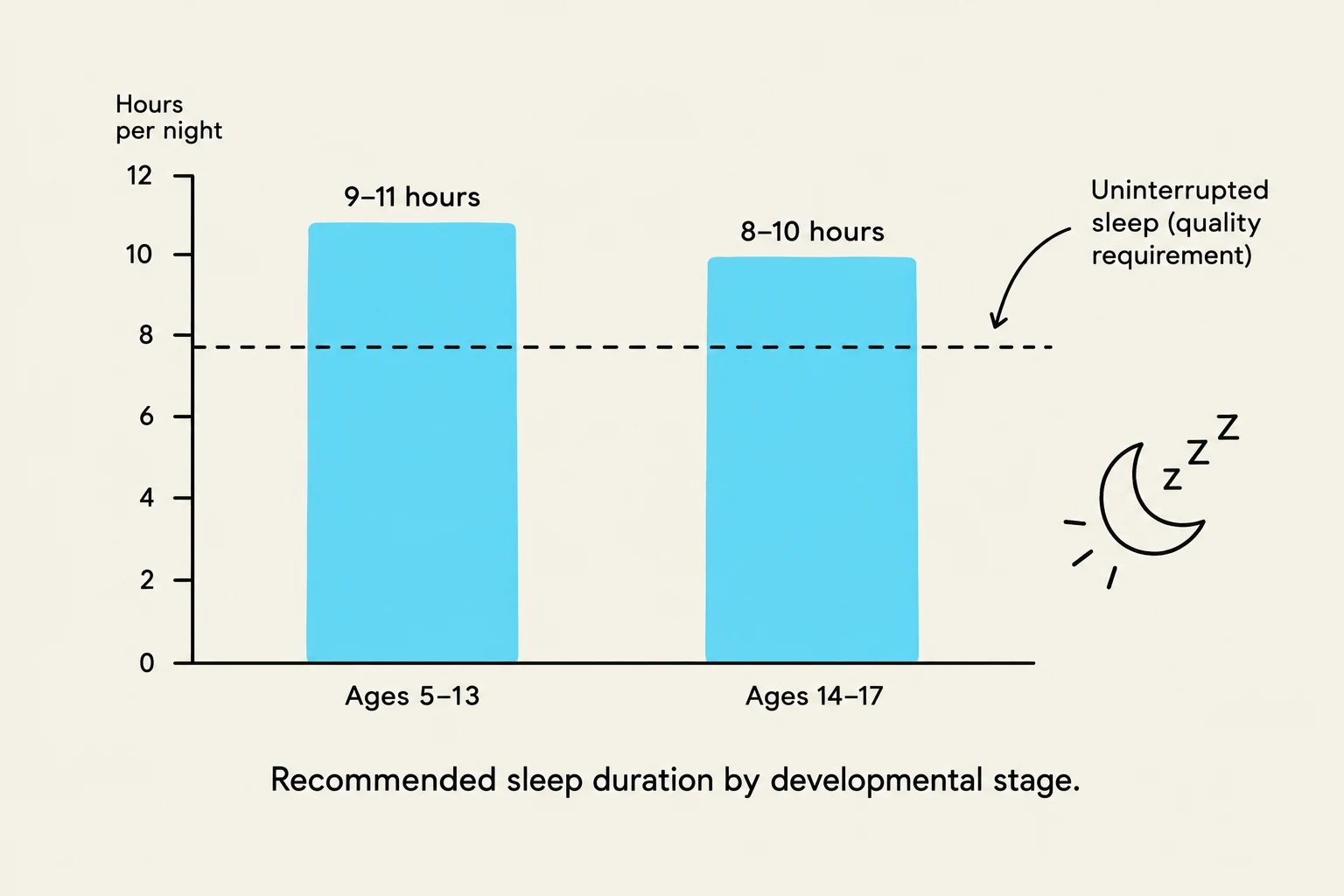
Recommended sleep duration by developmental stage, showing 9-11 hours for ages 5-13 and 8-10 hours for ages 14-17, with a dashed line indicating the uninterrupted sleep quality requirement.
Sleep requirements differ based on the developmental stage of the child, primarily due to biological changes such as puberty:
Ages 5–13: 9 to 11 hours of uninterrupted sleep per night.
Ages 14–17: 8 to 10 hours of uninterrupted sleep per night.
To achieve "good quality" sleep, the guidelines emphasize the importance of maintaining consistent bed and wake-up times.
Policy, Behavior, and Socioeconomic Trends
When we look at how well Canadian youth are actually adhering to these guidelines, the results are stark. While individual behaviors like sleep (65% adherence) or organized sport (over half of children) show varying levels of success, the combined adherence rate is remarkably low.
The 4% Reality
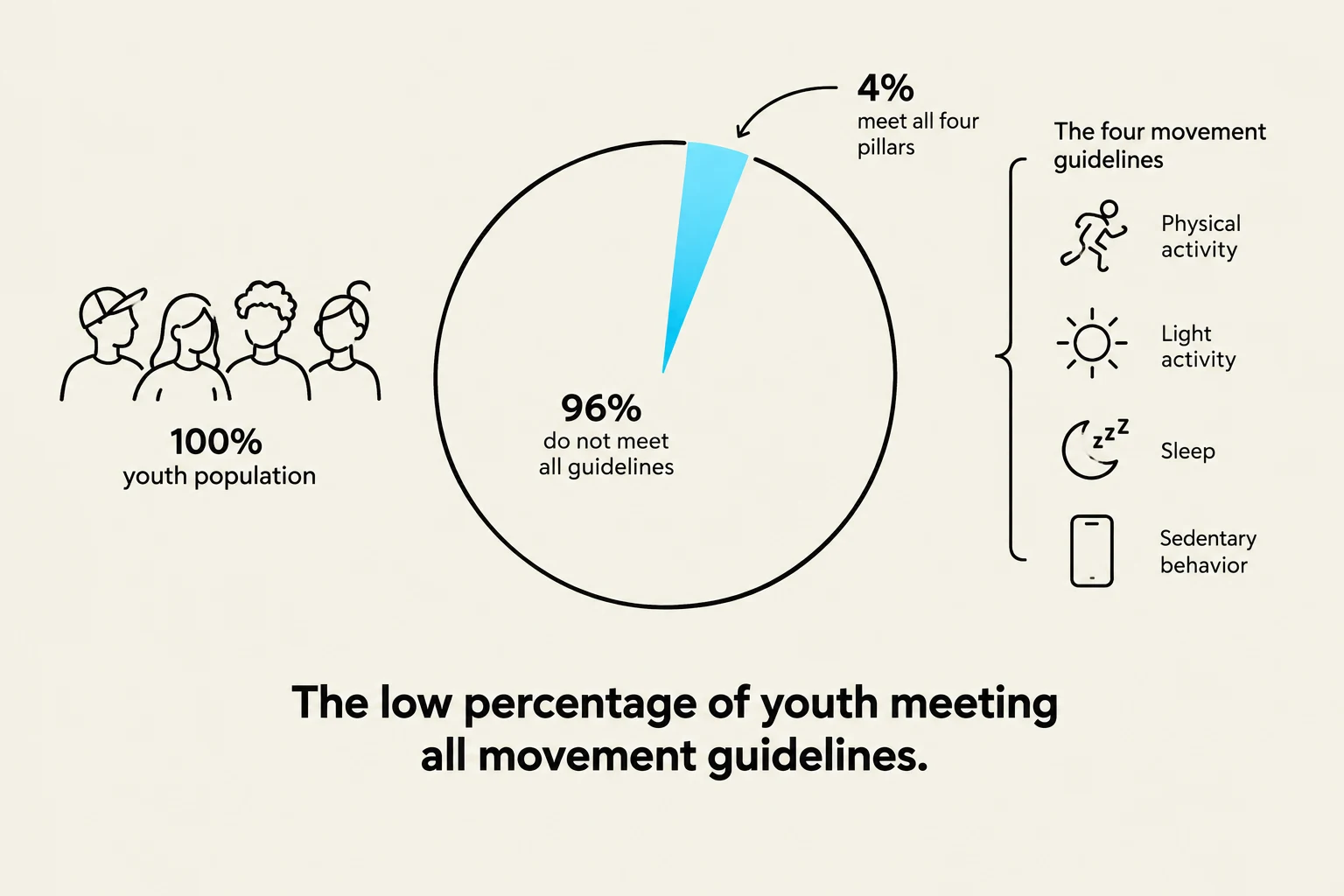
A pie chart illustrates that 96% of the youth population does not meet all four movement guidelines: physical activity, light activity, sleep, and sedentary behavior. Only 4% meet all guidelines.
When all four pillars—physical activity, light activity, sleep, and sedentary behavior—are combined, only 4% of children and youth are meeting the full set of Canadian 24-Hour Movement Guidelines.
Socioeconomic and Gender Disparities
Adherence to these guidelines is not uniform across the population:
Gender: Adherence to the combined guidelines is twice as low among girls compared to boys.
Income: Socioeconomic status is a major predictor of behavior. Children from higher-income households typically accumulate significantly less screen time and have better access to organized sports than those from lower-income households.
Geography: In larger municipalities, children are more likely to use active transportation (like biking or walking to school) compared to those in smaller communities.
Summary Table for Study:
Behavior
Recommendation
MVPA (Sweat)
≥60 mins/day; Strength/Bone ≥3 days/week
Light Activity (Step)
Several hours daily
Sleep
9–11 hrs (ages 5–13); 8–10 hrs (ages 14–17)
Screen Time (Sit)
≤2 hours/day
Ultimately, the goal is not perfection but progression. As noted by the Canadian Society for Exercise Physiologists, even small steps—such as replacing sitting with movement or trading light activity for moderate activity—can result in significant health benefits.
Keep reading for free.
Create an account to finish this reading and make it part of your study routine.