This guide explains how to write balanced nuclear equations for radioactive decay by understanding and applying the principles of mass number and atomic number conservation. It covers common decay types like alpha and beta decay, providing examples and steps for calculation.
In the study of chemistry, we often focus on the electrons that dance around an atom during a reaction. However, there is a much more powerful process occurring deep within the heart of the atom: the nucleus. When a nucleus becomes unstable, it undergoes a process known as radioactive decay, where it spontaneously breaks down by emitting radiation to reach a more stable state. To track these transformations, scientists use nuclear equations.
Understanding the Components of a Nucleus
Before we can write an equation, we must understand the two fundamental numbers that define a nucleus: the mass number and the atomic number.
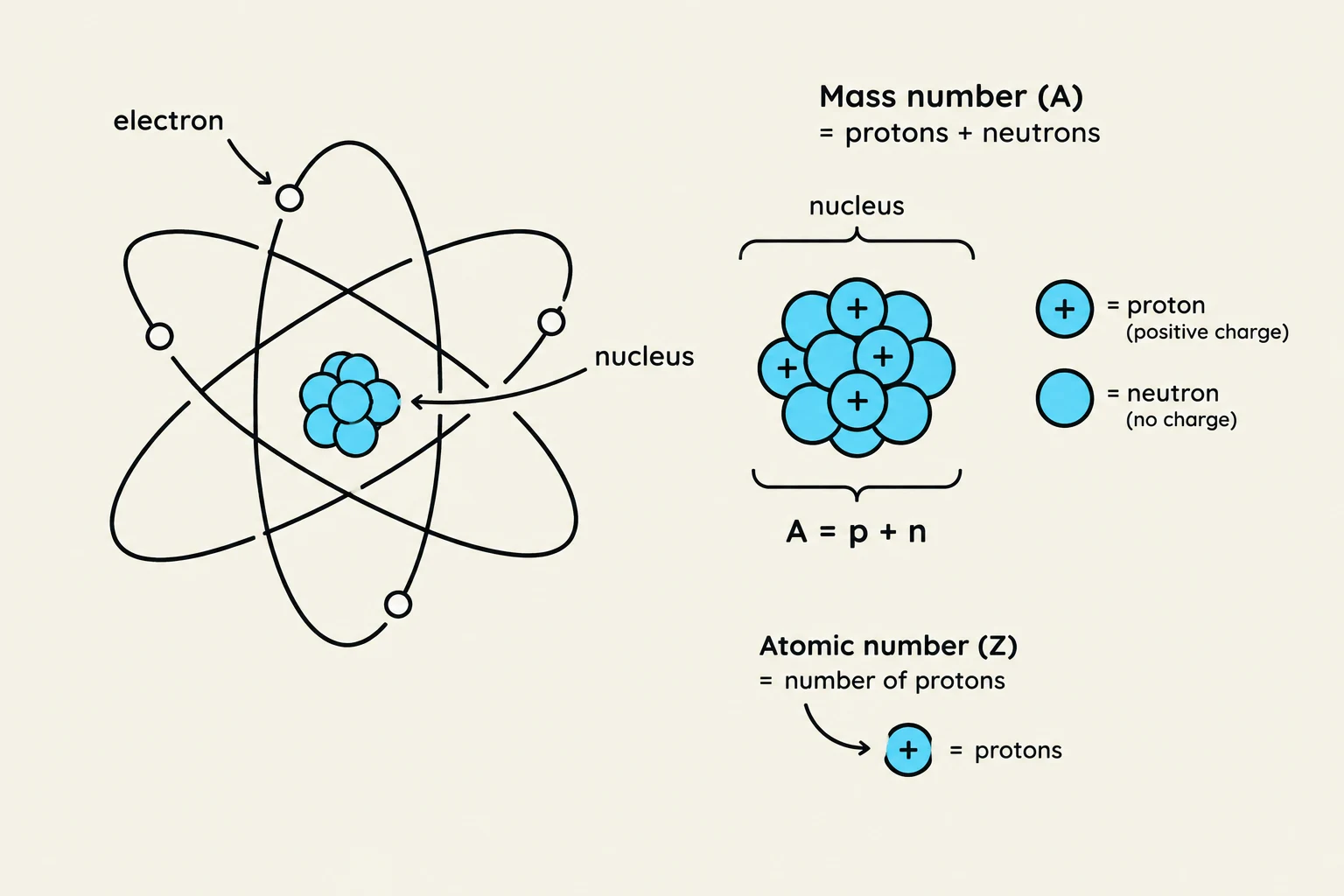
Mass Number (A): This is the total number of protons and neutrons in the nucleus. In a nuclear equation, the mass number is written as a superscript to the left of the element symbol.
Atomic Number (Z): This represents the number of protons in the nucleus. The atomic number determines the identity of the element. In a nuclear equation, it is written as a subscript to the left of the element symbol.
Pro-Tip: Always remember that the identity of an element is tied strictly to its atomic number. If the atomic number changes during a reaction, you have a completely different element!
This diagram illustrates the basic structure of an atom, defining its nucleus, protons, neutrons, and electrons. It also explains the concepts of mass number (A) and atomic number (Z) with simple formulas.
The Golden Rule of Balancing Nuclear Equations
Unlike chemical equations, which are balanced by counting the number of atoms, nuclear equations are balanced by the sum of the numbers within the nucleus. To ensure an equation is balanced, you must follow two strict rules:
The sum of the mass numbers on the reactant side (left) must equal the sum of the mass numbers on the product side (right).
The sum of the atomic numbers on the reactant side must equal the sum of the atomic numbers on the product side.
Different types of radiation are emitted depending on how the nucleus stabilizes itself. The two most common forms are alpha decay and beta decay.
Alpha Decay
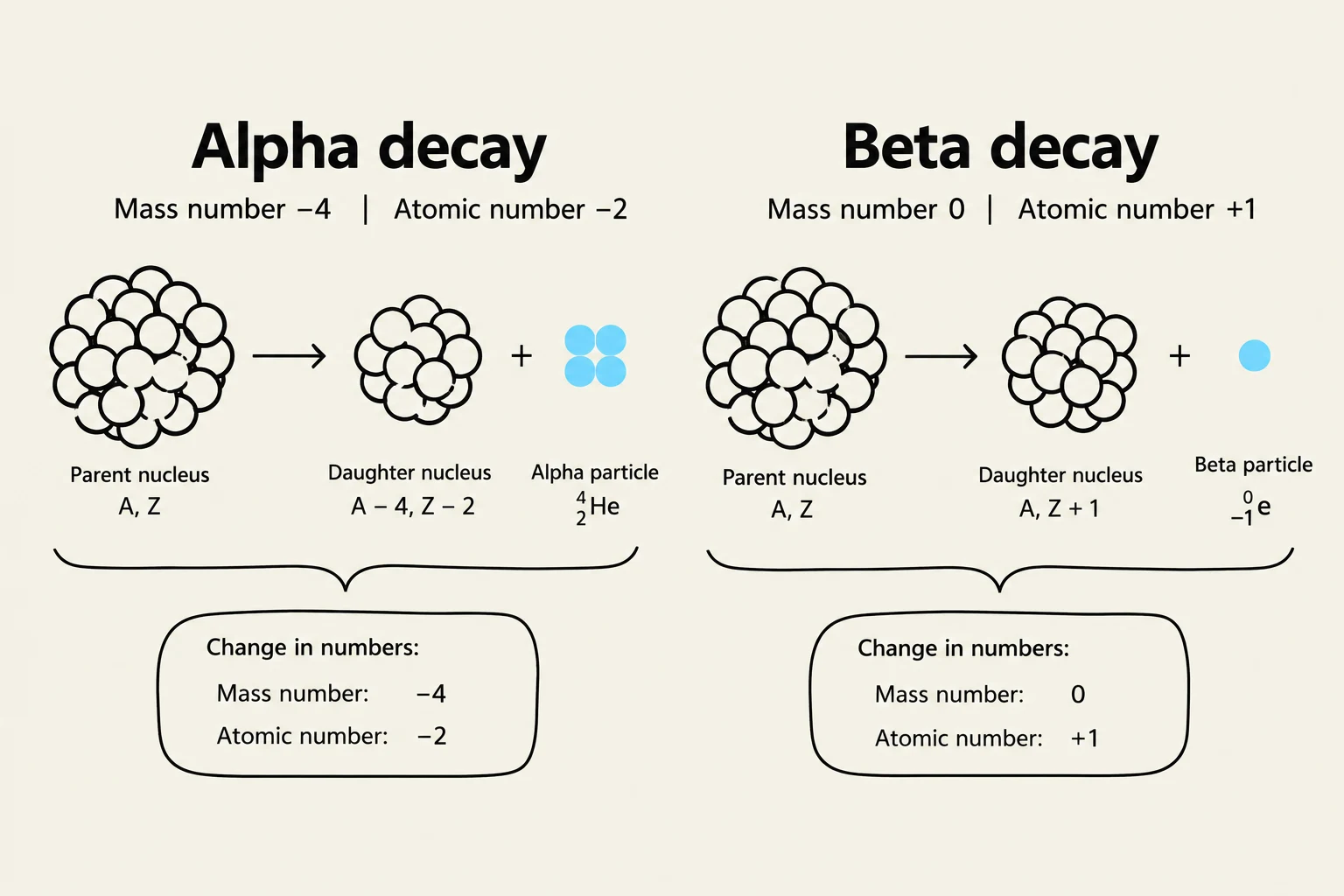
In alpha decay, the nucleus emits an alpha particle. An alpha particle is essentially a helium nucleus, represented as 24He. When this happens, the parent nucleus loses 4 from its mass number and 2 from its atomic number.
Example: The decay of Americium-241
Americium-241 is used in many household smoke detectors. Let's write its balanced equation for alpha decay:
Set up the equation:95241Am→ZAX+24He
Solve for Mass Number (A): $241 = A + 4 \Rightarrow A = 237$
Solve for Atomic Number (Z): $95 = Z + 2 \Rightarrow Z = 93$
Identify the element: Looking at the periodic table, atomic number 93 is Neptunium (Np).
Final Equation:95241Am→93237Np+24He
Diagram illustrating alpha and beta decay processes in atomic nuclei, showing changes in mass and atomic numbers.
Beta Decay
In beta decay, a neutron in the nucleus breaks down into a proton and a beta particle. The beta particle is an electron, represented as −10e. Because a new proton is created, the atomic number increases by 1, though the mass number remains unchanged.
Example: The decay of Yttrium-90
Yttrium-90 is used in medical treatments, such as relieving arthritis pain.
Set up the equation:3990Y→ZAX+−10e
Solve for Mass Number (A): $90 = A + 0 \Rightarrow A = 90$
Solve for Atomic Number (Z): $39 = Z + (-1) \Rightarrow Z = 40$
Identify the element: Atomic number 40 is Zirconium (Zr).
Final Equation:3990Y→4090Zr+−10e
Other Forms of Nuclear Change
While alpha and beta are the most common, you may also encounter:
Positron Emission: A proton is converted into a neutron and a positron (+10e). This decreases the atomic number by 1 but keeps the mass number the same.
Gamma Emission: High-energy radiation is emitted (00γ). This does not change the mass or atomic number; it only releases energy.
Bombardment: Scientists can also create new isotopes by hitting a stable nucleus with high-speed particles like protons or alpha particles.
By mastering the balance of mass and atomic numbers, you can predict the outcome of any nuclear reaction, whether it occurs naturally in a smoke detector or is engineered in a laboratory.
Keep reading for free.
Create an account to finish this reading and make it part of your study routine.