In everyday language, "work" refers to any effort or task performed. However, in physics, the term has a very specific mathematical definition. Work is not just about effort; it is about the transfer of energy that occurs when a force causes an object to move over a certain distance. Crucially, this definition applies specifically to situations where a constant force acts upon an object.
Defining Work and the Dot Product
Work is defined as the scalar dot product between a constant force vector (F) and the displacement vector (Δr). Because work is a scalar quantity, it does not have a direction, even though the force and displacement that create it are vectors. This is a significant advantage in physics because it allows us to add different forms of energy together without worrying about their directional components.
The mathematical formula for work is:
W=F⋅Δr=FΔrcos(θ)
In this equation, θ represents the angle between the force vector and the displacement vector. The value of the work depends heavily on this orientation:
Positive Work (θ=0∘): When the force and displacement are in the same direction, cos(0∘)=1, and the work is positive. This process adds energy to the object.
Negative Work (θ=180∘): When the force opposes the motion (such as kinetic friction), cos(180∘)=−1. This removes energy from the object.
Zero Work (θ=90∘): If the force is perpendicular to the displacement, cos(90∘)=0, and no work is done. For example, the weight of an object does zero work if the object moves horizontally, because gravity acts vertically.
Illustration showing the horizontal component of a force applied to an object and the calculation of work done by that force.
The standard SI unit for work is the joule (J). One joule is equivalent to one Newton-meter (N⋅m), which can be broken down into its base SI units as:
1 J=1 kg⋅m2/s2
Mechanical Advantage and Pulley Systems
When using machines like pulleys, we often encounter mechanical advantage. A pulley system can reduce the amount of force required to lift a load, but there is "no such thing as a free lunch". While the required applied force (Fapplied) decreases, the distance over which you must apply that force (dapplied) increases proportionally.
The total work remains constant:
W=Fapplied⋅dapplied=Fload⋅dload
Exam Tip: If a problem mentions a pulley system providing a mechanical advantage, remember that the work done by the person is equal to the work done on the load. If the force is divided by 6, the displacement must be multiplied by 6.
Friction and Angled Forces
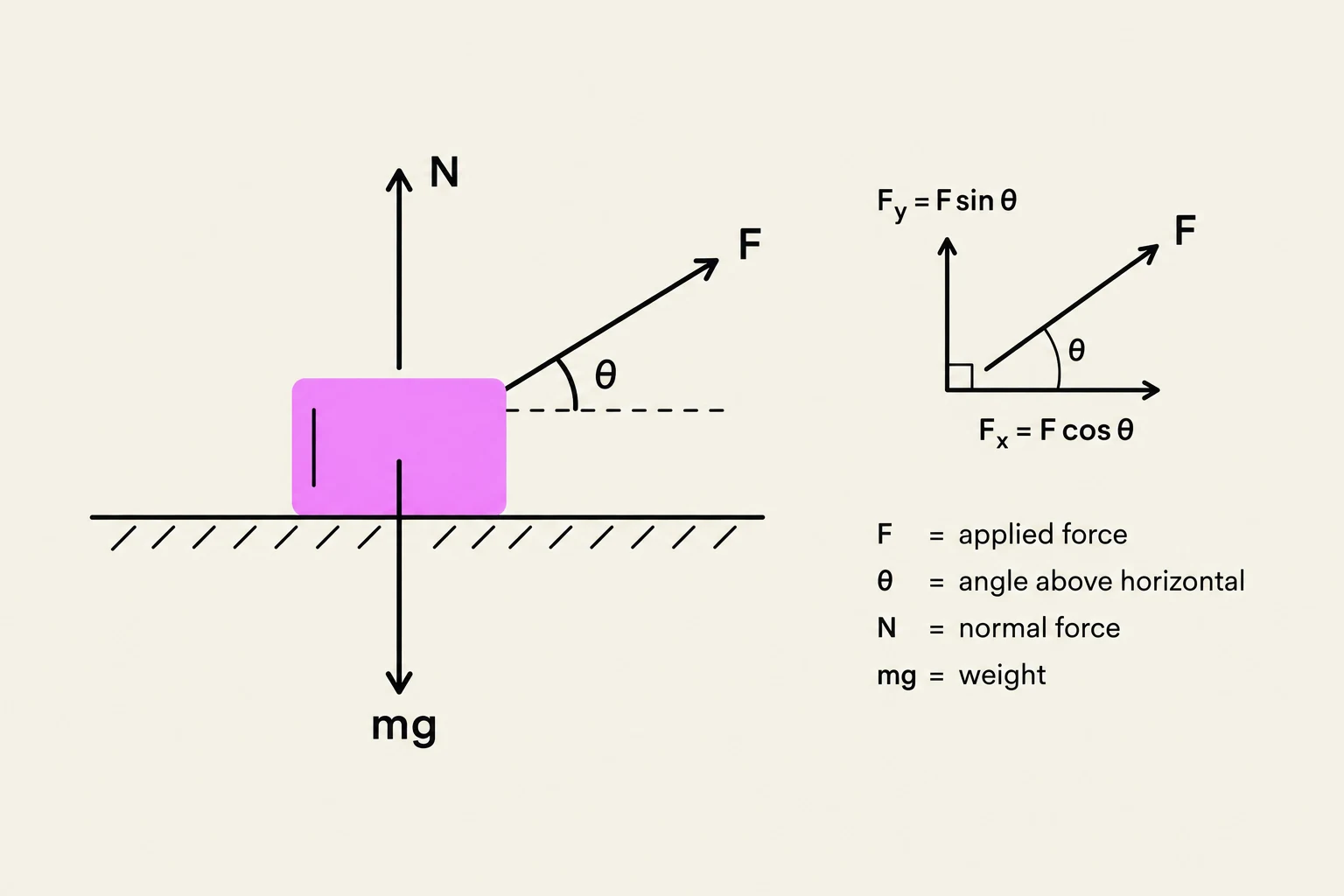
In many real-world scenarios, a force is applied at an angle rather than perfectly horizontally. When pulling an object at an angle θ above the horizontal, only the horizontal component of the force (Fcosθ) contributes to the work done over a horizontal displacement.
This angle also affects the normal force (FN), which is the contact force exerted by a surface. If you pull upward at an angle, you are effectively "lifting" some of the object's weight, which reduces the normal force:
FN=mg−Fsinθ
Because the force of kinetic friction is calculated as fk=μkFN, reducing the normal force subsequently decreases the work done by friction.
A diagram illustrating the forces acting on a block on a horizontal surface, including applied force, normal force, and weight, along with the decomposition of the applied force into horizontal and vertical components.
Energy Types and Conservation
Work is essentially a mechanism for energy transfer. We categorize energy into several types:
Kinetic Energy (KE): The energy associated with an object's motion.
KE=21mv2
Potential Energy (PE): Energy associated with position or configuration, such as gravitational PE ($PE_g = mgy$) or spring energy.
Mechanical Energy (ME): The sum of kinetic and potential energy ($ME = KE + PE$).
The Work-Energy Theorem states that the work done by the net force on an object is equal to its change in kinetic energy. When non-conservative forces (like friction) are present, the relationship is expressed as:
ΔKE+ΔPE=WNC
where WNC is the work done by non-conservative forces.
For elastic objects, we use Hooke's Law (Fsp=−kx) to describe the restoring force of a spring. The potential energy stored in a spring is:
PEsp=21kx2
Power: The Rate of Work
While work tells us how much energy was transferred, power (P) tells us how fast that transfer occurred. Power is the rate at which work is performed:
P=ΔtW
Power has several important relationships:
It is directly proportional to work, force, and displacement.
It is inversely proportional to time.
Since velocity v=Δx/Δt, power can also be expressed as:
P=F⋅v
The SI unit for power is the watt (W), where 1 W=1 J/s. In base SI units, this is expressed as:
1 W=1 kg⋅m2/s3
In automotive and mechanical contexts, you will often see horsepower (hp). One horsepower is approximately equal to 746 Watts.
This diagram illustrates the relationship between power, force, and velocity, showing that power is the product of force and velocity. It also depicts how increasing either force or velocity directly increases power, as represented by the graph.
Summary Table: Units and Relationships
Quantity
Symbol
SI Unit
Base SI Units
Work / Energy
$W, E$
Joule (J)
$\text{kg} \cdot \text{m}^2/\text{s}^2$
Force
F
Newton (N)
kg⋅m/s2
Power
P
Watt (W)
kg⋅m2/s3
Keep reading for free.
Create an account to finish this reading and make it part of your study routine.