Explore the fundamental properties of water, including polarity, hydrogen bonding, cohesion, adhesion, and its role as a universal solvent. Understand how these characteristics are essential for biological processes, metabolism, and nutrient transport in living organisms.
Water is far more than just a simple liquid; it is the essential medium for life. From the earliest organisms appearing in "warm little ponds" to the complex metabolic pathways in modern cells, water provides the liquid environment necessary for molecules to move, interact, and undergo the chemical reactions that define life. The unique ability of water to support these processes is a direct consequence of its molecular structure and the resulting intermolecular forces.
Molecular Structure and Hydrogen Bonding
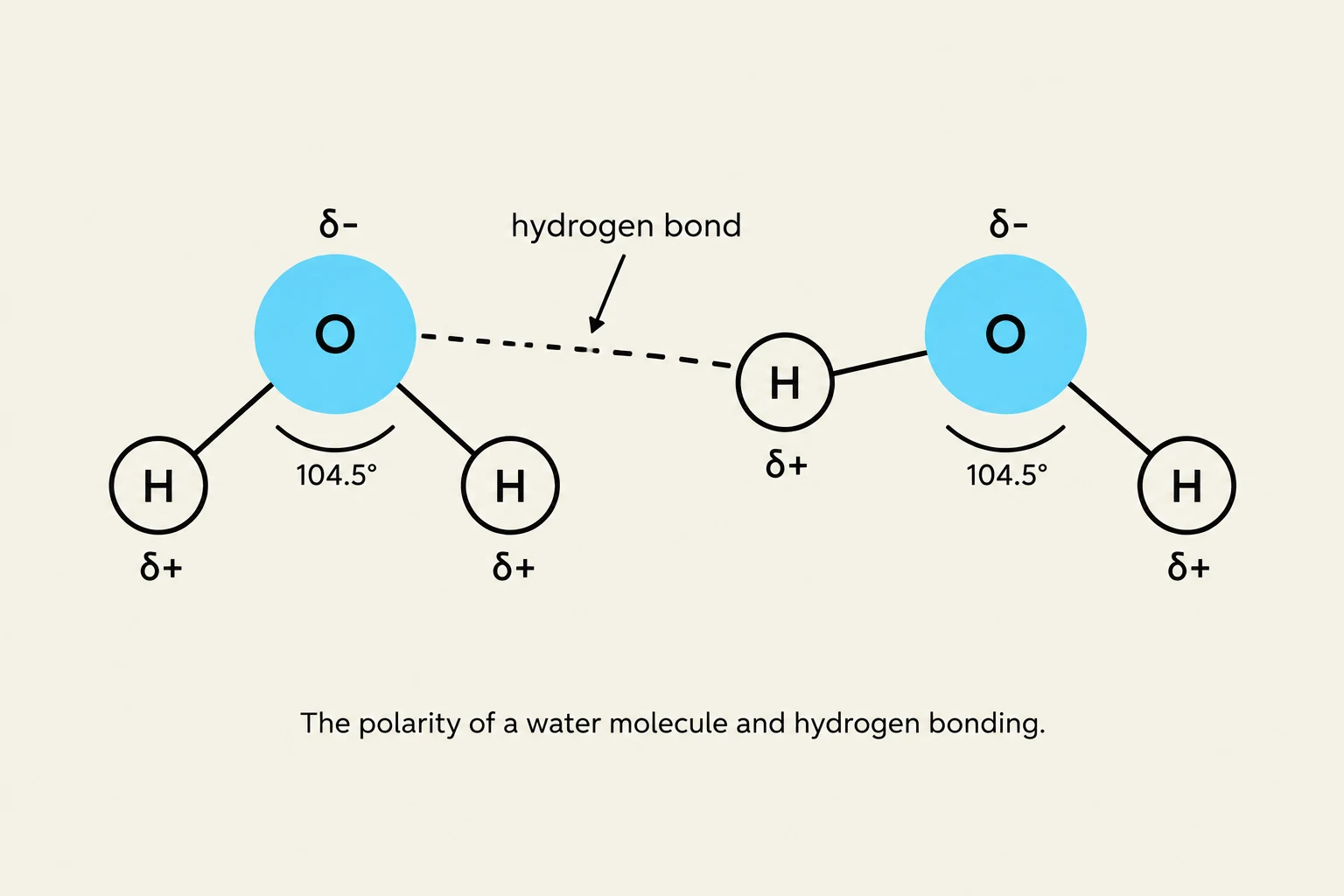
The polarity of a water molecule and hydrogen bonding.
The foundation of water's unique behavior lies in its polarity. A water molecule (H2O) is formed by polar covalent bonds between an oxygen atom and two hydrogen atoms. Because the oxygen nucleus has a higher number of protons than the hydrogen nuclei, it exerts a stronger attraction on the shared electrons. This unequal sharing of electrons results in a partial negative charge (δ−) at the oxygen pole and a partial positive charge (δ+) at the hydrogen poles.
Because the molecule is bent, these charges are separated, creating a dipole. This polarity allows for the formation of hydrogen bonds. A hydrogen bond is a weak electrostatic attraction that occurs when the partially positive hydrogen atom of one polar molecule is attracted to an electronegative atom (such as oxygen or nitrogen) of another polar molecule. While an individual hydrogen bond is weak, the sheer number of them in a liquid volume of water creates significant collective strength.
Exam Tip: Remember that while covalent bonds hold the atoms within a single water molecule together, hydrogen bonds are the intermolecular forces that hold separate water molecules to one another.
Key Physical Properties: Cohesion and Adhesion
The prevalence of hydrogen bonding leads to several critical physical properties that allow organisms to transport nutrients and maintain stability.
Cohesion and Surface Tension
Cohesion refers to the binding together of identical molecules—in this case, water molecules sticking to other water molecules due to hydrogen bonding. This cohesive force is responsible for surface tension, a property that allows the surface of water to resist external force, such as supporting a paperclip or allowing water to form a dome-like shape on a penny.
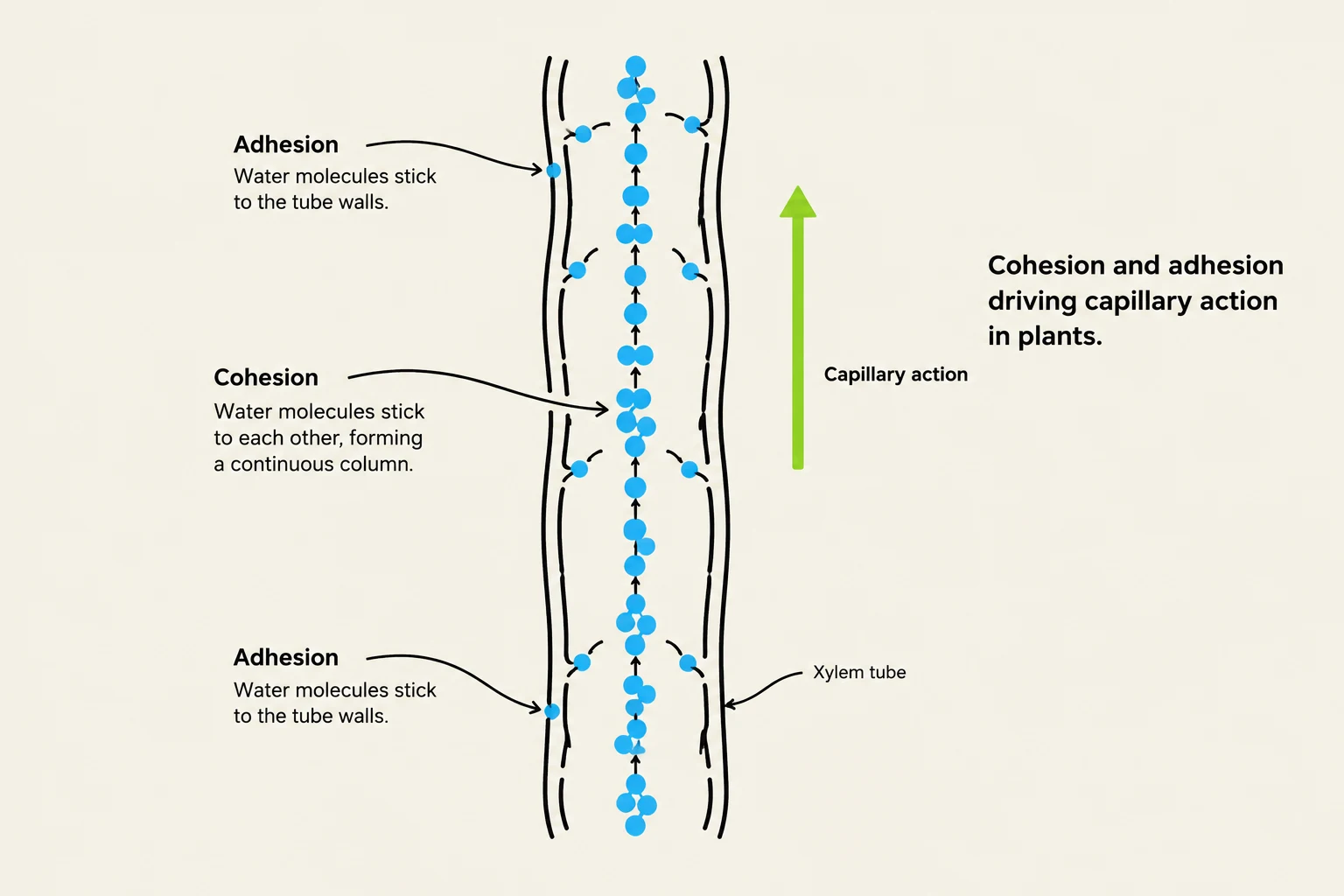
In biological systems, cohesion is vital for the transport of water in plants. As water evaporates from leaves, it creates a low-pressure "pull" that draws water upward from the roots through the xylem. This process can only function effectively if the water molecules remain connected in a continuous column through cohesion.
Adhesion and Capillary Action
This diagram illustrates the principles of cohesion and adhesion in plants, explaining how these forces drive capillary action within xylem tubes.Adhesion is the binding of water molecules to different types of polar or charged molecules. For example, water molecules adhere to the cellulose in plant cell walls. This helps maintain moist air spaces within plant tissues, which is essential for CO2 diffusion during photosynthesis.
When cohesion and adhesion work together, they facilitate capillary action. This is the ability of water to rise in narrow tubes or through porous materials (like a paper towel or plant stem) by sticking to the surfaces and pulling other molecules up behind it.
Solvent Properties and Metabolism
This diagram illustrates how water molecules, acting as a solvent, surround and separate sodium (Na+) and chloride (Cl-) ions from a sodium chloride crystal, a process known as dissolution.
One of the most critical roles of water is its function as a universal solvent for charged and polar substances. Because of its polarity, the partially positive hydrogen poles of water attract anions (negative ions), while the partially negative oxygen pole attracts cations (positive ions). This interaction effectively surrounds and dissolves the ions, preventing them from clumping together.
This solvent capability is the cornerstone of metabolism. Metabolism consists of the sum of all chemical reactions in a cell, including anabolic (building) and catabolic (breaking down) reactions. For these reactions to occur, the reactants, products, and enzymes must be dissolved and mobile within the cytoplasm. Water acts as the medium that allows these molecules to move randomly and collide with one another, facilitating the necessary chemical interactions.
Summary of Water's Role in Life
Property
Mechanism
Biological Significance
Cohesion
H-bonding between water molecules
Water transport in plants (xylem)
Adhesion
H-bonding between water and polar surfaces
Maintaining moisture for CO2 diffusion
Solvent
Polarity attracting ions/polar molecules
Medium for metabolic reactions
Surface Tension
Cohesive forces at the surface
Creating habitats at the water's surface
Together, these properties enable water to function as a transport medium in both plants and animals and as the foundational environment for all biological processes.
Keep reading for free.
Create an account to finish this reading and make it part of your study routine.