


Vitamins are essential micronutrients that play a critical role in maintaining the body's metabolic processes, supporting growth, and ensuring cellular health. Unlike macronutrients (carbohydrates, proteins, and fats), vitamins do not provide energy directly; instead, they act as catalysts or cofactors that allow the body to extract energy from food and build necessary biological structures.
Because most vitamins cannot be manufactured by the human body, they must be obtained through dietary intake. However, there is one notable exception: Vitamin D, which the body can produce when the skin is exposed to sunlight.
The Two Primary Classifications
Vitamins are categorized into two distinct groups based on their solubility: water-soluble and fat-soluble. This distinction is vital because it dictates how the body absorbs, uses, and stores these nutrients.
Water-Soluble Vitamins
Water-soluble vitamins dissolve in water and are generally not stored in large amounts in the body. Because they are not stored, they must be consumed regularly through the diet. This group includes Vitamin C and the B-complex vitamins.
Fat-Soluble Vitamins
Fat-soluble vitamins dissolve in organic solvents and are stored in the body's fatty tissues and the liver. Because they can be stored, there is a lower risk of immediate deficiency from a single missed meal, but also a higher risk of toxicity if consumed in excessive amounts. This group includes Vitamins A, D, E, and K.
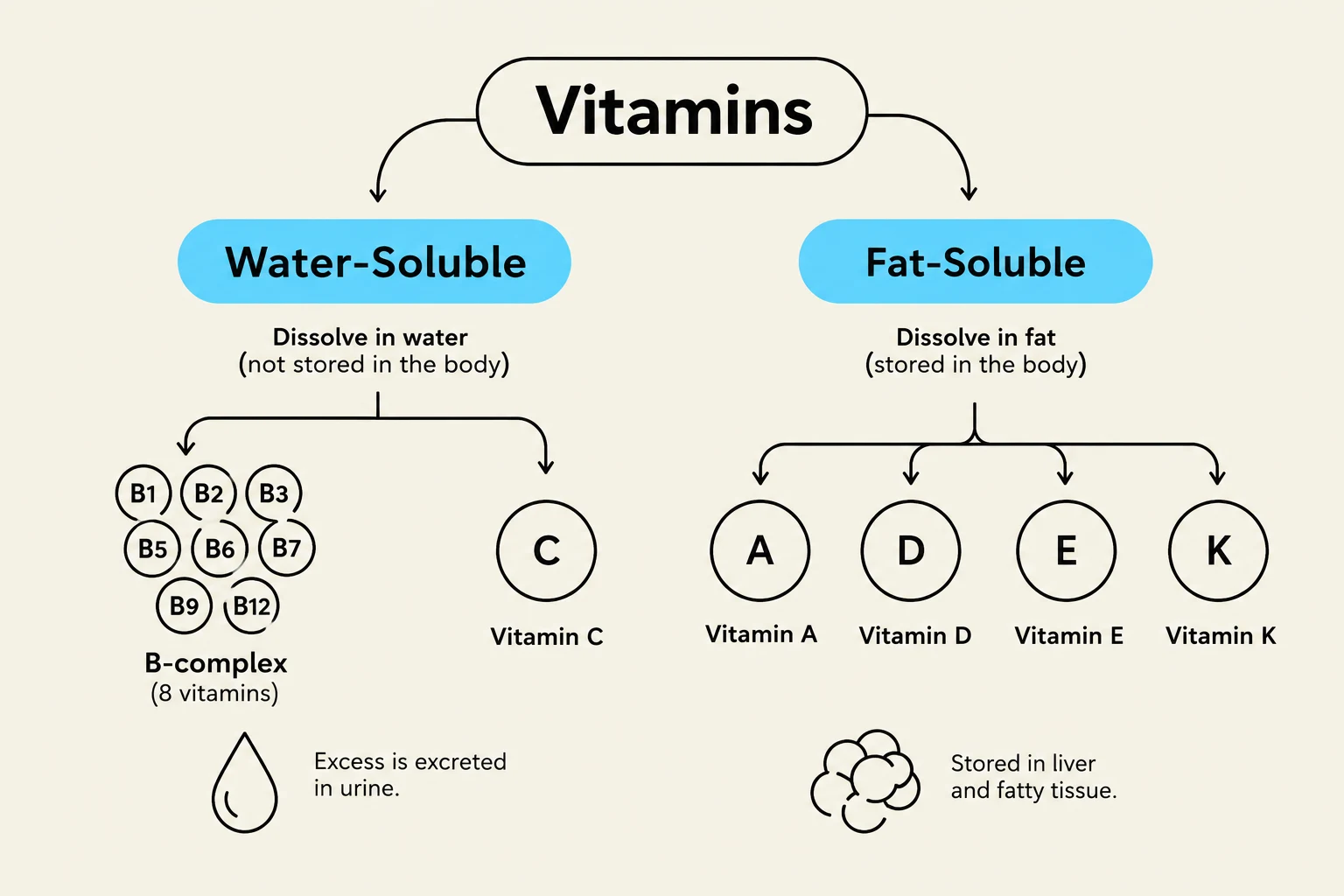
Exam Tip: Remember that "Water-soluble" means they are harder to store and easier to lose, whereas "Fat-soluble" means they are stored in the body's fat reserves.
Keep reading for free.
Create an account to finish this reading and make it part of your study routine.
Continue reading freeAlready have an account? Log in
Updated