Explore the universal five-step viral replication cycle, contrasting the virulent lytic pathway with the temperate lysogenic pathway, and comparing mechanisms in prokaryotes and eukaryotes.
Viruses are obligate intracellular parasites, meaning they lack the metabolic machinery to reproduce independently and must hijack a living host cell to multiply. While all viruses share certain fundamental tenets—such as the need for a capsid and a nucleic acid genome—the way they interact with their hosts varies dramatically. Depending on whether the virus is "virulent" or "temperate," it may choose to immediately destroy its host or enter a long-term, stable relationship where its genetic material becomes a permanent part of the host's own genome.
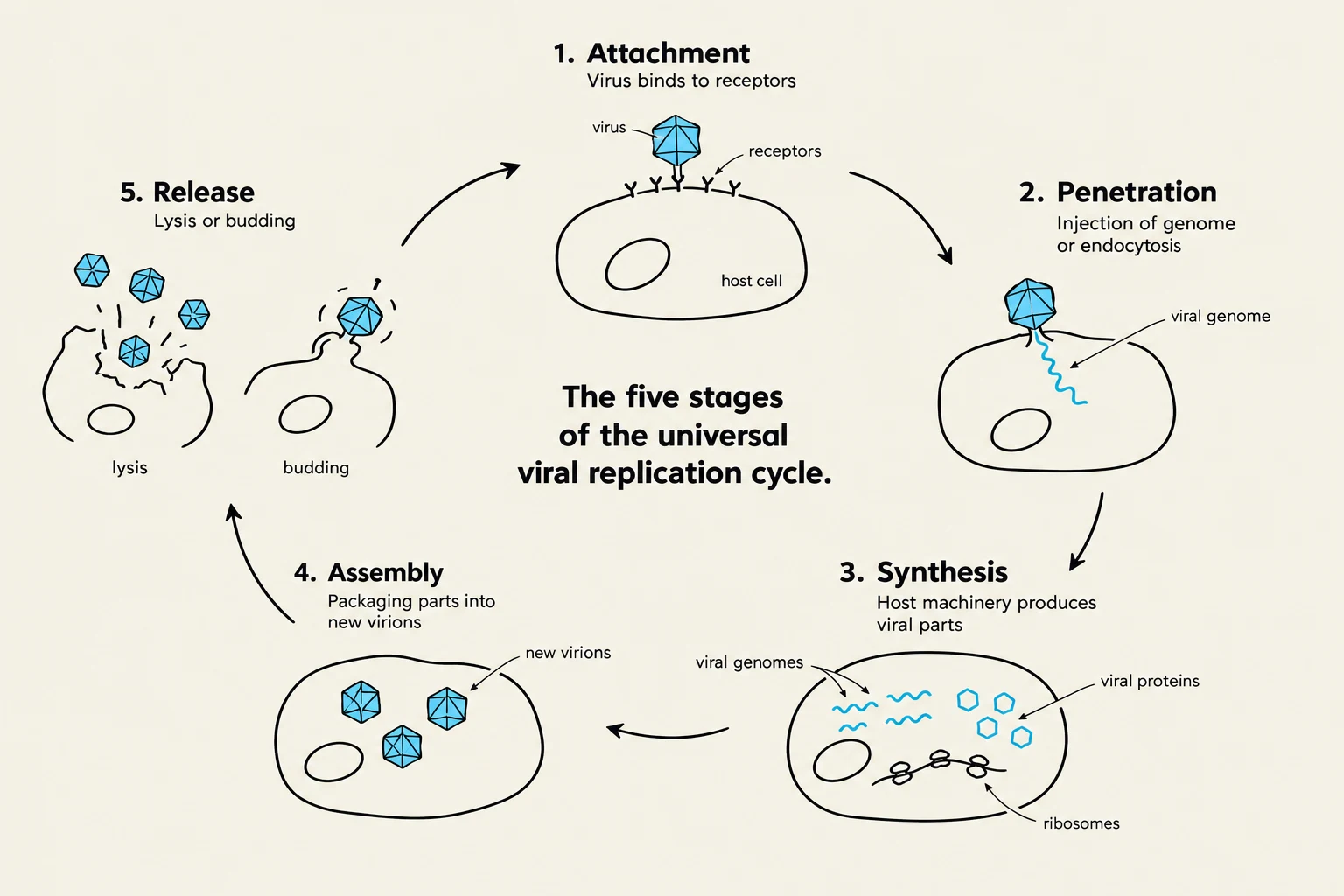
The five stages of the universal viral replication cycle: attachment, penetration, synthesis, assembly, and release.
The Universal Five-Step Replication Cycle
Regardless of the host type, most viral replication follows a general five-step progression within a permissive host:
Attachment (Adsorption): The virus binds to specific host receptors (proteins, carbohydrates, or lipids) using surface structures like glycoproteins or tail fibers. This "lock and key" mechanism is the primary factor in host specificity.
Penetration (Entry): This step differs significantly between prokaryotes and eukaryotes. In prokaryotes, viruses typically undergo nucleic acid entry, where the genome is injected into the cell. In eukaryotes, the entire virion (the complete virus particle) often enters the cell via endocytosis or membrane fusion.
Synthesis: The virus redirects host metabolism to replicate its genome and translate viral proteins using the host's ribosomes, enzymes, and energy (ATP).
Assembly: Newly synthesized viral components (capsomeres and nucleic acids) are packaged together to form new virions.
Release: The new virions exit the cell. This can occur through lysis (bursting the cell), budding (taking a piece of the host membrane to form an envelope), or exocytosis.
Exam Tip: The One-Step Growth Curve
When studying viral populations, remember the "one-step growth curve." The eclipse phase is when the genome is being replicated and proteins translated, but no infectious virions are visible. The maturation phase follows, where genomes are packaged into capsids. The sum of these two is the latent period. The total number of virions released upon lysis is called the burst size.
The Lytic Cycle: Virulent Infection
Diagram illustrating the process of a T4 bacteriophage injecting its viral DNA into a host bacterium through the cell membrane.
Virulent phages, such as the model Bacteriophage T4, follow the lytic cycle. In this pathway, the virus immediately takes over the cell, replicates rapidly, and kills the host through lysis.
Using T4 as an example, the process is highly mechanical. After the tail fibers bind to the host's LPS (lipopolysaccharide) receptors, the tail pins contact the cell wall. The enzyme T4 lysozyme creates a pore in the peptidoglycan layer, allowing the tail sheath to contract and "inject" the DNA into the cytoplasm like a syringe.
The T4 genome produces three distinct sets of proteins:
Early proteins: Enzymes for DNA replication and proteins that modify host enzymes.
Middle and Late proteins: Structural components like the head (capsid) and tail proteins.
To package the DNA, the virus uses an ATP-dependent packaging motor to pump the genome into empty proheads. Once assembly is complete, the cell is lysed, releasing upwards of 100 new virions.
The Lysogenic Pathway: Integration and Latency
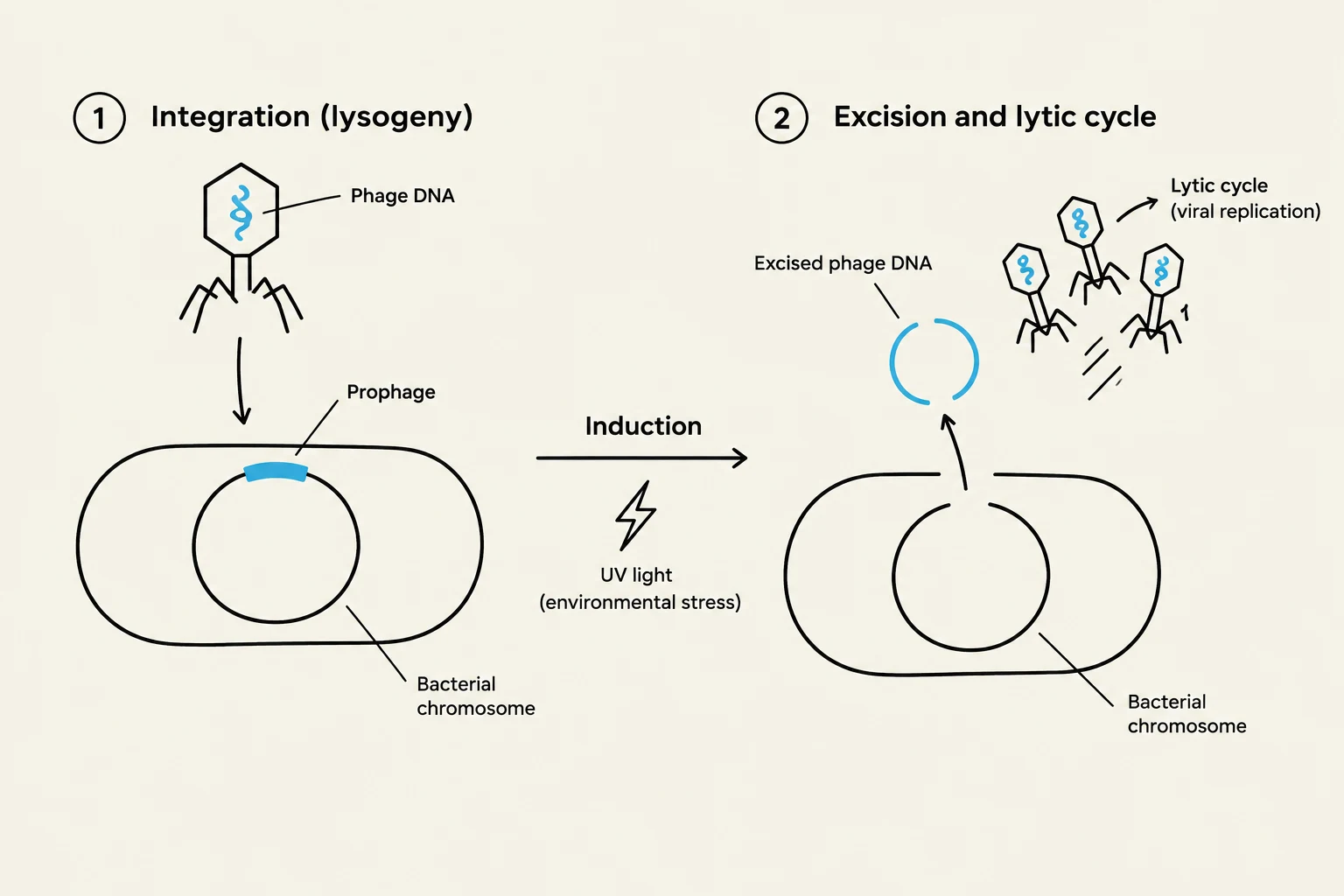
This diagram illustrates the lysogenic cycle of a bacteriophage, where its DNA integrates into the bacterial chromosome as a prophage. Under conditions like UV light, the prophage can be induced to excise and enter the lytic cycle, leading to viral replication and the production of new phages.Temperate phages (such as Lambda or P1) are capable of a different strategy known as lysogeny. Instead of killing the host immediately, the viral genome integrates into the bacterial chromosome. Once integrated, the viral DNA is referred to as a prophage.
The host cell, now called a lysogen, continues to live and divide via binary fission, passing the prophage on to all its offspring. This state is maintained by a phage-encoded repressor protein that prevents the virus from entering the lytic cycle.
Lysogenic Conversion
During lysogeny, the bacterium may undergo lysogenic conversion. This occurs when the integrated viral genes express new phenotypes or traits in the host bacterium, such as increased virulence in certain pathogens.
Induction
The transition from the lysogenic cycle back to the lytic cycle is called induction. When the host cell experiences environmental stressors—such as DNA damage—the prophage is enzymatically excised from the bacterial chromosome and begins the lytic process of synthesis, assembly, and release.
Comparison: Prokaryotes vs. Eukaryotes
While the concepts of integration and latency are similar, the terminology and mechanisms differ between bacteria and animal cells:
Feature
Prokaryotic Virus (Bacteriophage)
Eukaryotic Virus (Animal Virus)
Integrated State
Prophage
Provirus
Latent State
Lysogeny
Latency
Entry Mechanism
Direct penetration (injection)
Endocytosis or Membrane Fusion
Exit Mechanism
Primarily Lysis
Lysis, Budding, or Exocytosis
In animal cells, a provirus can lead to several outcomes. It might result in a latent infection, where the virus remains dormant and the host is unharmed until triggered. It can also lead to persistent infections, where enveloped viruses "bud" out of the cell slowly, allowing the host to remain alive and continue producing virus for a long time. Finally, viruses can cause transformation, where the insertion of viral DNA into the host genome turns a normal cell into a tumor cell (cancer).
Summary Table: Infection Outcomes in Animal Cells
Virulent: Rapid lysis and cell death.
Latent: Integrated provirus; no virions produced until triggered.
Persistent: Slow release via budding; cell stays alive.
Transformation: Genetic alteration leading to tumor formation.
Keep reading for free.
Create an account to finish this reading and make it part of your study routine.