


Viruses are unique biological entities that exist as an extracellular virion—a complete, infectious viral particle—but must hijack a living host cell to replicate. Because they lack their own metabolic machinery, they rely entirely on the host's enzymes, nucleotides, and ATP to produce new components. Understanding how viruses transition from a single particle to a massive burst of new progeny requires a grasp of specific biological stages and the diverse strategies dictated by the virus's genetic material.
The Five Stages of Viral Replication
Regardless of whether a virus infects a bacterium (a bacteriophage) or an animal cell, the replication process generally follows five fundamental steps:
- Attachment (Adsorption): The virus must first bind to the host. This is a highly specific interaction where viral proteins (often on the capsid or an envelope) act like a "key" to fit into specific protein or glycoprotein "locks" (receptors) on the host cell surface. This specificity is why certain viruses only infect specific tissues or species.
- Penetration (Entry): The virus must enter the cell. In bacteriophages like T4, the virus uses enzymes such as lysozyme to create a hole in the bacterial peptidoglycan cell wall, allowing the viral genome to be injected into the cytoplasm while the protein capsid remains outside. In animal cells, entry can occur via direct penetration, endocytosis, or membrane fusion for enveloped viruses.
- Synthesis: Once the genome is released (a process sometimes called uncoating), the virus begins producing its parts. This involves two distinct types of protein production:
- Early proteins: Often enzymes that modify the host machinery or shut down host transcription/translation.
- Middle and Late proteins: Structural components like capsomeres (protein disks that form the capsid), heads, and tails.
- Assembly (Maturation): The newly synthesized nucleic acids and proteins are packaged together. This is often described as an assembly line where parts are chemically attracted to one another to form new virions.
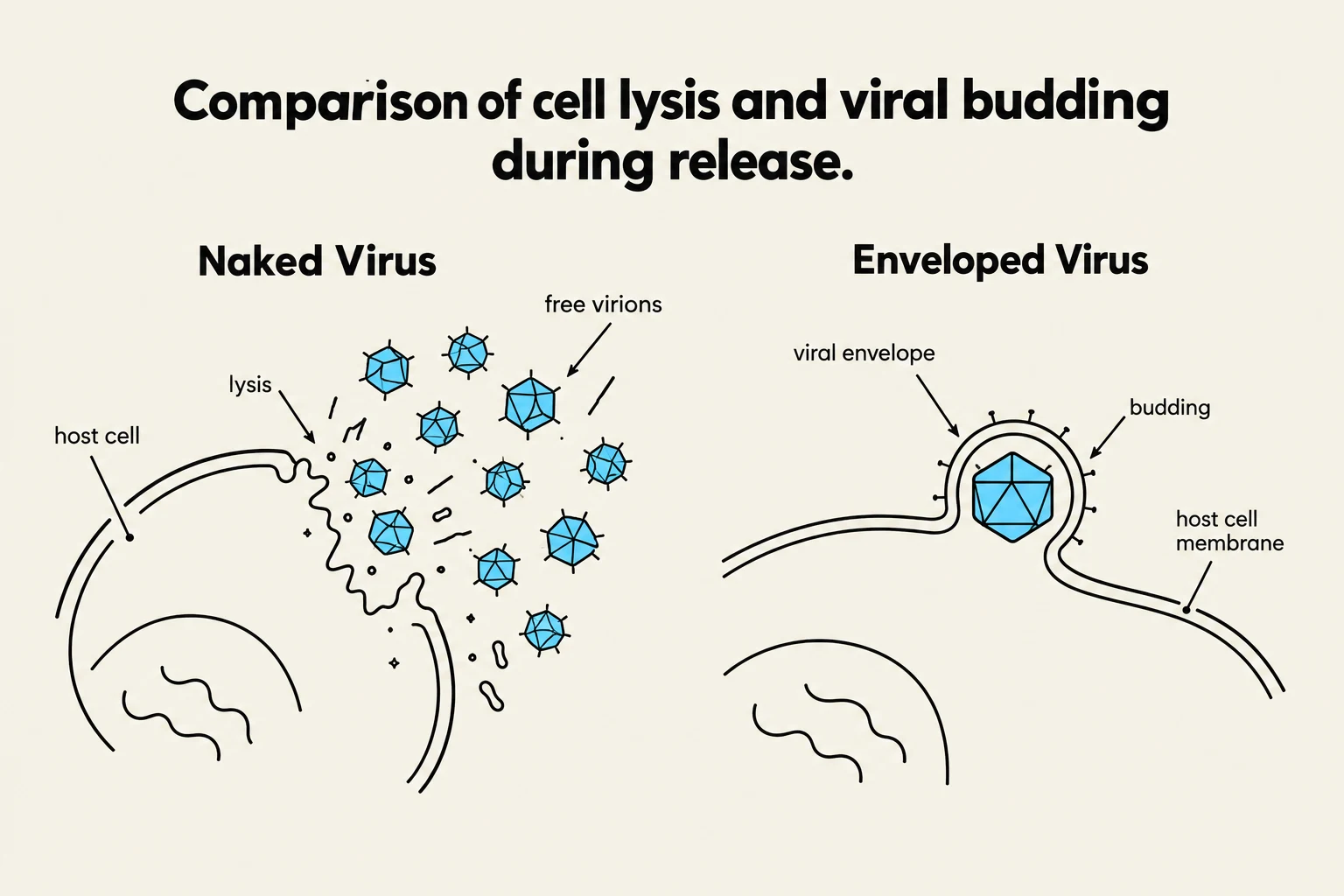
- Release: The final stage where new viruses exit the host. Naked viruses typically exit via cell lysis, which ruptures and kills the host cell. Enveloped viruses often exit through budding, a slower process where they wrap themselves in a piece of the host's membrane.

Keep reading for free.
Create an account to finish this reading and make it part of your study routine.
Continue reading freeAlready have an account? Log in
Updated