Viral Evolution and HIV: Natural Selection in Action
Explore the rapid evolution of viruses like HIV, focusing on how mutations, reverse transcriptase, and natural selection drive drug resistance and impact human health. Understand the challenges in developing vaccines.
When we think of evolution, we often imagine slow changes occurring over millions of years in animals or plants. However, some of the most rapid and impactful evolutionary processes on Earth are happening inside the human body right now. Viruses, particularly the Human Immunodeficiency Virus (HIV), serve as a "badass" case study of how quickly evolution can occur and how human intervention—such as medical treatment—can fundamentally alter the course of a pathogen's development.
The Origins of HIV: A Zoonotic Spillover
To understand why HIV affects human health today, we must first look at its history. HIV is a zoonotic disease, meaning it "spilled over" from another species into humans. Specifically, HIV is genetically similar to Simian Immunodeficiency Viruses (SIV) found in non-human primates like chimpanzees and sooty mangabees.
While SIVs have circulated in primate populations for thousands of years without making them significantly ill, the jump to humans changed everything. Phylogenetic trees—tools used to compare genetic sequences—suggest that these spillover events likely occurred in the early 20th century, around 1910 to 1920. Because the physiology of primates is relatively close to our own, viruses that can survive in a chimpanzee have a high probability of successfully infecting and replicating within a human host.
This phylogenetic tree illustrates the evolutionary relationships between SIV strains found in non-human primates and HIV in humans, indicating that HIV strains are most closely related to chimpanzee SIV.
The Mechanics of Viral Replication and Mutation
HIV is a unique type of virus known as a retrovirus. Most cellular life follows a "central dogma" where DNA is transcribed into RNA, which is then translated into proteins. HIV flips this process on its head. It carries its genome as RNA, but to replicate within a human host, it must convert that RNA into DNA so it can integrate into the host's own chromosomes.
To achieve this, HIV uses a specialized enzyme called reverse transcriptase. This enzyme is the Achilles' heel of the virus, but it is also the source of its greatest strength: a massive mutation rate. Unlike human cells, which have sophisticated proofreading enzymes to correct errors during DNA synthesis, HIV's reverse transcriptase is incredibly "sloppy". It makes frequent mistakes, leading to a high rate of mutations.
Exam Tip: When considering what drives the speed of evolution in a population, remember that three factors are critical:
Generation Time: Faster replication means more opportunities for errors.
Population Size: More individual virions mean more chances for a specific mutation to arise.
Proofreading Ability: The lack of error-correction enzymes significantly increases the mutation rate.
Natural Selection and Drug Resistance
The interplay between mutations and natural selection explains why treating HIV is so challenging. It is a common misconception that a drug like AZT causes the virus to mutate. In reality, mutations are random, "dumb" errors that happen constantly in the background.
The environment—in this case, the presence of an antiviral drug—does not determine which mutations occur, but it determines the fate of those mutations.
The AZT Example
AZT (azidothymidine) was one of the first anti-HIV drugs. It is a "nucleoside analog," meaning it mimics the natural building blocks of DNA (like thymidine). When the viral enzyme reverse transcriptase tries to build a DNA strand, it accidentally grabs the AZT molecule instead of a real thymidine. Because AZT is shaped slightly differently, it acts as a "stop sign," preventing the enzyme from adding any more pieces and halting viral replication.
However, because mutations are always happening, a few individual virions might randomly develop a mutation that slightly changes the shape of the reverse transcriptase enzyme. If this change prevents the enzyme from "grabbing" the AZT but still allows it to grab real thymidine, that specific virus is now resistant.
This diagram illustrates the process of natural selection in a viral population. It shows how mutations can lead to resistance, and how selective pressures, such as drugs or the immune system, favor the survival and proliferation of resistant viruses, causing the viral population to shift over time.
In this new "selective environment," the susceptible viruses cannot reproduce, while the resistant ones thrive. This is evolution by natural selection:
Variation: Mutations create different versions of the virus (susceptible vs. resistant).
Selection: The drug (environment) eliminates the susceptible versions.
Inheritance: The resistant survivors pass their genetic traits to the next generation.
Implications for Human Health and Prevalence
The rapid evolution of HIV has profound implications for human health and the prevalence of the disease. While medical advances, social activism, and improved public health have made HIV much less of a "death sentence" than it was in the 1980s, it remains a major global health concern. In some regions, such as sub-Saharan Africa, the prevalence remains extremely high due to the historical "ground zero" of the initial spillover.
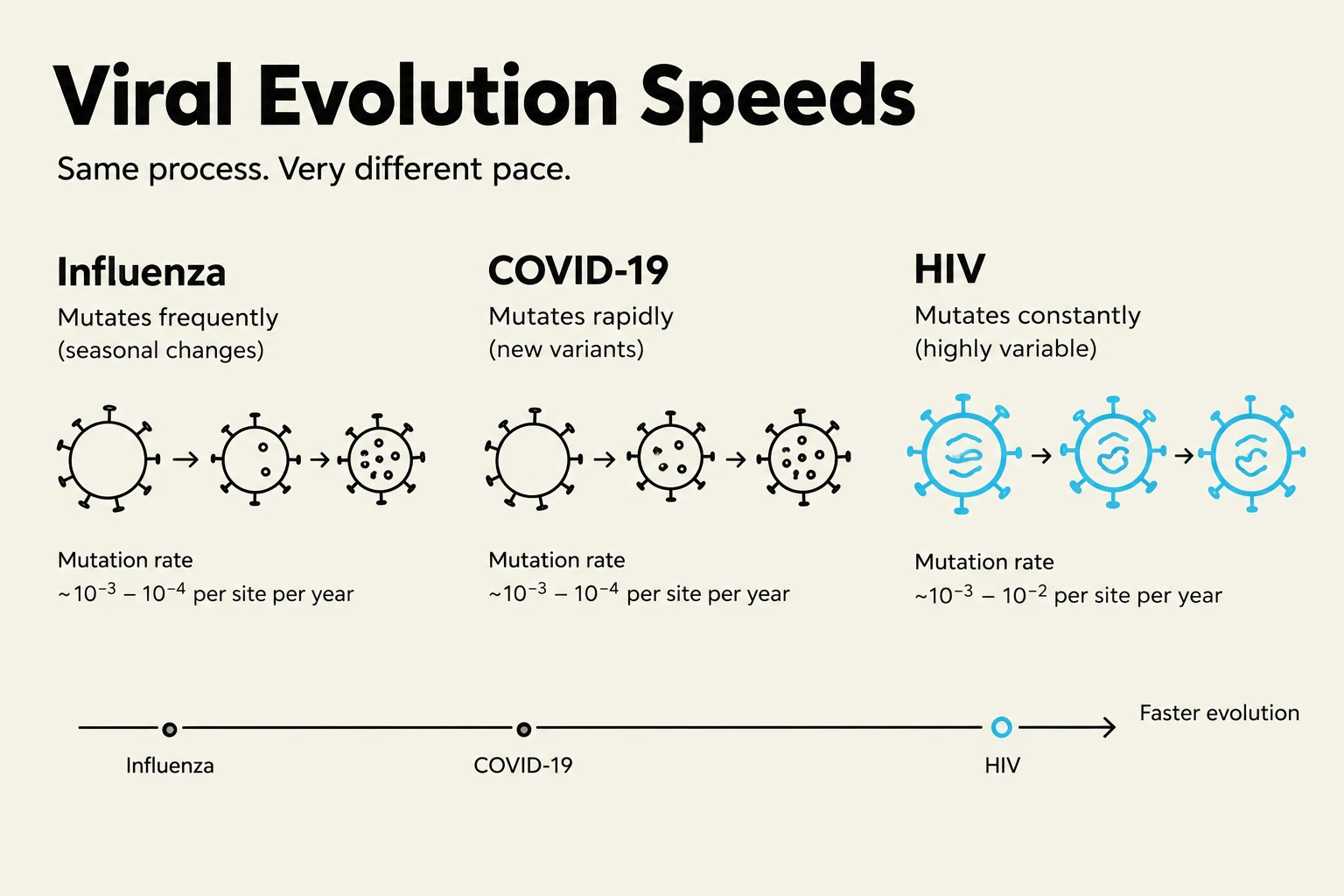
One of the greatest hurdles in modern medicine is the lack of an HIV vaccine. Because the virus evolves so much faster than the flu or COVID-19, the proteins on the outside of the virus (the coat proteins) are constantly changing shape. A vaccine that teaches the immune system to recognize one version of the virus might be rendered useless within weeks as the virus mutates into a new form.
This graphic illustrates the varying speeds of viral evolution for Influenza, COVID-19, and HIV, showing their mutation rates and how they change over time.
Understanding the relationship between the molecular "mistakes" of a virus and the selective pressures we apply through medicine is essential for the next generation of healthcare and evolutionary biology.
Keep reading for free.
Create an account to finish this reading and make it part of your study routine.