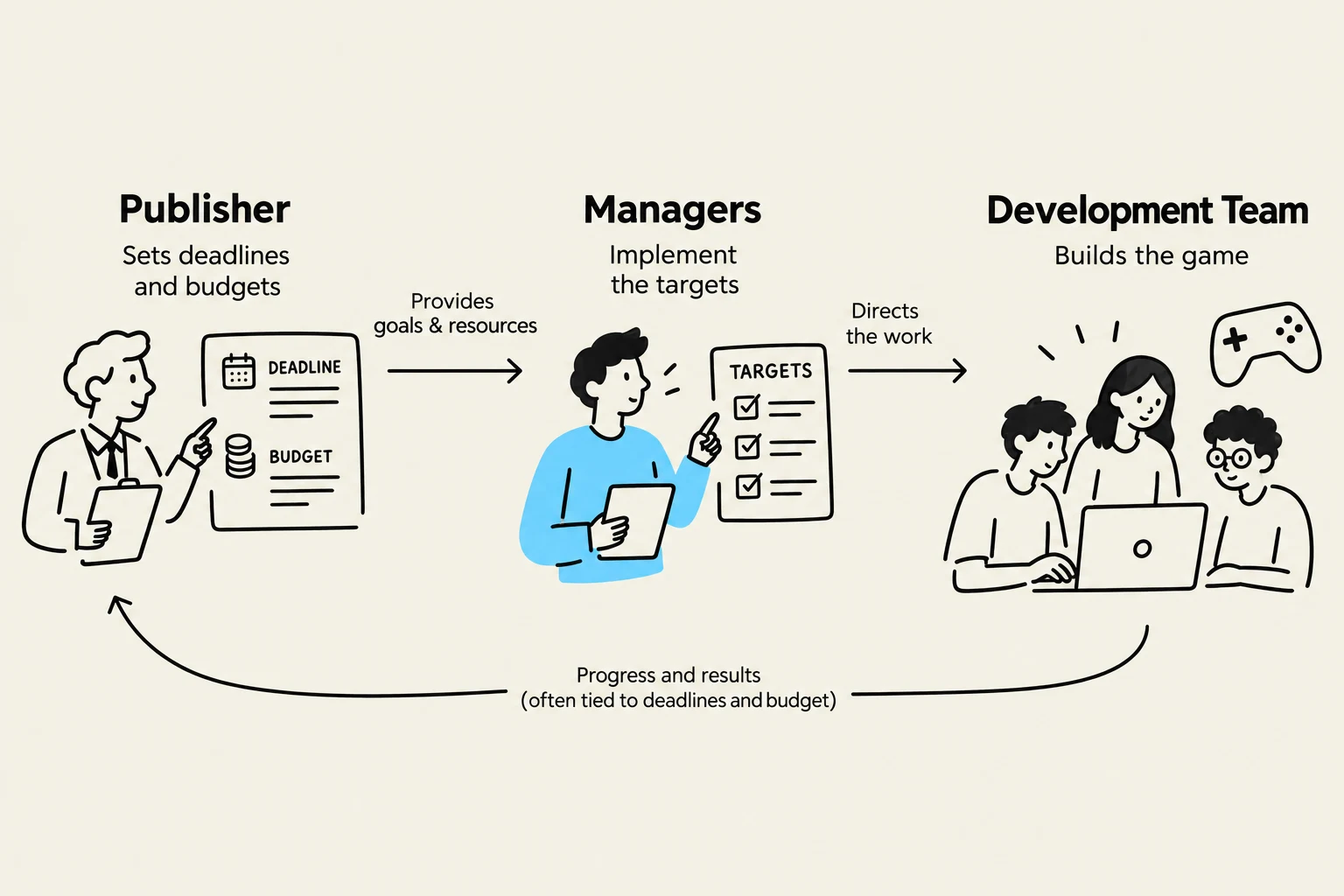
Crunch typically occurs near major milestones or final release deadlines. It is often justified through two cultural lenses:
- The "War Story" Culture: Long-term industry veterans often share stories of extreme hardship as a badge of honor. This turns professional struggle into a form of "portfolio building," where surviving intense production cycles is seen as proof of dedication.
- Passion Exploitation: Because developers are often emotionally invested in their work, management can leverage this passion to justify poor working conditions, suggesting that the gratification of making a great game outweighs the need for fair compensation or rest.
Exam Tip: When analyzing crunch, distinguish between individual causes (like poor personal time management) and systemic causes (like publishers setting unrealistic deadlines or studios building "crunch periods" into their official production schedules).
Hierarchy of Roles: Above vs. Below the Line
The industry operates with a distinct structural hierarchy that separates roles by prestige, pay, and stability. This is often categorized as "above the line" and "below the line" work.
Above the Line
These are high-prestige, creative leadership roles. They include:
- Directors and Designers: The creative architects of the experience.
- Lead Programmers and Engineers: The technical leads responsible for core systems.
These roles generally offer better career mobility, higher compensation, and more public credit.
Below the Line
These roles are essential to production but are often more precarious and less visible. They include:
- Quality Assurance (QA) and Testing: Ensuring the game is functional and free of bugs.
- Asset Production: Creating the thousands of "less interesting" objects (trees, boots, furniture) required to populate a world.
- Live Operations Support: Maintaining the technical health of a game after launch.
This disparity has significant demographic consequences. The demanding nature of crunch and the lower pay of "below the line" roles can push women and marginalized groups out of the industry earlier in their careers, contributing to a persistent male-dominated workforce.
The Evolution of Work: GaaS and Precarity
The rise of the Games as a Service (GaaS) model was originally intended to solve the "crunch" problem by replacing massive, singular release cycles with steady, indefinite content updates. The theory was that a continuous release schedule would provide more stable employment and relaxed production timelines.
However, the reality has proven more complex. GaaS has introduced "unrelenting" work pressures, including:
- Technical Debt: The difficulty of adding new features to a complex, aging codebase without breaking existing systems.
- Live Ops Pressure: The need for 24/7 maintenance and immediate bug fixes to prevent player loss.
This has contributed to a broader sense of industry precarity—a state where employment is unstable and workers are easily replaceable. Recent years have seen high turnover rates and frequent, systemic layoffs. For example, in 2025, approximately 57% of developers reported experiencing layoffs in their workplace.
New Frontiers: Solo Devs, AI, and Unionization
As large-scale studios struggle with stability, the industry is seeing a shift in how games are produced. There is a growing presence of solo developers and independent contractors. While solo developers offer more creative freedom, they lack the institutional support of large studios.
Simultaneously, the integration of Generative AI has introduced new layers of professional alienation. While some use it for efficiency, many developers view it as a threat to job security and the integrity of creative work.
In response to these mounting pressures, the movement toward unionization is gaining momentum.
- In the US and Canada: Unions like United// (working with the CWA) often focus on securing healthcare benefits and better compensation.
- In Europe: The focus tends to be more on regulating working hours and preventing the systemic use of crunch.
The struggle for better conditions is not just about pay; it is about reclaiming agency in an industry that is increasingly defined by high-speed digital cycles and intense economic volatility.