This document outlines the essential framework provided by USP <800> for protecting healthcare staff from hazardous drug exposure. It covers the scope of USP <800>, identification of hazardous drugs, risk assessment, facility design, engineering controls, personnel protection, and disposal/spill management.
In the modern healthcare environment, protecting staff from the invisible dangers of chemical exposure is a critical priority. USP <800> provides the essential framework for this protection, establishing rigorous practice and quality standards for the handling of Hazardous Drugs (HDs). These standards are not merely suggestions; they are comprehensive protocols designed to mitigate risk throughout the entire lifecycle of a drug—from the moment it is received at a facility to its final disposal.
Scope of USP <800>
The scope of USP <800> is broad, covering both sterile and nonsterile products, whether they are commercially available or custom-compounded. It applies to a wide array of healthcare entities, including:
Pharmacies and hospitals.
Patient treatment clinics and physician practices.
Veterinary offices and technicians.
Crucially, these standards are designed to protect all personnel who may come into contact with HDs. This includes pharmacists and pharmacy technicians, but extends to nurses, physicians, physician assistants, home healthcare workers, and even veterinarians.
Identifying Hazardous Drugs
A drug is classified as hazardous if it possesses specific toxicological properties. According to the National Institute for Occupational Safety and Health (NIOSH), a drug is considered hazardous if it is:
Carcinogenic (cancer-causing).
Teratogenic (causing birth defects).
Genotoxic (damaging genetic information).
Toxic to organs.
Toxic to reproduction.
Structurally similar to another known hazardous drug.
To ensure safety, NIOSH organizes these drugs into three distinct tables:
Table 3: Non-antineoplastic drugs that primarily have adverse reproductive effects (e.g., Clonazepam, Testosterone).
Exam Tip: Healthcare entities are required to review their specific list of identified hazardous drugs at least every 12 months to ensure compliance with updated NIOSH lists.
Risk Assessment and Communication
Effective safety management begins with a robust Risk Assessment. This involves understanding the specific hazards of the drugs being handled and implementing measures to minimize exposure.
Key Components of a Safety Program
Safety Data Sheets (SDS): These are drug-specific safety documents provided by the manufacturer that detail the chemical properties and hazards of the substance.
Hazard Communication Plan: Each facility must develop its own specific framework involving Standard Operating Procedures (SOPs) to guide staff behavior.
Personnel Awareness: Staff must be fully informed of the risks. Notably, personnel with reproductive capability must provide written confirmation that they understand the specific risks associated with handling HDs.
For lower-risk formulations, such as intact tablets or capsules, the Assessment of Risk (AoR) may allow for simplified SOPs. These might include using distinctive shelf bins, chemotherapy gloves, and dedicated counting trays/spatulas to limit exposure. However, if a lower-risk formulation is manipulated (e.g., crushed), these protections are no longer sufficient.
Facility Design and Engineering Controls
To prevent the spread of hazardous particles, USP <800> mandates specific environmental controls. The facility must be designed to manage airflow and pressure effectively.
Space and Ventilation Requirements
The requirements differ based on whether the compounding is sterile or nonsterile:
Requirement
Sterile Compounding
Nonsterile Compounding
Primary Engineering Control (C-PEC)
Class II BSC or CACI
Class I or II BSC, CACI, or CVE
Containment Segregated Environment (C-SEC)
30 Air Changes Per Hour (ACPH)
12 ACPH
Containment Sterile Area (C-SCA)
12 ACPH
N/A
Ventilation
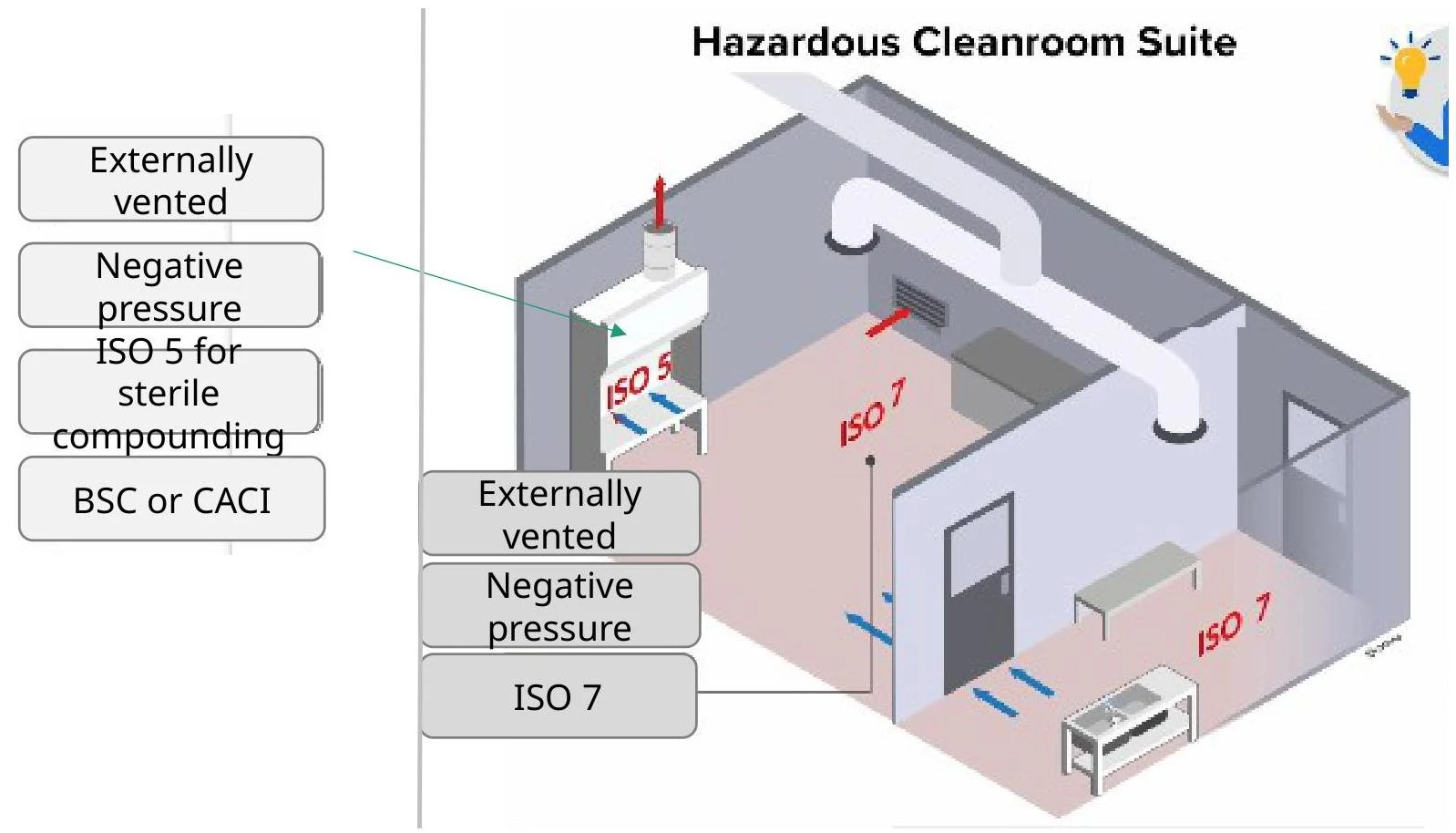
Externally vented & negative pressure
Or redundant HEPA filters
Diagram illustrating a hazardous cleanroom suite with different ISO pressure zones and ventilation.
Primary Engineering Controls (PECs)
Class II Biological Safety Cabinet (BSC): Uses HEPA-filtered air to provide product protection (downflow) and personnel protection (inflow).
Compounding Aseptic Containment Isolator (CACI): A closed system specifically for hazardous sterile compounding.
This diagram illustrates the features and functions of a biological safety cabinet, including its HEPA filtration, ISO Class 5 work chamber, glove ports, and transfer chamber, highlighting personnel, product, and environmental protection.
Containment Ventilated Enclosure (CVE): An externally vented enclosure used specifically for nonsterile hazardous drug compounding.
Personnel Protection: Garbing and Training
Even with advanced engineering controls, personal protective equipment (PPE) is the final line of defense.
Garbing for Compounding
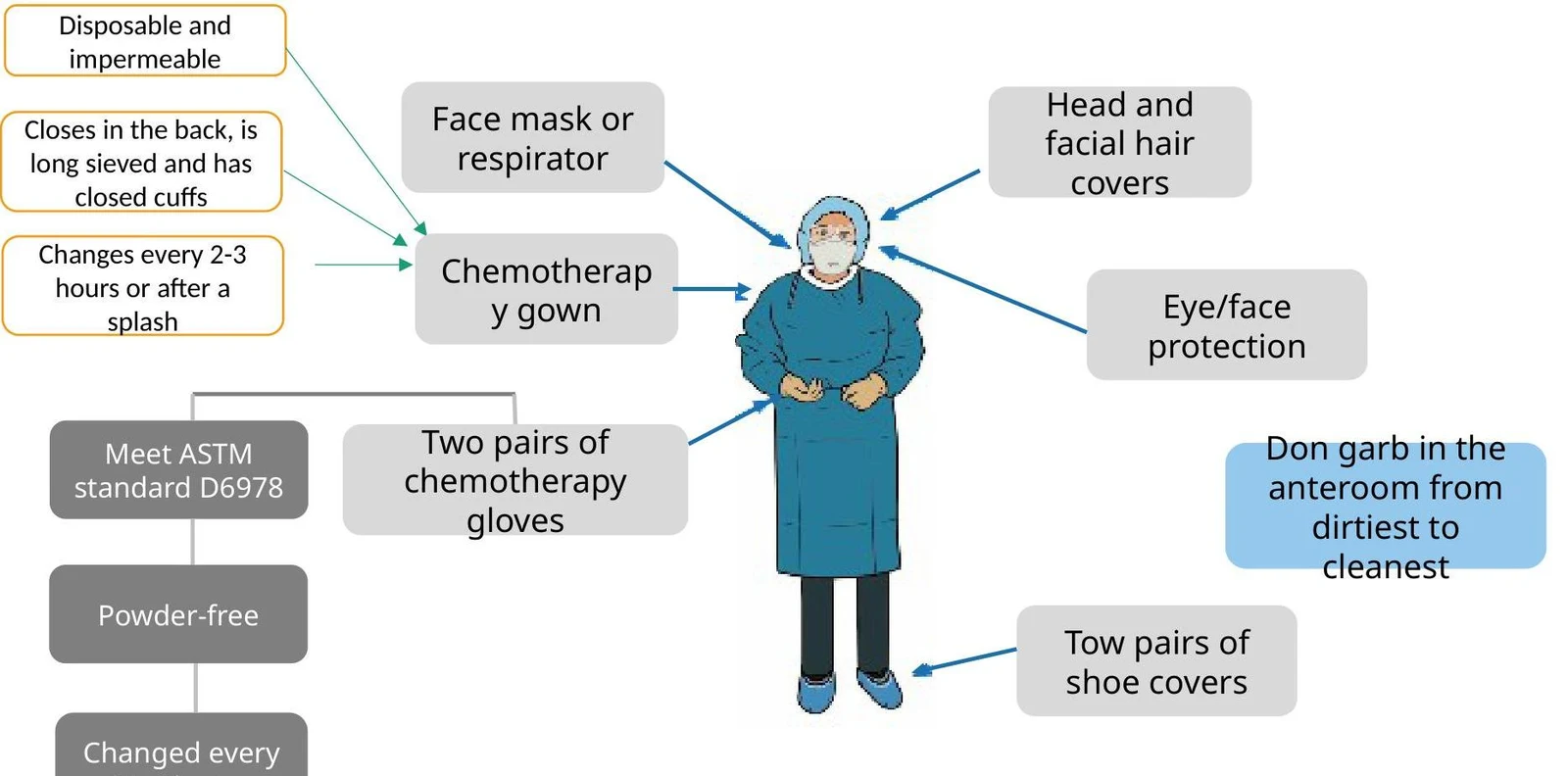
For hazardous compounding, staff must use specialized gear to prevent skin contact and inhalation:
Diagram illustrating personal protective equipment for chemotherapy.
Personnel may require:
Respirators: Such as a fit-tested N95, a respirator with gas canisters, or a Powered Air-Purifying Respirator (PAPR).
Gloves: Two pairs of gloves are required when handling injectable antineoplastics.
Gowns: Required for handling injectable HDs.
Administration and Transport
When transporting or administering drugs, specific precautions must be taken:
Transport: Drugs should be wrapped by the supplier in impervious plastic.
Labeling: Labels must clearly state "CHEMOTHERAPY DRUG" and include instructions to observe safety precautions.
Disposal and Spill Management
Improper disposal can lead to environmental contamination and exposure to cleaning staff.
Waste Segregation
Waste must be categorized correctly to ensure it is handled by the appropriate disposal stream:
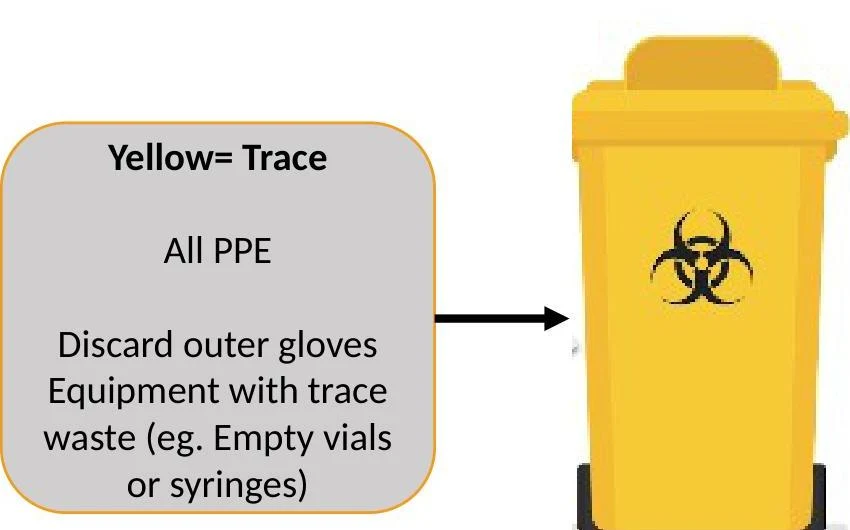
Trace Waste (Yellow Bin): Used for PPE and equipment that have come into contact with trace amounts of HDs.
This diagram illustrates the proper disposal of trace waste, including all personal protective equipment (PPE) and items like empty vials or syringes, into a yellow biohazard bin.
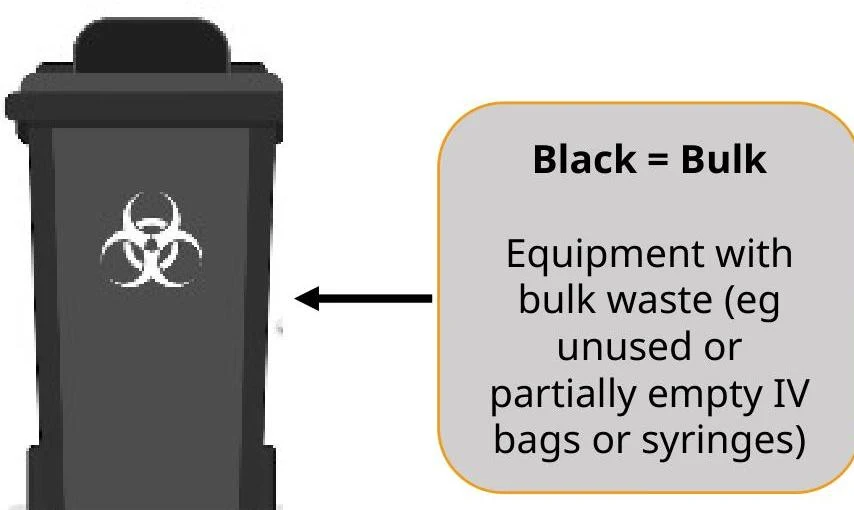
Bulk Waste (Black Bin): Used for large amounts of waste, such as unused or partially empty IV bags and syringes.
Illustration showing a black bin labeled for bulk waste, with a description of what constitutes bulk waste, such as unused or partially empty IV bags or syringes.
Non-hazardous Infectious Waste (Red Bin): Used for standard IV tubing containing blood or body fluids.
Emergency Response: Spills and Exposure
In the event of a spill, staff must follow the facility's SOP and use a dedicated spill kit. This includes donning appropriate PPE (gown, respirator, goggles, shoe covers, and two pairs of gloves), absorbing the spill with pads, and completing a formal HD spill report.
If personal exposure occurs, immediate action is required:
Remove the HD from the person immediately.
Cleanse the skin with soap and water.
Flush eyes at an eyewash station for at least 15 minutes if contact occurred.
Seek medical attention and document the exposure.
Keep reading for free.
Create an account to finish this reading and make it part of your study routine.