United States Westward Land Expansions and Manifest Destiny
An overview of the significant westward expansions of the United States in the 1800s, driven by economic interests, population growth, and the ideology of Manifest Destiny. Covers key acquisitions like the Louisiana Purchase and Mexican Cession, and the internal debates on land management.
During the 1800s, the United States underwent a series of significant westward expansions that dramatically increased the nation's territory. This era was defined by a transition from a collection of original colonies to a transcontinental power, driven by strategic economic interests, population growth, and the ideological concept of "Manifest Destiny".
Economic Drivers: Rivers and Ports
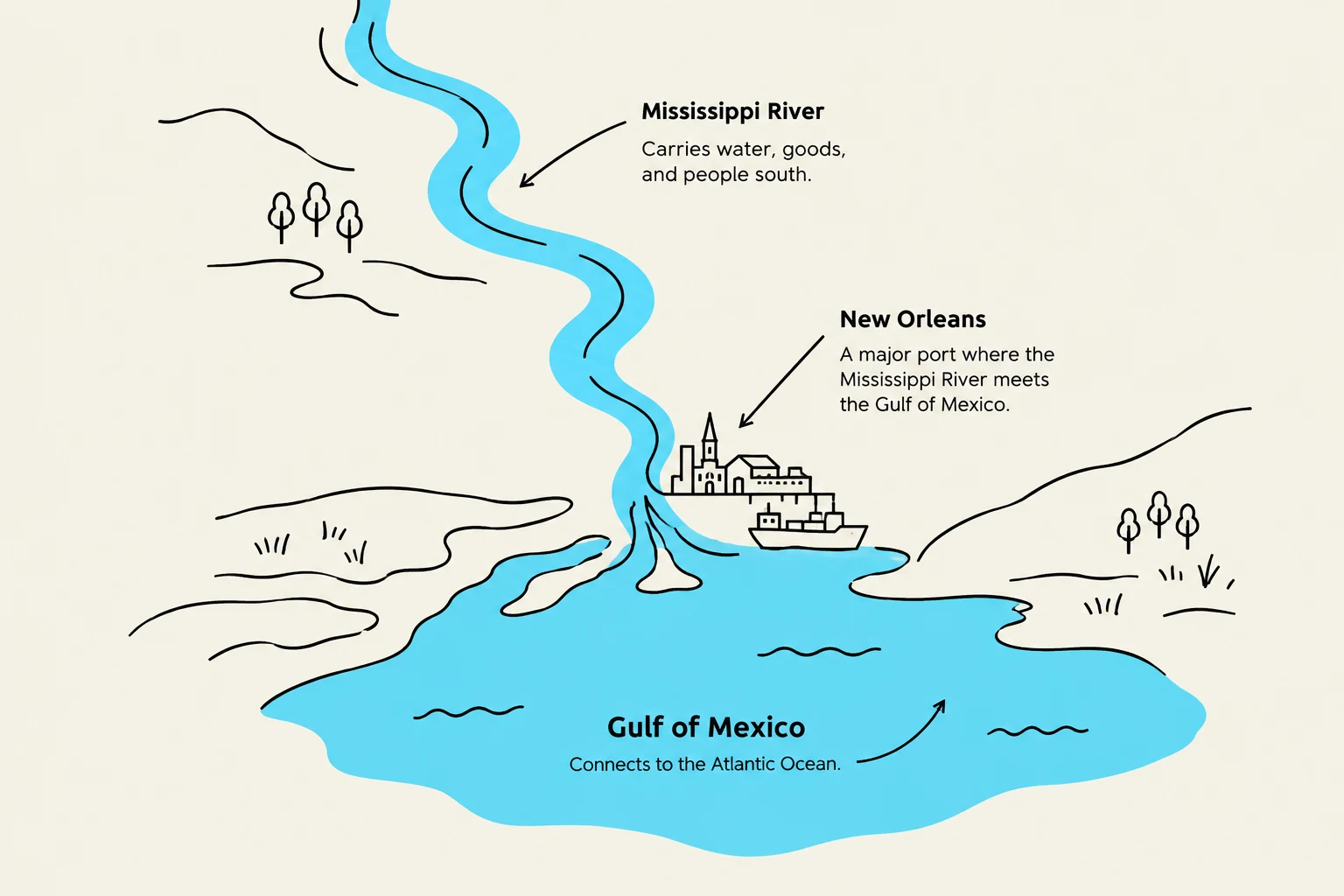
The primary motivation for early expansion was not merely the acquisition of soil, but the securing of vital trade routes. For settlers living west of the Appalachian Mountains, access to the Mississippi River was essential for transporting goods to global markets. Furthermore, control over the Gulf of Mexico was crucial, as it provided the necessary access to major ports like New Orleans. Without these waterways, the economic development of the American interior would have been severely stifled.
Map showing the Mississippi River flowing into the Gulf of Mexico near New Orleans.
The Louisiana Purchase (1803)
One of the most pivotal moments in American history was the Louisiana Purchase. Originally, President Thomas Jefferson intended only to purchase permanent transit rights to New Orleans to ensure American farmers could move their goods. However, geopolitical shifts changed the scope of the negotiation.
Napoleon Bonaparte, facing the loss of control over Haiti and needing funds to finance wars against the British, was willing to sell the entire territory. Although Monroe had been authorized to spend only $2 million, the United States ultimately purchased the vast territory for $15 million.
Exam Tip: Be prepared to explain why the price jumped from $2 million to $15 million. The key factors are Napoleon's loss of Haiti and his urgent need for war funding.
Florida and the Texas Conflict
Expansion continued through diplomacy and conflict in the early 19th century. In 1819, the United States acquired Florida through a treaty with Spain. This acquisition was a response to increasing tensions and conflicts between American settlers and the Spanish government in the region. In exchange for Florida, the U.S. agreed to renounce its own claims to Spanish territory in Texas.
The relationship with Texas remained volatile. After Mexico won independence from Spain in 1821, Texas became a frontier community often at odds with the central Mexican government. Conflicts arose particularly regarding slavery; while the Mexican government had officially abolished slavery in 1829, an exception was made for Texas, leading to political friction between Anglo-American slave owners and Mexican authorities. This tension culminated in 1836 when Texas broke away from Mexico to become the "Lone Star Republic".
Manifest Destiny and the Mexican Cession
By the 1840s, the concept of Manifest Destiny emerged—the belief that it was the divinely ordained mission of the United States to expand across the continent to spread democracy. This ideology was fueled by massive population growth, which saw the U.S. population rise from 5 million in 1800 to 23 million by 1850.
This ideology directly influenced the Texas Annexation in 1845. However, Mexico did not recognize Texas's independence, leading to the Mexican-American War. Following the war, the Mexican Cession of 1848 saw the U.S. acquire vast territories, including New Mexico and California, for $15 million.
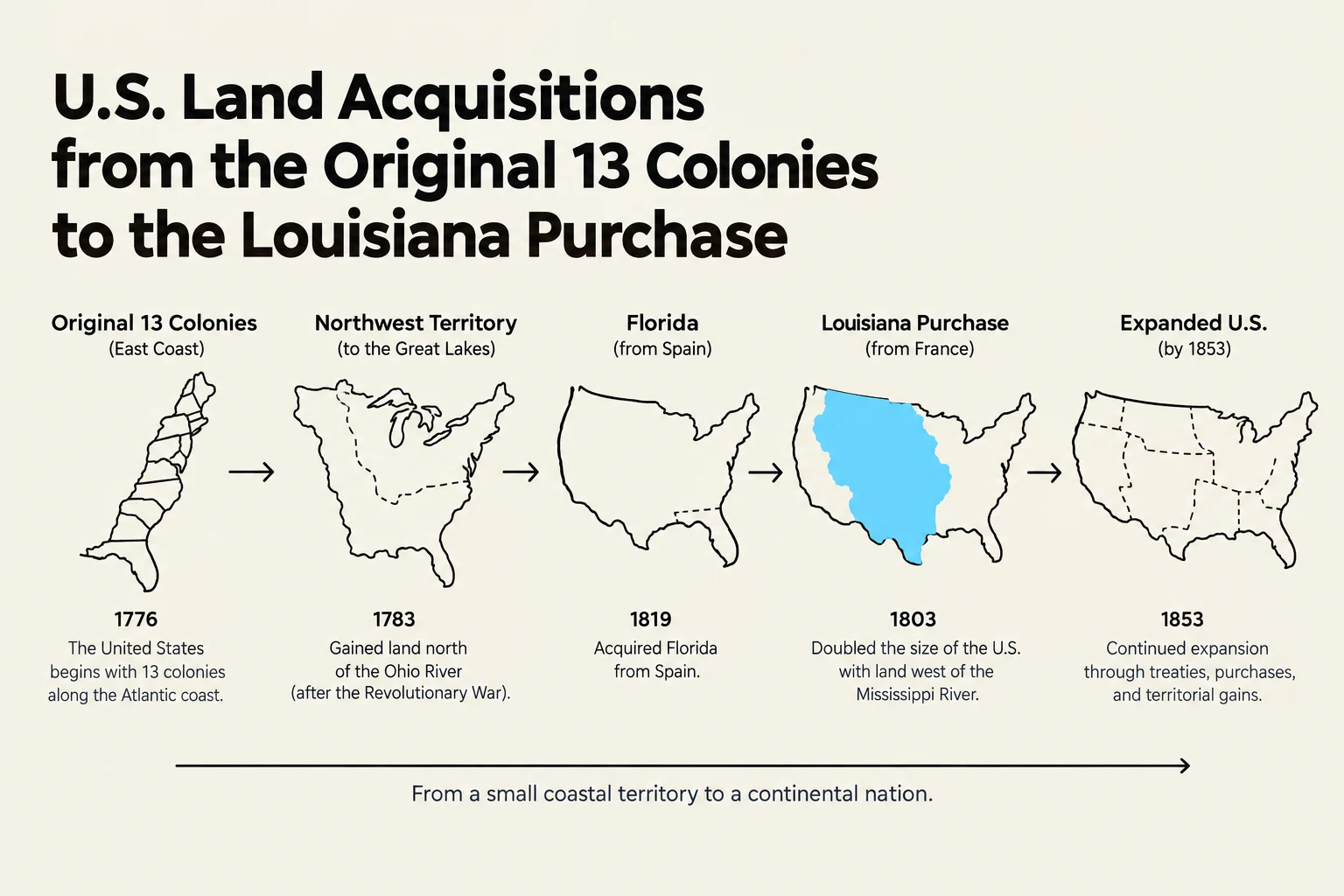
This infographic illustrates the expansion of the United States from the original 13 colonies to the Louisiana Purchase and beyond, showing key territorial acquisitions and their dates.
The Oregon Country and the Gadsden Purchase
Not all expansion was born of war. The Oregon Country was settled through diplomacy. Due to heated disputes between British and American fur traders and settlers, the Oregon Treaty of 1846 was signed, incorporating the territory into the U.S. peacefully. The British ultimately conceded because the territory was too distant to maintain effective control.
Later, in 1853, the Gadsden Purchase was made to expand the southern territories, further refining the nation's borders.
Internal Debates: How to Manage New Land?
As the nation grew, a fierce debate erupted over how to distribute the newly acquired land. This debate reflected the broader political divide between Federalists and Anti-Federalists:
Feature
Federalist Approach (Hamilton)
Anti-Federalist Approach (Jefferson)
Goal
Raise money for the central government
Create a nation of small farmers
Method
Sell large plots at high prices
Sell small lots on credit at low prices
Economic Impact
Strengthened federal power/manufacturing
Decreased income inequality/supported democracy
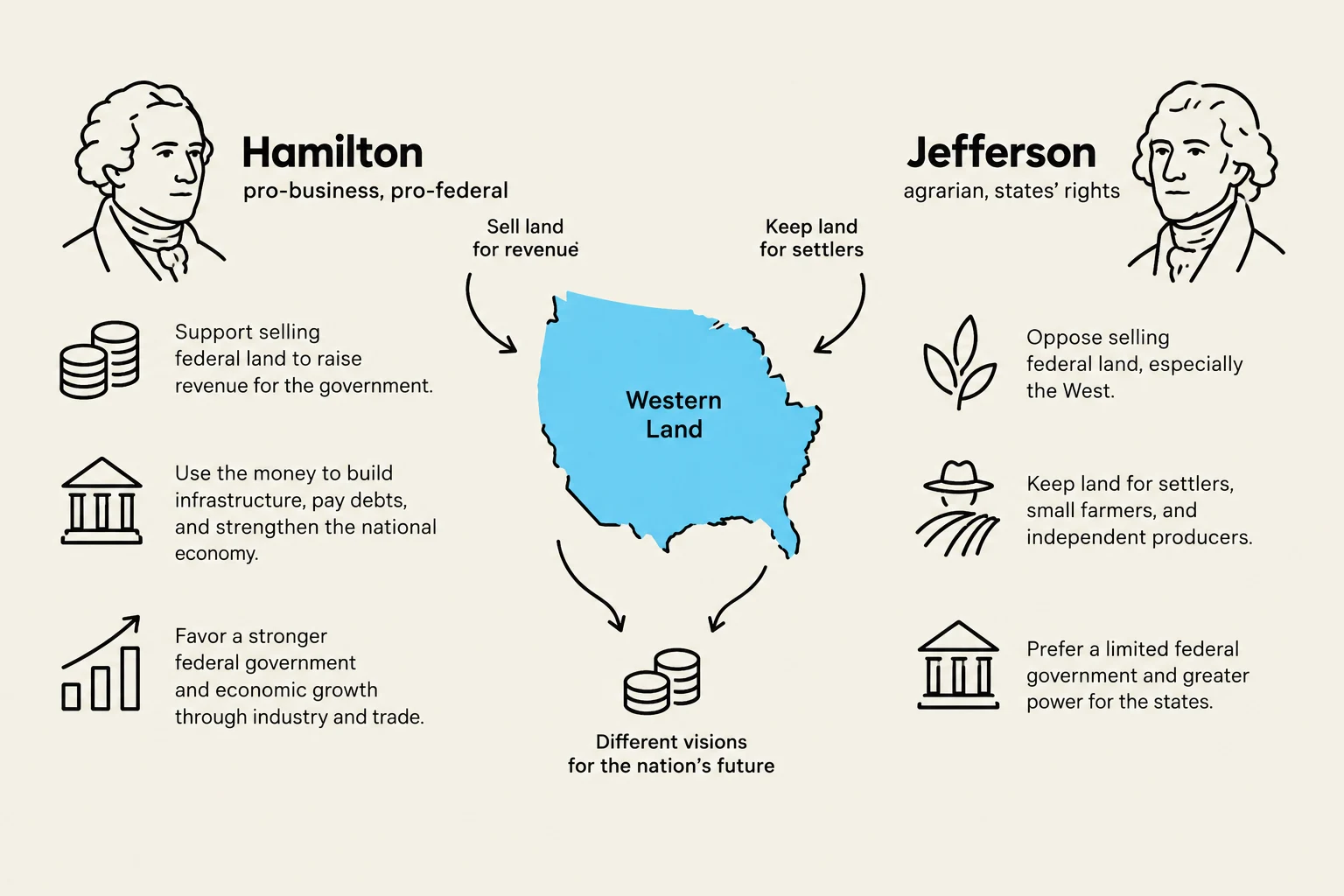
This illustration contrasts the differing visions of Alexander Hamilton and Thomas Jefferson regarding the development and governance of the Western territories, focusing on land policy, economic strategy, and the role of the federal government.
To manage this orderly settlement, the government utilized specific ordinances:
Land Ordinance of 1785: Established a system of surveying land into rectangular 6-mile square townships to be sold at auction.
Northwest Ordinance of 1787: Created a path to statehood (requiring 60,000 people) and prohibited slavery in the new territories, aiming to stop its spread.
Summary of Territorial Progression
The expansion from the Original 13 Colonies to a transcontinental nation was a complex process of purchase, treaty, and conquest. While the economic benefits of controlling the Mississippi and the Gulf were immediate, the political consequences—particularly regarding the balance of power between slave and free states—would shape American history for decades to come.
Keep reading for free.
Create an account to finish this reading and make it part of your study routine.