Understanding Zero-Shot Prompting in Large Language Models
Explore the concept of Zero-Shot Prompting, a method for evaluating AI's raw intelligence by asking it to perform tasks without prior examples. Learn its applications, limitations, and comparison with Few-Shot Prompting.
In the rapidly evolving field of Large Language Models (LLMs), one of the most critical ways to evaluate how "smart" a model truly is involves a technique known as Zero-Shot Prompting. While it might sound technical, the concept is fundamentally simple: it is the act of asking an AI to perform a task without giving it any prior examples to follow.
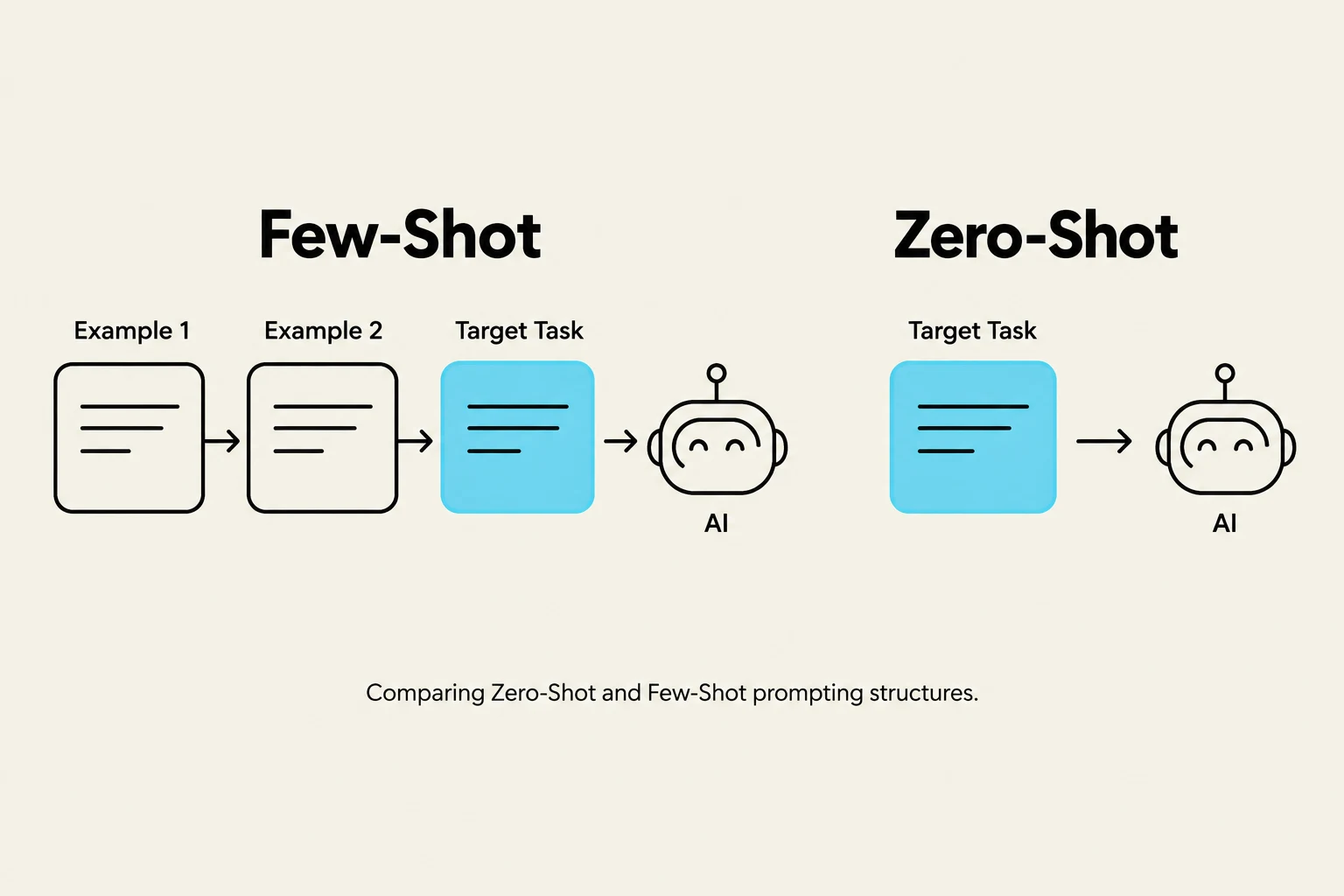
This diagram illustrates the difference between Few-Shot and Zero-Shot prompting structures in AI, showing how Few-Shot provides examples while Zero-Shot relies on the model's pre-existing knowledge.
By stripping away the "training wheels" of examples, researchers and developers can observe the model's baseline capability—its innate ability to understand instructions and apply its pre-trained knowledge to new, unseen problems.
What is Zero-Shot Prompting?
To understand zero-shot prompting, it is helpful to contrast it with its counterpart, Few-Shot Prompting. In few-shot prompting, you provide the model with a few examples of a task (e.g., "Input: Happy → Output: Positive; Input: Sad → Output: Negative") before asking it to solve a new one.
In Zero-Shot Prompting, you skip the examples entirely. You provide only the instruction and the input. You are essentially saying, "Here is a task; do it."
The Logic of the "Zero"
The "zero" in zero-shot refers to the number of demonstrations provided within the prompt itself. The model relies entirely on the patterns it learned during its initial massive training phase to interpret your intent.
Exam Tip: If a question asks you to distinguish between Zero-Shot and Few-Shot prompting, look for the presence of "exemplars" or "demonstrations." Zero-shot = No examples; Few-shot = One or more examples.
Why Use Zero-Shot Prompting?
The graph illustrates the relationship between the number of examples provided in a prompt and the resulting token usage or computational cost, indicating that more examples lead to higher costs and latency.
You might wonder why we would intentionally make a task harder by withholding examples. There are three primary reasons for this approach:
Measuring Baseline Capability: It serves as a "stress test" for the model's reasoning. If a model can solve a complex math problem or summarize a legal document without seeing how it's done first, it demonstrates a high level of general intelligence.
Efficiency and Speed: In production environments, sending fewer tokens (words/characters) saves money and reduces latency. If a model is powerful enough to handle a task zero-shot, there is no need to waste computational resources on long, example-heavy prompts.
Generalization Testing: It helps developers understand if a model has truly "learned" concepts or if it is simply "mimicking" patterns provided in the prompt.
Worked Examples: From Instruction to Output
This diagram illustrates the process of a Large Language Model (LLM) brain, showing how instructions and input are processed through pre-trained patterns and logical reasoning to produce a result.
To see the difference in practice, let's look at how a zero-shot prompt is structured compared to a task that might require more guidance.
Example 1: Sentiment Analysis
The Prompt:
"Classify the sentiment of the following review as Positive, Neutral, or Negative: 'The food was okay, but the service was incredibly slow.'"
The Model's Internal Process:
The model identifies the instruction ("Classify the sentiment"), identifies the categories ("Positive, Neutral, or Negative"), and analyzes the text. Because it has seen millions of reviews during training, it can map the phrase "food was okay" and "service was slow" to the "Neutral" or "Negative" category without needing to see a template first.
Expected Output:Neutral (or Negative)
Example 2: Mathematical Reasoning
Zero-shot prompting is often used to test if a model can follow logical steps.
The Prompt:
"If a train travels at a constant speed of v=60 km/h for a time of t=3 hours, what is the total distance d?"
The Model's Internal Process:
The model must retrieve the formula for distance:
d &= v \cdot t \\
d &= 60 \cdot 3 \\
d &= 180
\end{aligned}$$
$$$
The distance is 180 km.
$$
By providing no examples of math problems, we are testing whether the model's underlying weights contain the correct mathematical relationships.
## Limitations and Challenges
While powerful, zero-shot prompting is not a silver bullet. It faces several hurdles:
* **Ambiguity:** Without examples, the model might interpret your instructions differently than you intended. For instance, if you ask to "summarize this," does that mean a one-sentence summary or a bulleted list?
* **Complexity Ceiling:** For highly specialized tasks (like writing code in a niche programming language or following a very specific corporate tone), zero-shot performance often drops significantly compared to few-shot performance.
* **Sensitivity to Phrasing:** In zero-shot scenarios, the *way* you word the instruction (the "prompt engineering") becomes much more critical. A slight change from "Summarize this" to "Provide a concise summary of" can yield different results.
## Summary Table: Zero-Shot vs. Few-Shot
| Feature | Zero-Shot Prompting | Few-Shot Prompting |
| --- | --- | --- |
| **Examples Provided** | 0 | 1 or more |
| **Token Usage** | Low (Efficient) | High (Expensive) |
| **Primary Use Case** | Testing baseline intelligence | Improving accuracy on complex tasks |
| **Complexity Handling** | Best for general tasks | Best for niche/specialized tasks |
## Conclusion
Zero-shot prompting is the ultimate litmus test for artificial intelligence. It allows us to move beyond simple pattern matching and explore the boundaries of machine reasoning. By providing nothing but a command, we force the model to rely on its core architecture, providing a clear window into its true capabilities.
$$
$$$
Keep reading for free.
Create an account to finish this reading and make it part of your study routine.