Understanding Working Memory Capacity and Its Impact
Explore the concept of Working Memory Capacity (WMC), its measurement through reading span tests, its connection to cognitive control, and its predictive power for academic achievement, including standardized tests like the SAT.
In the study of cognitive psychology, few concepts are as central to human intelligence and daily functioning as working memory. While long-term memory acts as a vast warehouse of information, working memory serves as the "mental workspace" where we actively manipulate, process, and hold information temporarily to complete complex tasks. However, not everyone has the same amount of space in this workspace. This variation is known as Working Memory Capacity (WMC), and understanding how it differs between individuals provides profound insights into how we learn, solve problems, and perform on standardized tests.
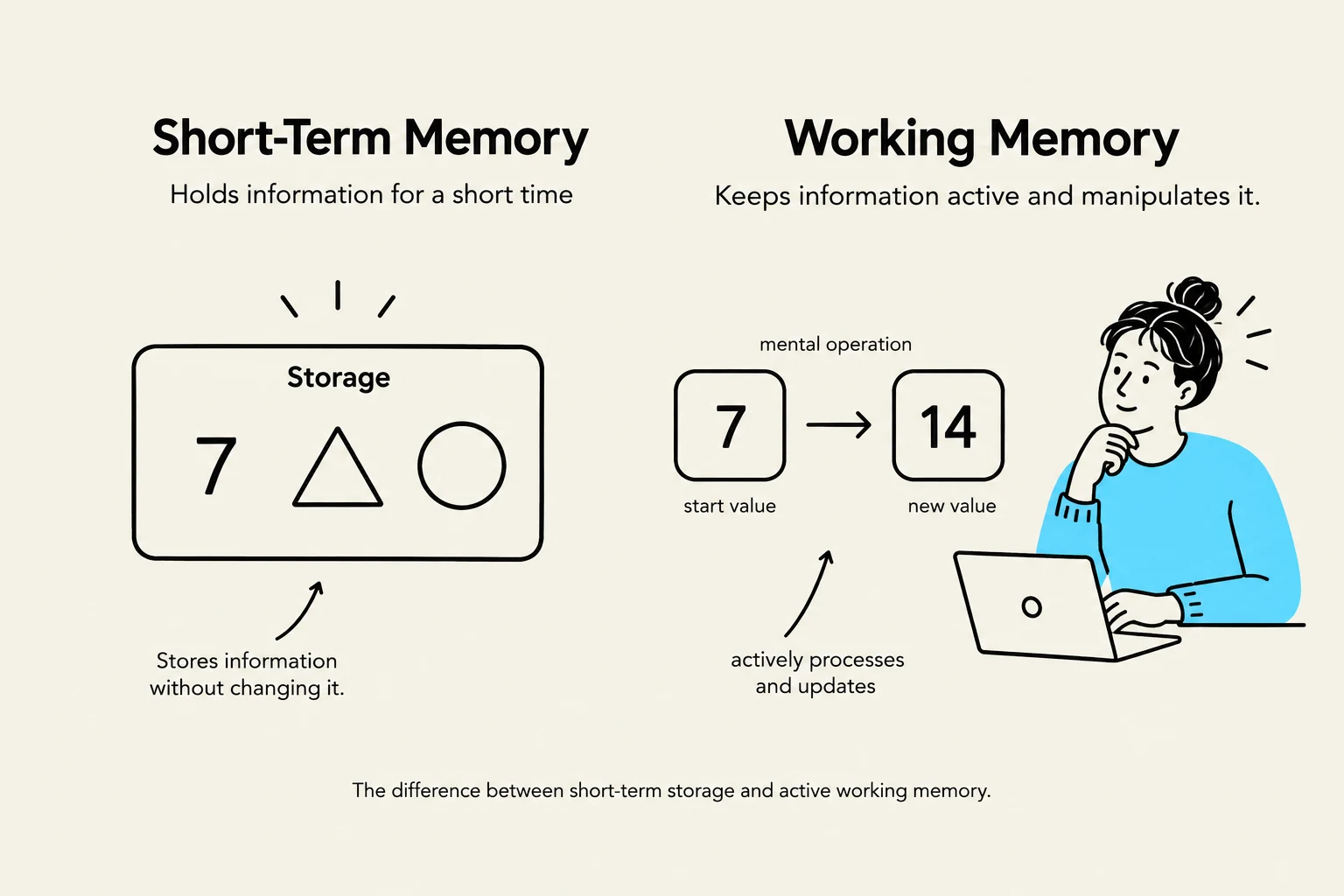
This illustration differentiates between short-term memory, which stores information without modification, and working memory, which actively processes and updates information, using a numerical example and a diagram.
What is Working Memory Capacity?
Working memory is more than just a storage bin; it is a dynamic system that integrates attention and memory. Working Memory Capacity (WMC) refers to the limit on the amount of information an individual can simultaneously hold in mind while performing cognitive operations on that information.
Think of WMC like the RAM (Random Access Memory) in a computer. If you are running a heavy software program (like solving a calculus problem) while also trying to listen to a podcast (processing auditory information), a computer with low RAM might lag or crash. Similarly, an individual with lower WMC may struggle to keep track of multiple variables in a complex sentence or a multi-step math equation.
Exam Tip: When distinguishing between "Short-Term Memory" and "Working Memory," remember that Short-Term Memory is primarily about storage, whereas Working Memory involves both storage and active manipulation of information.
Measuring Capacity: The Role of Reading Span Tests
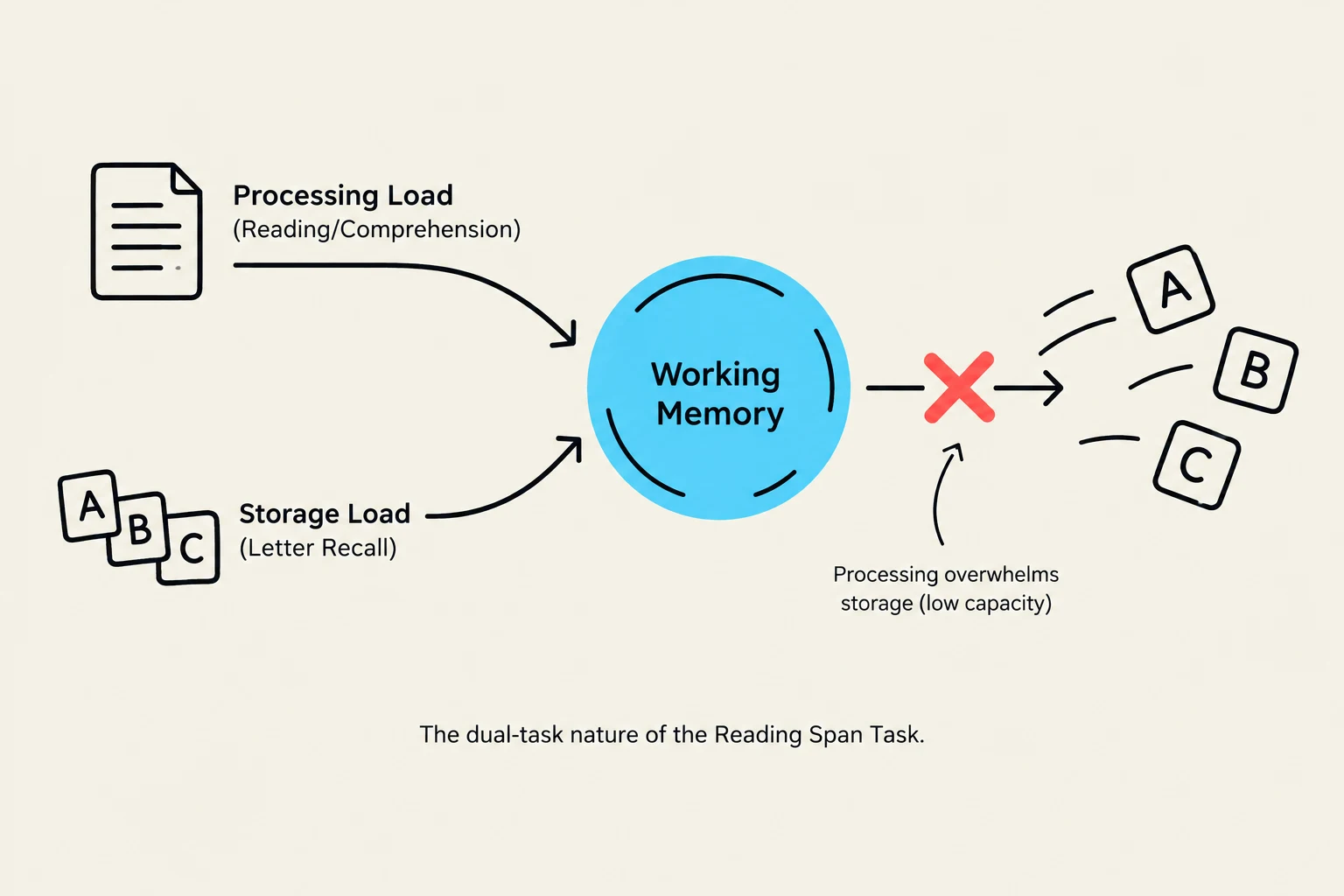
This diagram illustrates the dual-task nature of the Reading Span Task, showing how processing load and storage load interact with working memory and can lead to overwhelmed storage capacity.
Psychologists cannot simply "look" at a brain to see how much capacity a person has; they must use behavioral tasks to induce cognitive load. One of the most effective and widely used methods is the Reading Span Task.
In a typical reading span test, a participant is presented with a series of sentences. For each sentence, the participant must:
Read the sentence.
Recall the meaning of the sentence (comprehension).
Remember a single letter presented between sentences (storage).
This task is designed to measure WMC because it forces the participant to juggle two distinct processes: the processing load (reading and understanding the sentence) and the storage load (keeping the letters in mind). If a person has high WMC, they can maintain the sequence of letters even while their attention is heavily taxed by the reading material. If WMC is low, the effort required to understand the text "overwrites" the letters being held in memory.
The Link to Cognitive Control
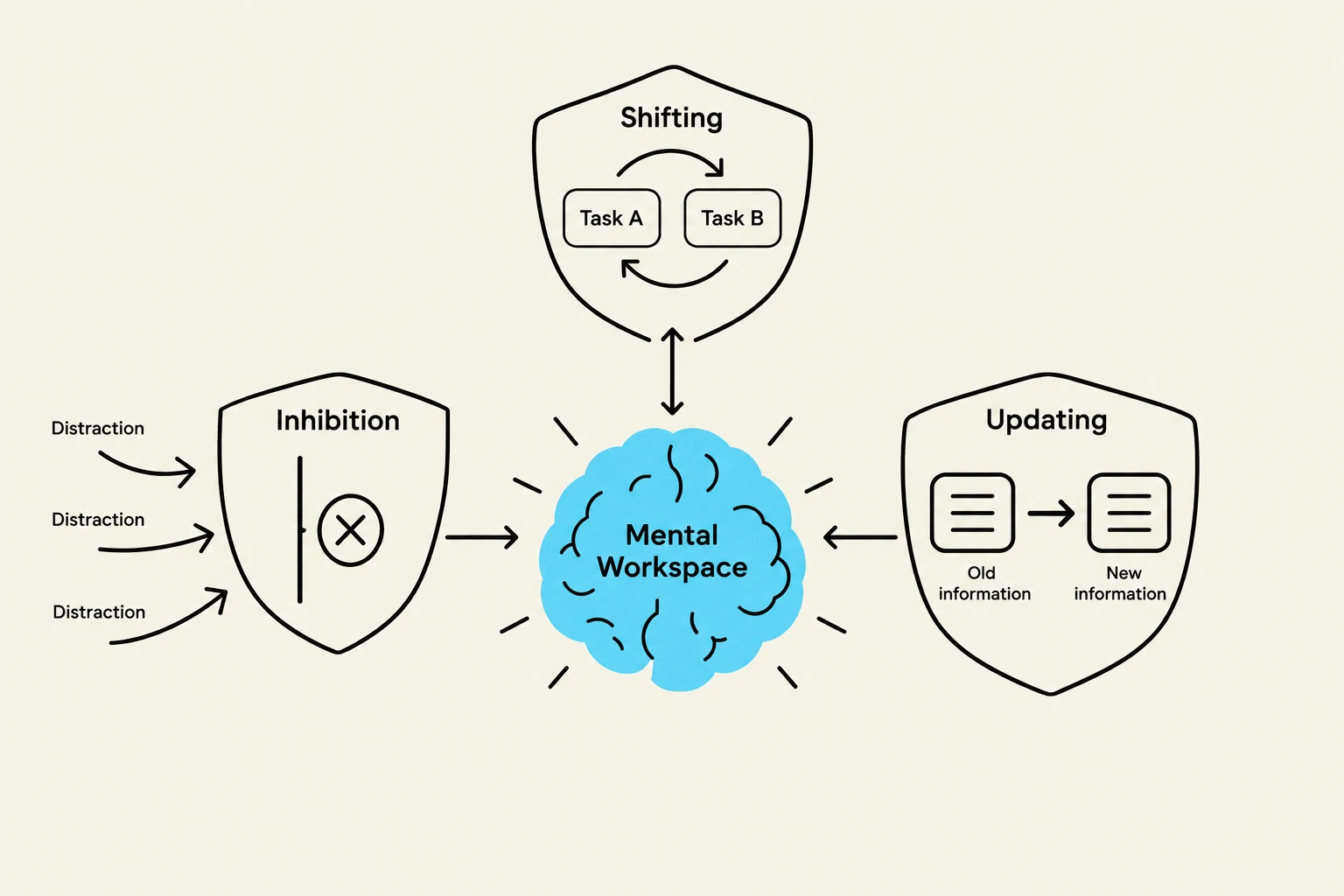
A diagram illustrating the components of the mental workspace: inhibition, shifting, and updating, with a central representation of the mental workspace itself.
A critical finding in modern cognitive science is that WMC is not just about "memory"; it is deeply intertwined with cognitive control.
Cognitive control refers to the ability to direct your mental resources toward relevant information while inhibiting distractions. High-capacity individuals are better at:
Inhibition: Ignoring irrelevant stimuli (e.g., a noisy room while studying).
Shifting: Moving attention between different rules or tasks smoothly.
Updating: Constantly refreshing the information in the workspace to ensure it remains current.
Because WMC requires you to hold information while ignoring distractions, it serves as a proxy for how well a person can manage their attention. This is why people with high WMC often appear more "focused" during complex tasks; their mental workspace is robust enough to shield important information from being displaced by noise or irrelevant thoughts.
WMC and Academic Achievement: The SAT Connection
One of the most practical applications of WMC research is its correlation with academic performance. Extensive research has shown that WMC is a strong predictor of scores on standardized tests, most notably the SAT.
Why does WMC predict SAT scores so effectively? Consider the nature of the exam:
Reading Comprehension: To answer complex reading questions, students must hold the context of an entire paragraph in mind while simultaneously analyzing specific sentence structures.
Mathematical Reasoning: Solving high-level math problems requires holding intermediate steps in mind (e.g., the result of a sub-calculation) while applying a new rule or formula to the next step.
Students with higher WMC can manage these "cognitive loads" more efficiently. They are less likely to lose their place in a logical argument or forget a crucial variable in an equation, leading to higher accuracy and faster processing speeds.
Summary Table: Cognitive Profiles
To help visualize the differences, consider the following comparison:
Feature
Low Working Memory Capacity
High Working Memory Capacity
Distractibility
Highly susceptible to irrelevant stimuli.
Stronger ability to inhibit distractions.
Complex Tasks
Struggles to juggle multiple rules or steps.
Efficiently manipulates multiple pieces of info.
Reading Span
High error rate in letter recall during reading.
High accuracy in letter recall during reading.
Academic Impact
Often correlates with lower standardized test scores.
Often correlates with higher standardized test scores.
By understanding WMC, we gain a clearer picture of why some individuals find complex, multi-layered information easier to navigate than others, highlighting the vital intersection of memory, attention, and intelligence.
Keep reading for free.
Create an account to finish this reading and make it part of your study routine.