Understanding Weberian Bureaucracy: An Ideal Type of Organization
This reading explains Max Weber's concept of bureaucracy as an 'ideal type' of organization, focusing on its core characteristics: hierarchy, specialization, formal rules, and impersonality. It also touches upon merit-based authority and the 'iron cage' critique.
In the study of sociology and public administration, few concepts are as influential—or as frequently misunderstood—as "bureaucracy." While the term is often used in modern conversation to imply red tape, inefficiency, or sluggishness, the academic concept originated as a way to describe the most rational and efficient form of human organization. Developed by the German sociologist Max Weber, the Weberian model provides a blueprint for how large-scale institutions can function predictably and fairly through structured rules and specialized roles.
The Concept of the "Ideal Type"
To understand Weber, one must first understand his methodological tool: the Ideal Type. An ideal type is not a description of a "perfect" organization, nor is it a moral judgment on whether a system is "good" or "bad." Instead, it is a conceptual construct—a simplified model that highlights the most essential characteristics of a phenomenon.
By creating this "ideal" model, researchers can compare real-world organizations against the blueprint to see where they succeed or deviate. When we speak of Weberian Bureaucracy, we are discussing this theoretical benchmark of rationality and order.
Exam Tip: If a question asks about the "Ideal Type," do not describe it as a "perfect" version of an organization. Describe it as a "conceptual tool used for comparison and analysis".
The Four Pillars of Weberian Bureaucracy
Weber identified several core characteristics that distinguish a rational-legal bureaucracy from other forms of organization, such as traditional or charismatic authority. These pillars ensure that the organization operates based on logic rather than the whims of an individual.
1. Hierarchy of Authority
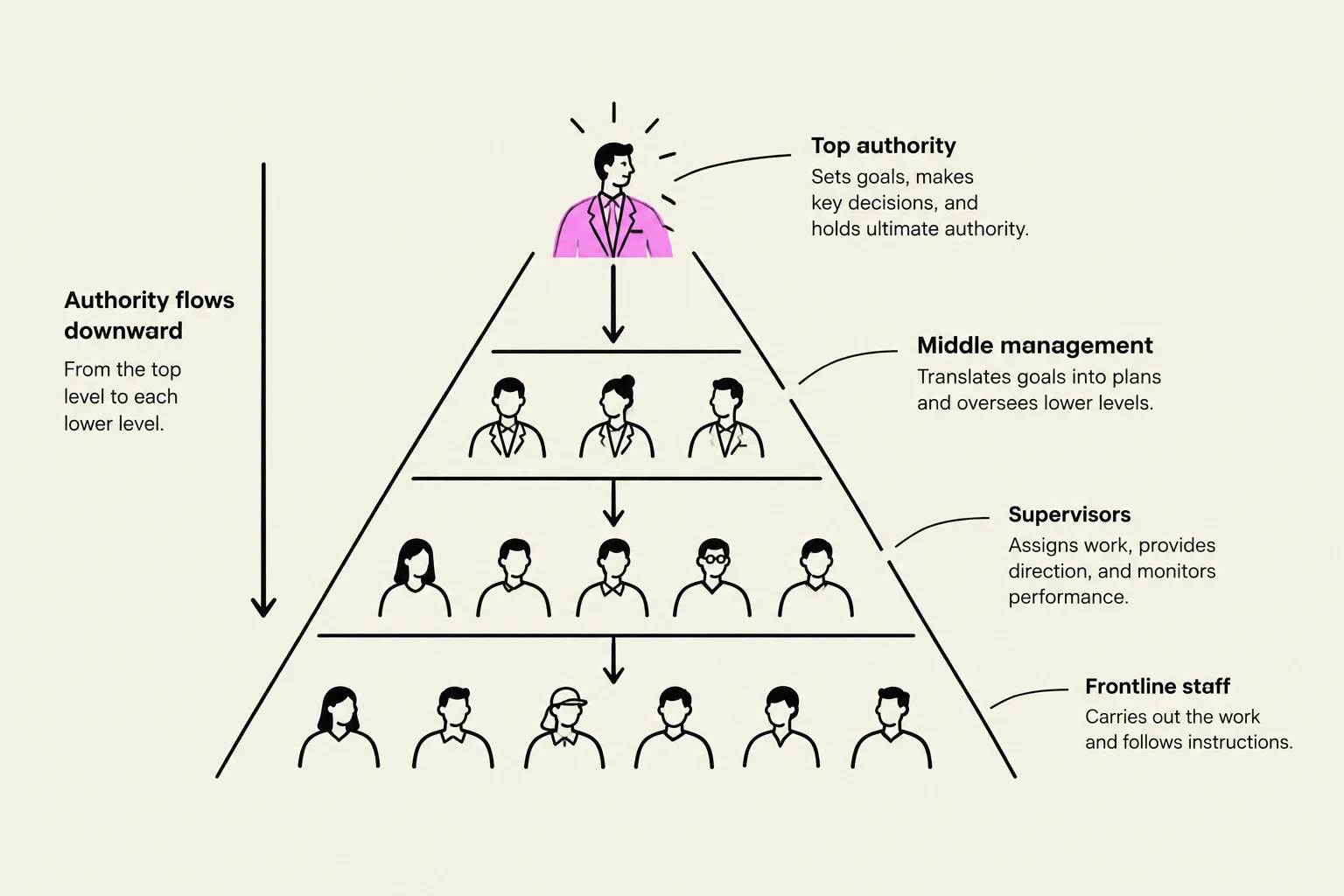
A bureaucracy is organized into a clear, vertical chain of command. Every official occupies a specific position within a pyramid-shaped structure. Each lower office is under the control and supervision of a higher one. This ensures that responsibility is clearly defined and that instructions flow predictably from the top down.
This diagram illustrates a hierarchical organizational structure, showing the flow of authority from top management down to frontline staff.
2. Specialization and Division of Labor
In a Weberian system, tasks are broken down into simple, routine, and well-defined operations. Rather than having "generalists" who do a little bit of everything, a bureaucracy relies on specialists. Each person has a specific "sphere of competence," meaning they are experts in a particular niche of the organization's mission.
3. Formal Rules and Procedures
To ensure consistency, bureaucracies rely on a complex system of written rules and standard operating procedures (SOPs). These rules govern how tasks are performed and how decisions are made. This reduces ambiguity; an employee should know exactly what to do in a given situation because the "rulebook" has already provided the answer.
4. Impersonality
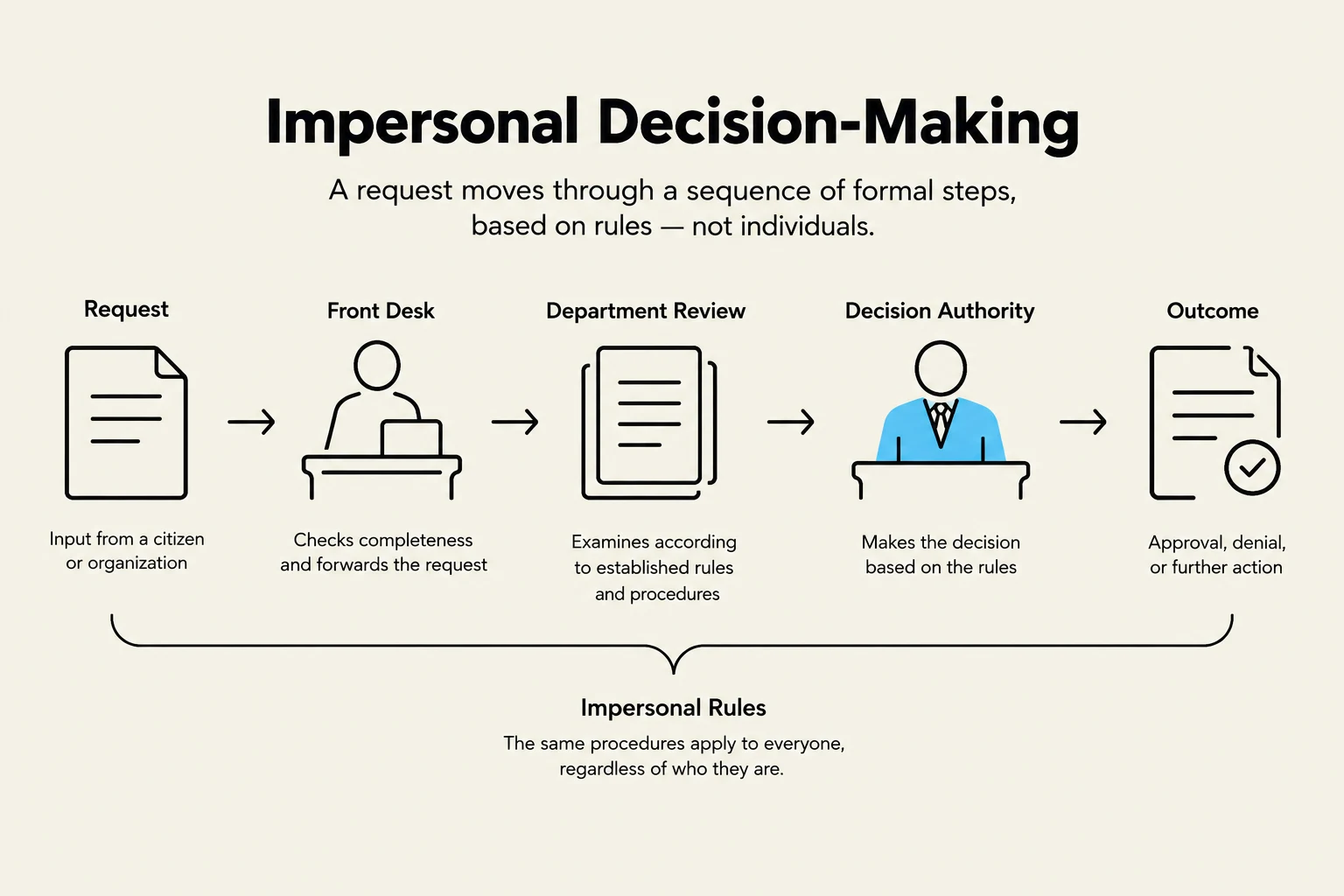
Perhaps the most critical (and often most criticized) feature is impersonality. Decisions are made based on objective criteria and established rules, rather than on personal feelings, favoritism, or social connections. In a true bureaucracy, "the office" is separate from "the person." This ensures that every client or citizen is treated according to the same standard, regardless of their status or relationship to the official.
A flowchart illustrating the process of impersonal decision-making, where requests are processed through formal steps based on rules rather than individuals, ensuring consistent application of procedures.
Merit-Based Authority and Career Stability
In many historical forms of organization, positions were granted through nepotism (hiring family) or patronage (hiring political allies). Weberian bureaucracy replaces these "irrational" methods with merit-based authority.
In this model, employment and promotion are based on:
Technical Qualifications: Demonstrated through examinations or educational credentials.
Competence: Proven ability to perform the specialized tasks required by the role.
Seniority and Achievement: A predictable career path where advancement is tied to performance and time in service.
This creates a professional class of administrators who are loyal to the institution and the law, rather than to a specific political leader or individual patron.
Worked Example: The DMV vs. A Small Family Business
To see these concepts in action, let's compare a Department of Motor Vehicles (DMV) to a small, family-owned local bakery.
Feature
The Bakery (Traditional/Informal)
The DMV (Weberian Bureaucracy)
Authority
The owner makes all decisions based on intuition.
Rules and laws dictate how licenses are issued.
Specialization
One person might bake, clean, and manage cash.
One clerk handles renewals; another handles testing.
Impersonality
The owner might give a discount to a friend.
Every applicant must provide the same ID and pay the same fee.
Hiring
The owner hires their nephew.
Applicants must pass a civil service exam.
While the bakery might be more "flexible" and "warm," it lacks the scalability and predictability required to manage millions of citizens. The DMV, despite its reputation for being slow, provides a level of legal certainty and fairness that a personal system cannot match.
The "Iron Cage" Critique
While Weber admired the efficiency of bureaucracy, he was also deeply concerned about its long-term social consequences. He famously warned that the drive for total rationality and control could lead to an "iron cage" of bureaucracy.
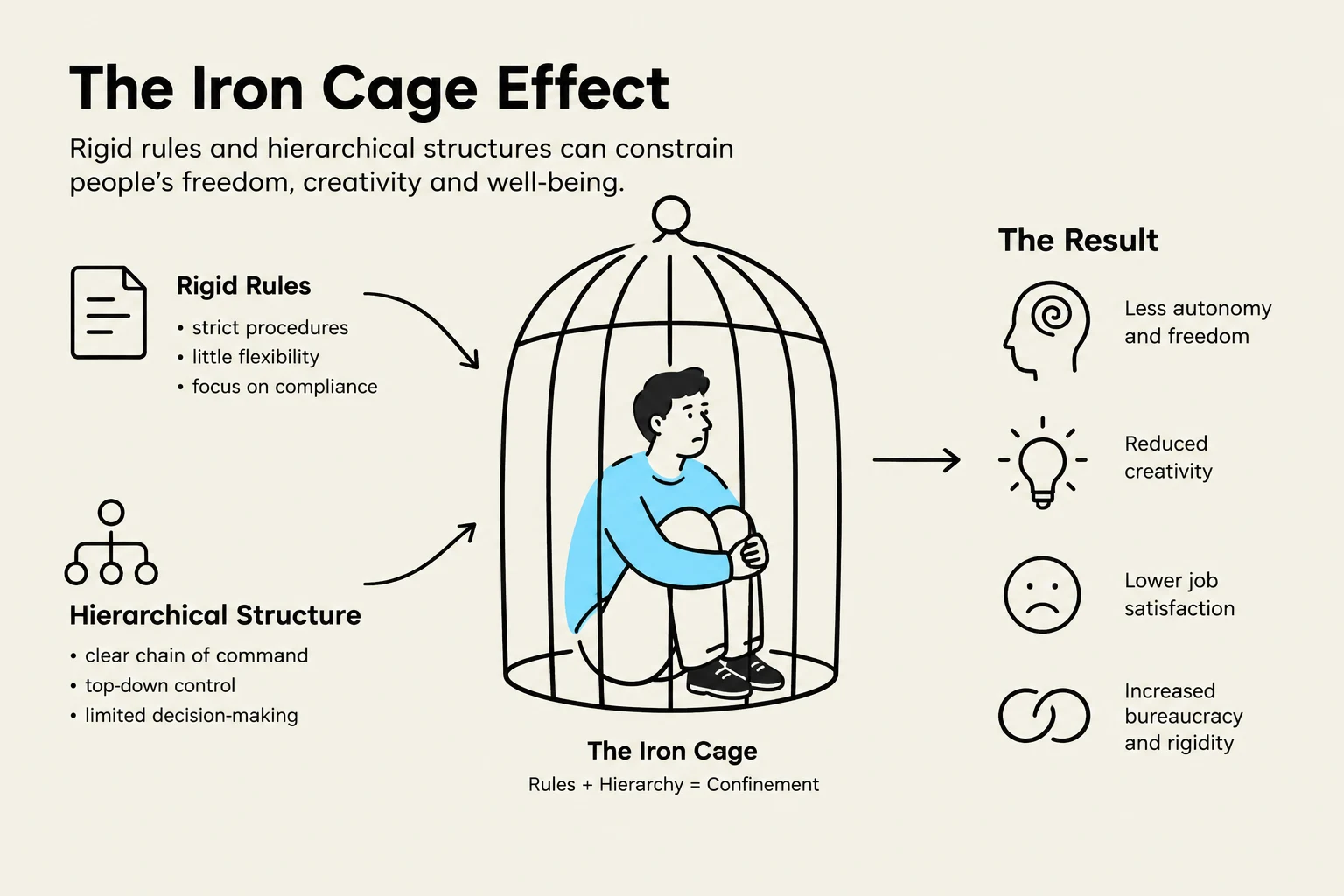
The "iron cage" refers to a society where human spontaneity, creativity, and individual freedom are crushed by the weight of endless rules and impersonal systems. In such a world, people become mere "cogs in a machine," following procedures without understanding the human purpose behind them.
The Iron Cage Effect illustrates how rigid rules and hierarchical structures can limit individual freedom, creativity, and well-being, leading to reduced autonomy, creativity, job satisfaction, and increased bureaucracy.
Summary Checklist for Students:
When analyzing an organization through a Weberian lens, ask:
Is there a clear hierarchy?
Are tasks divided among specialists?
Are decisions governed by written rules?
Are people treated impersonally?
Is authority based on merit?
Keep reading for free.
Create an account to finish this reading and make it part of your study routine.