Understanding Unemployment: Types, Rates, and Economic Indicators
An in-depth explanation of the different types of unemployment (frictional, structural, cyclical), how the labor force is defined, and the calculation of key economic indicators like the natural unemployment rate and full employment.
In macroeconomics, measuring the health of an economy involves more than just looking at how much money is being spent. One of the most critical indicators of economic well-being is the unemployment rate. However, not all unemployment is created equal. Some unemployment is a sign of a healthy, moving labor market, while other forms signal deep structural problems or severe economic downturns. To truly understand an economy, economists categorize unemployment into specific types and use them to calculate various rates that describe the state of the labor market.
Defining the Labor Force
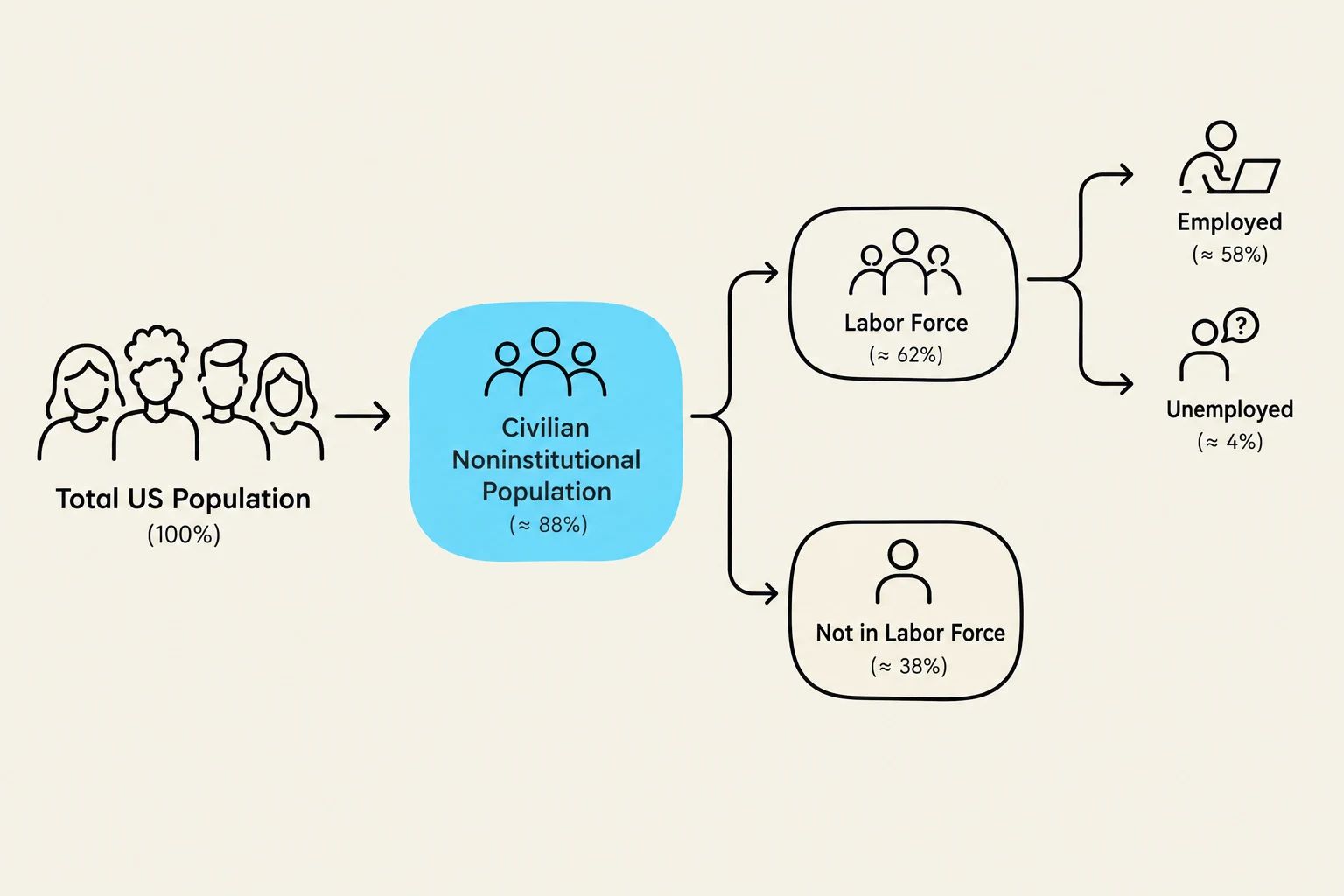
Before we can calculate unemployment rates, we must first define who is actually being measured. The total population is divided into several groups, but the most important distinction for our purposes is between the Civilian Noninstitutional Population (CNP) and those excluded from it.
The CNP excludes individuals who are under the age of 16, members of the armed forces, and those who are institutionalized (such as inmates in prisons or patients in certain facilities). Within the CNP, we find two distinct subgroups:
Persons not in the labor force: These are individuals who are neither working nor actively looking for work, such as retirees, full-time students, or stay-at-home parents.
Civilian Labor Force: This group consists of everyone who is either currently employed or unemployed (meaning they are without a job but actively seeking one).
Important Note: "Discouraged workers"—those who want a job but have given up looking due to previous failures—are classified as not in the labor force and are therefore not counted in the official unemployment rate.
To find the general Unemployment Rate (U), we use the following formula:
U=Civilian Labor Forceunemployed persons
This diagram illustrates the breakdown of the US population into the civilian noninstitutional population, labor force, and those not in the labor force, with further categorization of the labor force into employed and unemployed individuals.
The Three Types of Unemployment
Economists categorize unemployment based on its underlying cause. Understanding these causes helps policymakers decide whether they need to implement stimulus packages or educational reforms.
1. Frictional Unemployment
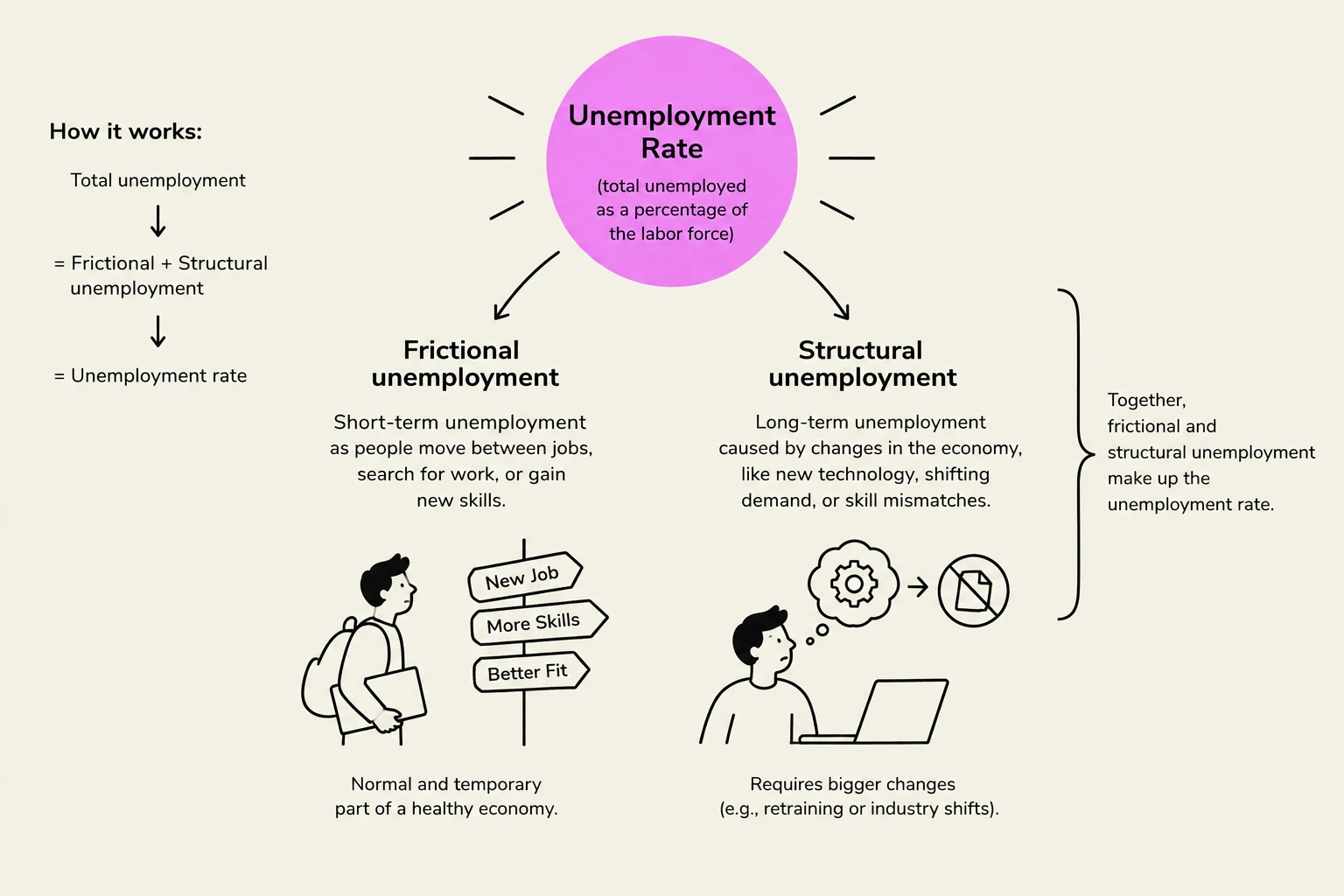
Frictional unemployment is considered a natural and even positive part of a functioning economy. It occurs due to voluntary transitions, such as when a worker quits a job to find a better one, or when new graduates enter the labor force for the first time. It represents the time spent "between" jobs.
2. Structural Unemployment
Unlike frictional unemployment, structural unemployment is often long-lasting and can be quite damaging. It occurs when there is a fundamental mismatch between the skills workers possess and the skills companies actually need. A primary driver of this is technological advancement; for example, if a factory automates its assembly line, the workers who previously performed those manual tasks may find their skills are no longer required by the market.
3. Cyclical Unemployment
Cyclical unemployment is directly tied to the business cycle. It fluctuates based on the state of the economy:
Economic Recession: During a downturn, demand for goods and services falls, leading companies to lay off workers. This causes cyclical unemployment to rise.
Economic Expansion: During periods of growth, demand increases, and companies hire more staff, causing cyclical unemployment to fall.
Calculating Economic Health: Natural and Full Employment
By combining the types of unemployment, we can derive more sophisticated measures of economic stability.
The Natural Unemployment Rate (UN)
The Natural Unemployment Rate is the minimum level of unemployment that exists even when the economy is performing well. It is the sum of the frictional and structural components:
UN=UF+US
where UF is the frictional rate and US is the structural rate.
Full Employment
A common misconception is that "Full Employment" means a 0% unemployment rate. In reality, Full Employment is achieved when the actual unemployment rate (U) is equal to the natural unemployment rate (UN).
Exam Tip: A 0% unemployment rate is actually a sign of an inflexible labor market where workers cannot move between jobs, which can hinder economic efficiency.
This diagram illustrates the concept of unemployment rate, breaking it down into frictional and structural unemployment, and explaining how they contribute to the overall rate.
When the actual unemployment rate deviates from the natural rate, it indicates that the economy is experiencing a cycle of expansion or recession. The Cyclical Unemployment Rate (UC) measures this specific impact:
UC=U−UN
Worked Example: Calculating Rates
Let's apply these formulas to a hypothetical economy to see how they work in practice:
In this specific case, the negative cyclical unemployment rate suggests the economy is actually performing slightly better than its "natural" trend would predict.
This graph illustrates the relationship between the actual unemployment rate and the natural unemployment rate over time, showing how the actual rate fluctuates around the natural rate due to economic cycles.
Keep reading for free.
Create an account to finish this reading and make it part of your study routine.