Explore the principles of projectile motion, focusing on the independence of horizontal and vertical components and the mathematical framework for analyzing trajectories. Includes worked examples and summary tables.
When you throw a basketball toward a hoop or fire a projectile from a cannon, the object does not move in a simple straight line. Instead, it follows a curved path known as a trajectory. Understanding this motion requires us to look beyond simple one-dimensional physics and embrace the complexity of two dimensions.
A diagram illustrating projectile motion, showing the trajectory of an object and its velocity vector decomposed into horizontal (Vx) and vertical (Vy) components.
The secret to mastering projectile motion lies in a single, fundamental principle: the independence of motions. By breaking a complex curve into two simpler, perpendicular components, we can predict exactly where an object will land and how fast it will be moving at any given moment.
The Principle of Independence
The most critical concept in two-dimensional kinematics is that horizontal motion and vertical motion act independently of one another. This means that what happens to an object as it moves left or right has no effect on how fast it falls toward the ground, and vice versa.
To analyze this, we split the motion into two distinct axes:
The Horizontal Axis (x): In an ideal scenario (ignoring air resistance), there are no horizontal forces acting on the projectile once it is released. According to Newton's First Law, an object in motion stays in motion with a constant velocity. Therefore, the horizontal acceleration is zero (ax=0), and the horizontal velocity (vx) remains constant throughout the entire flight.
The Vertical Axis (y): Gravity is constantly pulling the object toward the center of the Earth. This means there is a constant downward acceleration (ay=−g, where g≈9.8 m/s2). The vertical velocity will change continuously, slowing down as the object rises and speeding up as it falls.
Exam Tip: When solving projectile motion problems, always start by creating two separate columns in your workspace: one for x-variables and one for y-variables. This prevents you from accidentally plugging a vertical acceleration into a horizontal equation.
Breaking Down the Initial Velocity
Resolving initial velocity into horizontal and vertical components using trigonometry.
Most projectiles are launched at an angle θ relative to the horizontal. Because the object is moving both up and across simultaneously, we must use trigonometry to "resolve" the initial velocity vector (v0) into its components.
If an object is launched with an initial velocity v0 at an angle θ, the components are calculated as follows:
v0x=v0⋅cos(θ)v0y=v0⋅sin(θ)
The horizontal component (v0x) tells you how much of that speed is dedicated to covering distance across the ground. The vertical component (v0y) tells you how much speed is dedicated to fighting gravity and gaining altitude.
The Mathematical Framework
Since the horizontal motion is constant and the vertical motion is under constant acceleration, we can use the standard kinematic equations for each dimension separately.
Horizontal Motion (Constant Velocity)
Because ax=0, we only need one simple equation to find the horizontal displacement (the "range"):
Δx=v0x⋅t
Vertical Motion (Constant Acceleration)
Because ay=−g, we use the equations for uniformly accelerated motion:
vy=v0y−g⋅tΔy=v0y⋅t−21g⋅t2vy2=v0y2−2g⋅Δy
Worked Example: The Soccer Kick
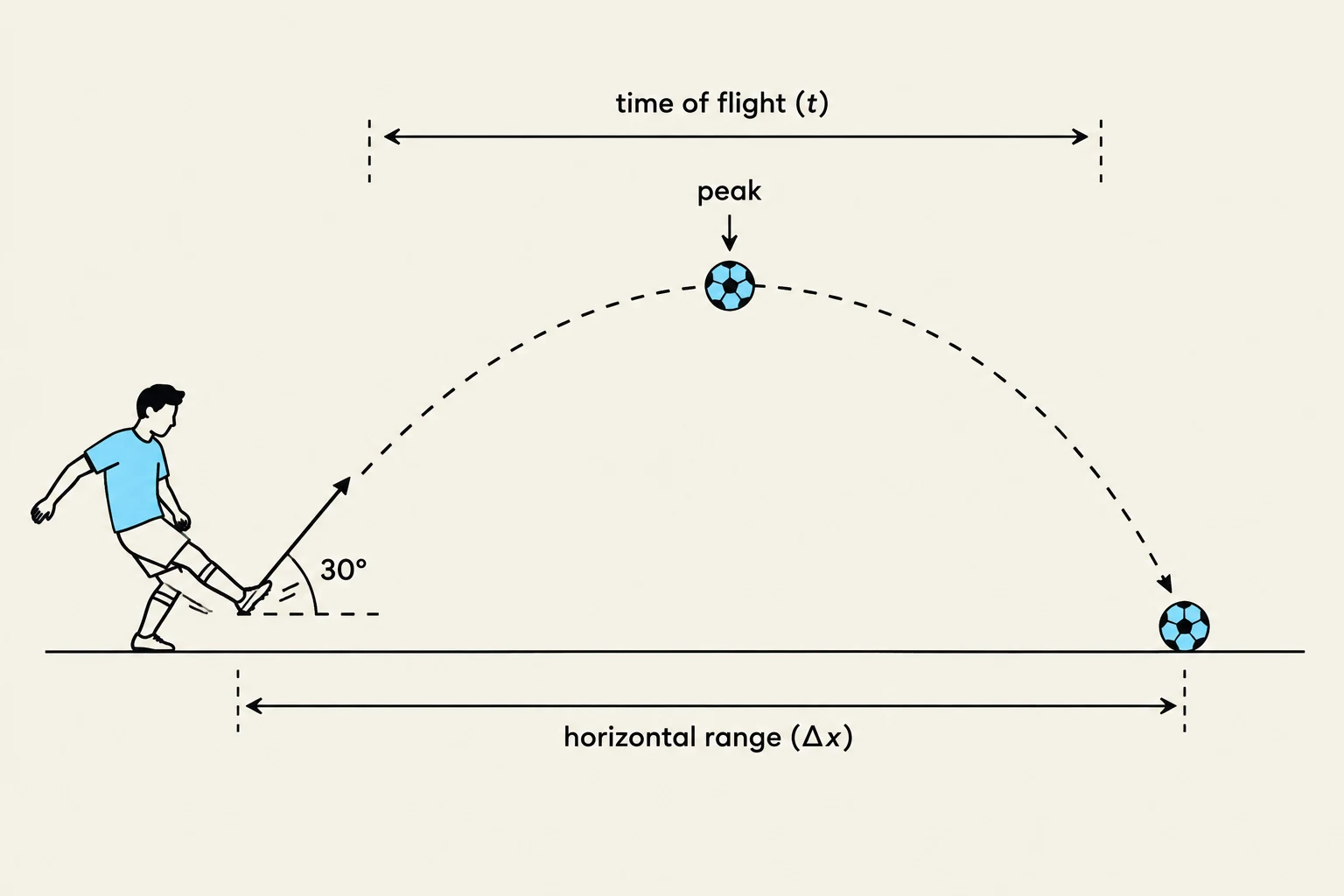
A diagram illustrating projectile motion, showing a soccer ball kicked at an angle of 30 degrees, with labels for time of flight, peak height, and horizontal range.
Let's put these concepts into practice. Imagine a soccer player kicks a ball from the ground with an initial velocity of 20 m/s at an angle of 30∘ above the horizontal. How far does the ball travel before hitting the ground?
Step 1: Resolve the initial velocity components.
v0x=20⋅cos(30∘)≈17.32 m/sv0y=20⋅sin(30∘)=10 m/s
Step 2: Find the time of flight.
The ball hits the ground when its vertical displacement Δy=0. Using the vertical displacement equation:
0=(10)⋅t−21(9.8)⋅t20=t(10−4.9t)
This gives us two solutions: t=0 (the moment of the kick) and t=4.910≈2.04 s. So, the ball is in the air for approximately 2.04 seconds.
Step 3: Calculate the horizontal range.
Now, use the time of flight in the horizontal motion equation:
Δx=v0x⋅tΔx=17.32⋅2.04≈35.33 m
The soccer ball travels approximately 35.33 meters.
Summary Table of Motion Characteristics
To keep your analysis organized, remember this summary of how the two dimensions behave during flight:
Feature
Horizontal Motion (x)
Vertical Motion (y)
Acceleration
ax=0
ay=−g
Velocity
Constant (vx=v0x)
Changing (vy decreases, then increases)
Force
None (ignoring air resistance)
Gravity
Key Equation
Δx=vx⋅t
Δy=v0yt−21gt2
By treating the horizontal and vertical components as two separate stories happening at the same time, you can solve even the most complex trajectories with confidence.
Keep reading for free.
Create an account to finish this reading and make it part of your study routine.