Understanding Tuberculosis: Immune Response, Natural History, and Treatment
This content explains the immune system's role in fighting tuberculosis (TB), the progression from latent to active disease, diagnostic methods like the Tuberculin Skin Test (TST), and standard treatment regimens including challenges like drug resistance.
Tuberculosis (TB) remains one of the most significant global health challenges, particularly in underdeveloped regions where 95% of reported cases originate. Caused by the bacterium Mycobacterium tuberculosis, the disease progresses through a complex interplay between bacterial virulence and the human immune system. Understanding the distinction between latent infection and active disease is critical for effective clinical management and the prevention of drug resistance.
The Immune Response to Infection
To understand TB, one must first understand how the body fights infection. The human immune system is divided into two primary arms: the innate and the adaptive immune systems.
The innate immune system serves as the first line of defense. It is characterized by a rapid response involving leukocytes such as neutrophils, monocytes, and macrophages. Macrophages, in particular, play a central role in TB pathogenesis by attempting to engulf the inhaled bacilli through phagocytosis.
Diagram illustrating the process of phagocytosis, where a cell engulfs a bacterium, forms a phagosome, fuses with a lysosome to form a phagolysosome, and finally expels soluble debris through exocytosis.
The adaptive immune system is more specialized and takes longer to develop, peaking weeks to months after colonization. It involves:
T Lymphocytes: Recognize specific antigens and produce cytokines to activate other cells.
B Lymphocytes: Produce antibodies to target the pathogen.
Dendritic cells act as a bridge between these two systems, transporting antigens from the site of infection (such as the lungs) to the lymph nodes to trigger the adaptive response.
Natural History: From Exposure to Disease
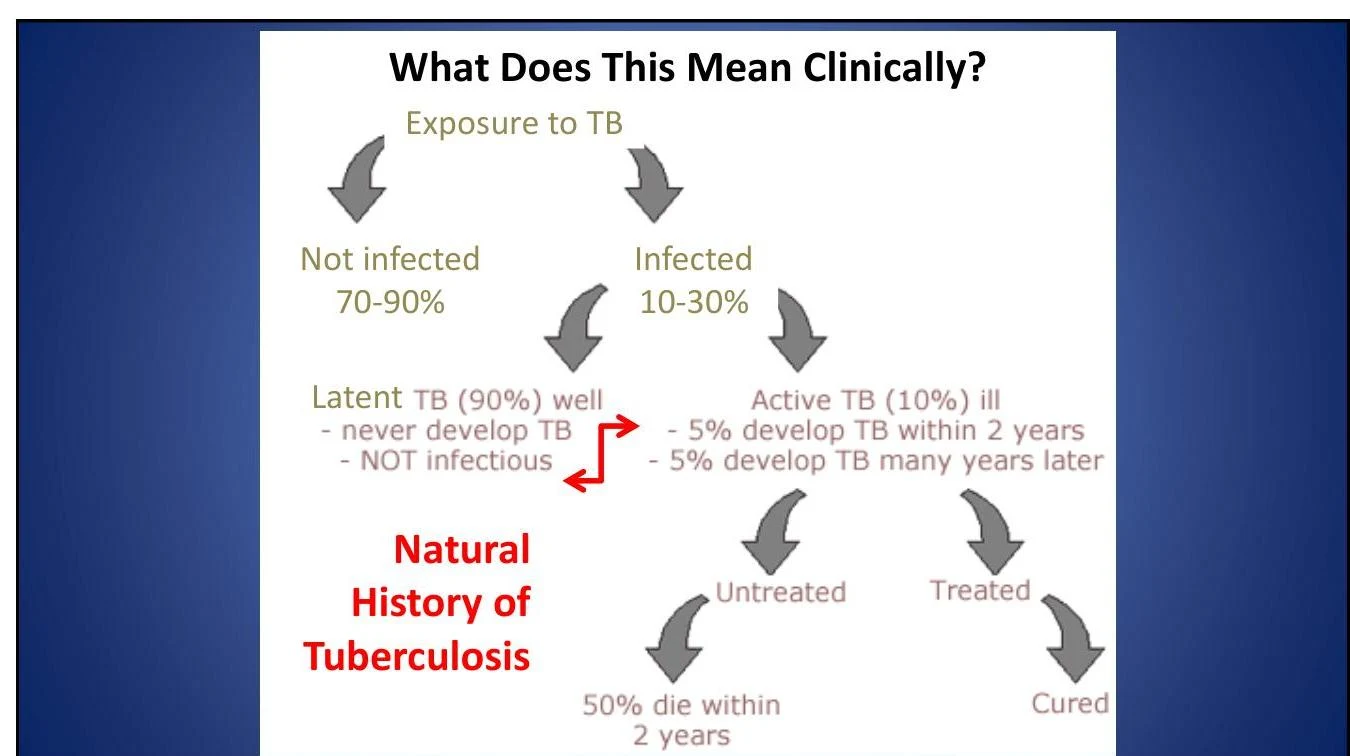
When M. tuberculosis is inhaled via aerosols, the bacilli are engulfed by alveolar macrophages. The outcome of this encounter determines the clinical path of the patient.
Latent TB Infection (LTBI)
In many cases, the immune system successfully contains the bacteria. In LTBI, the tubercle bacilli remain inactive and contained within the body, often within a structure called a granuloma—an aggregation of macrophages and immune cells designed to confine the pathogen.
Characteristics: Inactive bacilli, normal chest X-ray, negative sputum cultures, and no clinical symptoms.
Infectivity: Individuals with LTBI are not infectious.
Active TB Disease
If the immune response fails to contain the bacteria, or if the immune system becomes compromised, the bacilli multiply, leading to active TB disease.
Characteristics: Multiplying bacilli, abnormal chest X-rays (often showing cavitary lesions), positive sputum smears, and clinical symptoms such as fever, weight loss, night sweats, and cough.
Infectivity: Active TB is highly infectious and can be fatal if left untreated.
This diagram illustrates the natural history of tuberculosis following exposure, differentiating between not infected, latent TB, and active TB, with outcomes for untreated and treated cases.
Diagnostic Testing: The Tuberculin Skin Test (TST)
The Tuberculin Skin Test (TST) is a primary tool for detecting TB infection. It involves the intradermal injection of Purified Protein Derivative (PPD). The clinician then measures the induration (swelling) at the injection site 48–72 hours later.
Because a positive test can indicate either latent or active infection, the interpretation of the induration size depends heavily on the patient's risk factors:
Induration Size
Target Populations
≥5 mm
HIV-infected/immunosuppressed persons, recent contacts of active TB patients, or those with X-rays consistent with old TB.
≥10 mm
Recent immigrants from TB-prevalent countries, injection drug users, children, and high-risk healthcare or laboratory workers.
Clinical Note: A positive TST alone does not confirm active disease. To diagnose active TB, clinicians must correlate the TST result with clinical symptoms and imaging (e.g., an abnormal chest X-ray).
Clinical Management and Treatment Regimens
Treatment is mandatory for all cases of active TB and is recommended for high-risk individuals with latent TB. Standard WHO regimens typically follow a two-phase approach:
Initial (Intensive) Phase: Lasting approximately 8 weeks, this phase uses a four-drug combination to kill the majority of the bacilli: Isoniazid (H), Rifampicin (R), Pyrazinamide (Z), and Ethambutol (E).
Continuation Phase: Lasting approximately 4 months, this phase typically utilizes H and R to eliminate any remaining bacilli.
Adherence and Drug Resistance
The greatest threat to TB control is the development of drug resistance, which often stems from premature cessation of therapy or improper medication storage.
Multidrug-Resistant TB (MDR-TB): Defined as TB that is resistant to at least isoniazid and rifampin.
Extensively Drug-Resistant TB (XDR-TB): A more severe form where the bacteria are resistant to more than two drugs.
To combat these risks, healthcare providers utilize Directly Observed Treatment Short-course (DOTS), a strategy where health workers observe patients taking their medication to ensure strict adherence and prevent the emergence of resistant strains.
Exam Tip: If a patient's sputum cultures remain positive after several months of therapy, consider the possibility of drug resistance (MDR-TB) or a failure to complete the intensive phase of treatment.
Case Study Reflection: Mr. JA 67-year-old male presents with night sweats, fever, and hemoptysis. X-rays show cavitary lesions, and sputum is positive for acid-fast bacilli. Given his history of incarceration and potential substance use, he is at high risk for both TB and complications from non-adherence.
Barriers to adherence: Socioeconomic factors, history of substance use, and the long duration of the treatment course.
Management: Implementation of DOTS is essential to ensure he completes both the intensive and continuation phases to prevent relapse or the development of MDR-TB.
Keep reading for free.
Create an account to finish this reading and make it part of your study routine.