


In geometry, understanding the relationship between shapes is fundamental to solving complex spatial problems. One of the most important concepts is that of congruence. When we say two triangles are congruent, we are stating that they are identical in shape and size. If you were to cut one triangle out of paper, it would fit perfectly over the other, covering it exactly.
While all corresponding sides and angles must be equal for two triangles to be truly congruent, you do not actually need to measure every single part to prove it. Instead, mathematicians use specific "congruence rules" or theorems that allow us to confirm congruence using only a limited set of information.
The Concept of Congruent Triangles
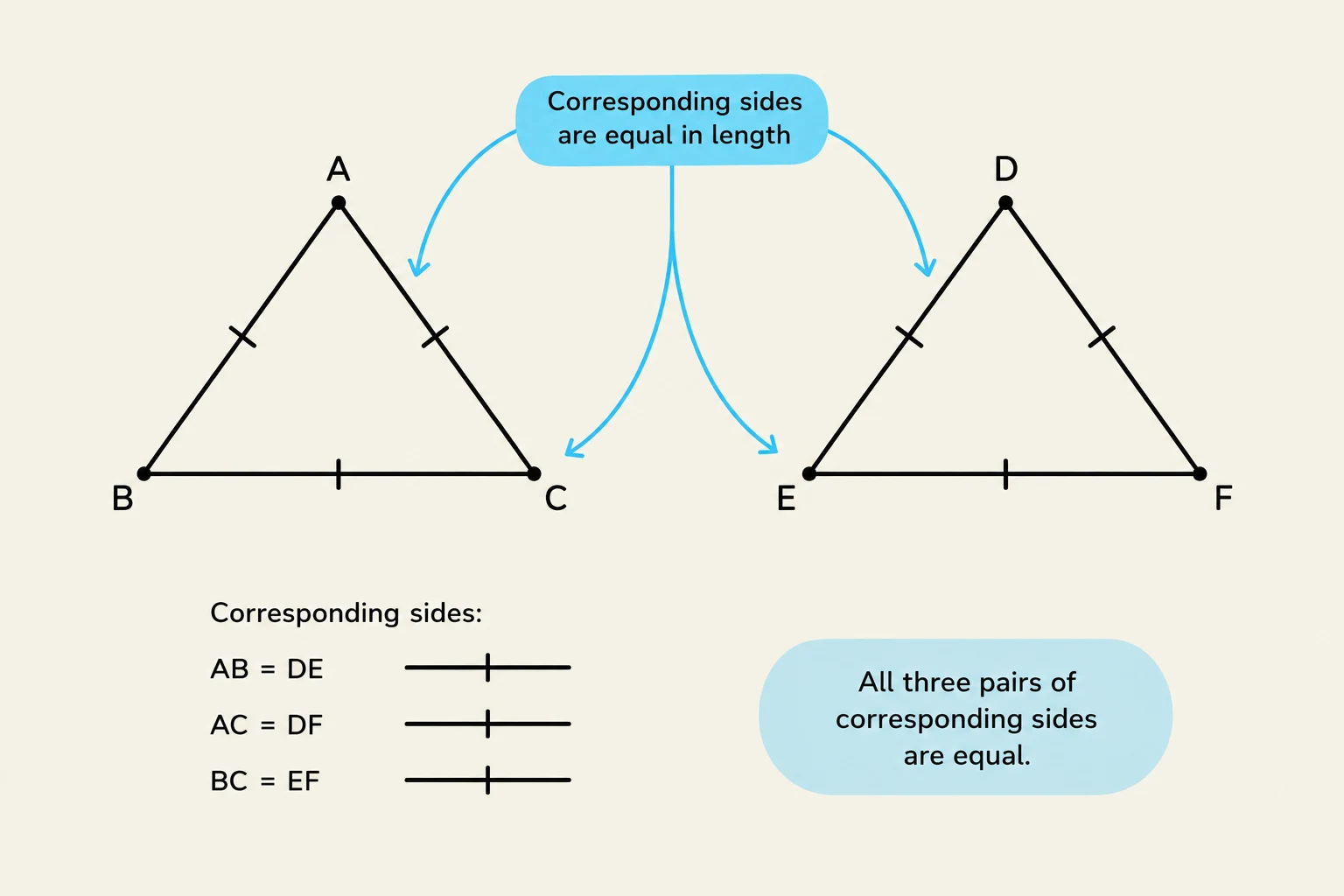
Two triangles are considered congruent if all three corresponding sides are equal in length and all three corresponding angles are equal in measure.
In formal notation, if , it implies:
- $AB = DE$
- $BC = EF$
- $AC = DF$
However, checking all six elements every time is inefficient. This is where congruence theorems come into play. These theorems act as "shortcuts" to prove that two triangles are identical.
Triangle Congruence Theorems
There are five primary rules used to determine if two triangles are congruent. Each rule specifies a different combination of sides and angles that must match.

Keep reading for free.
Create an account to finish this reading and make it part of your study routine.
Continue reading freeAlready have an account? Log in
Updated