Understanding Total Compensation and Organizational Culture
This content explains the components of total rewards, including direct and indirect compensation, and how organizational culture, equity, pay strategies, and external pressures influence compensation systems.
In the modern business landscape, attracting and retaining talent requires more than just a paycheck. Organizations utilize a "Total Rewards" approach, which encompasses all forms of financial and non-financial returns provided to employees. However, designing an effective compensation system is not merely a mathematical exercise in balancing labor costs; it is a deeply human endeavor influenced by the values, expectations, and psychological drivers of the workforce. To build a successful system, leaders must harmonize economic realities with the unique organizational culture and the broader external environment.
Understanding Total Rewards
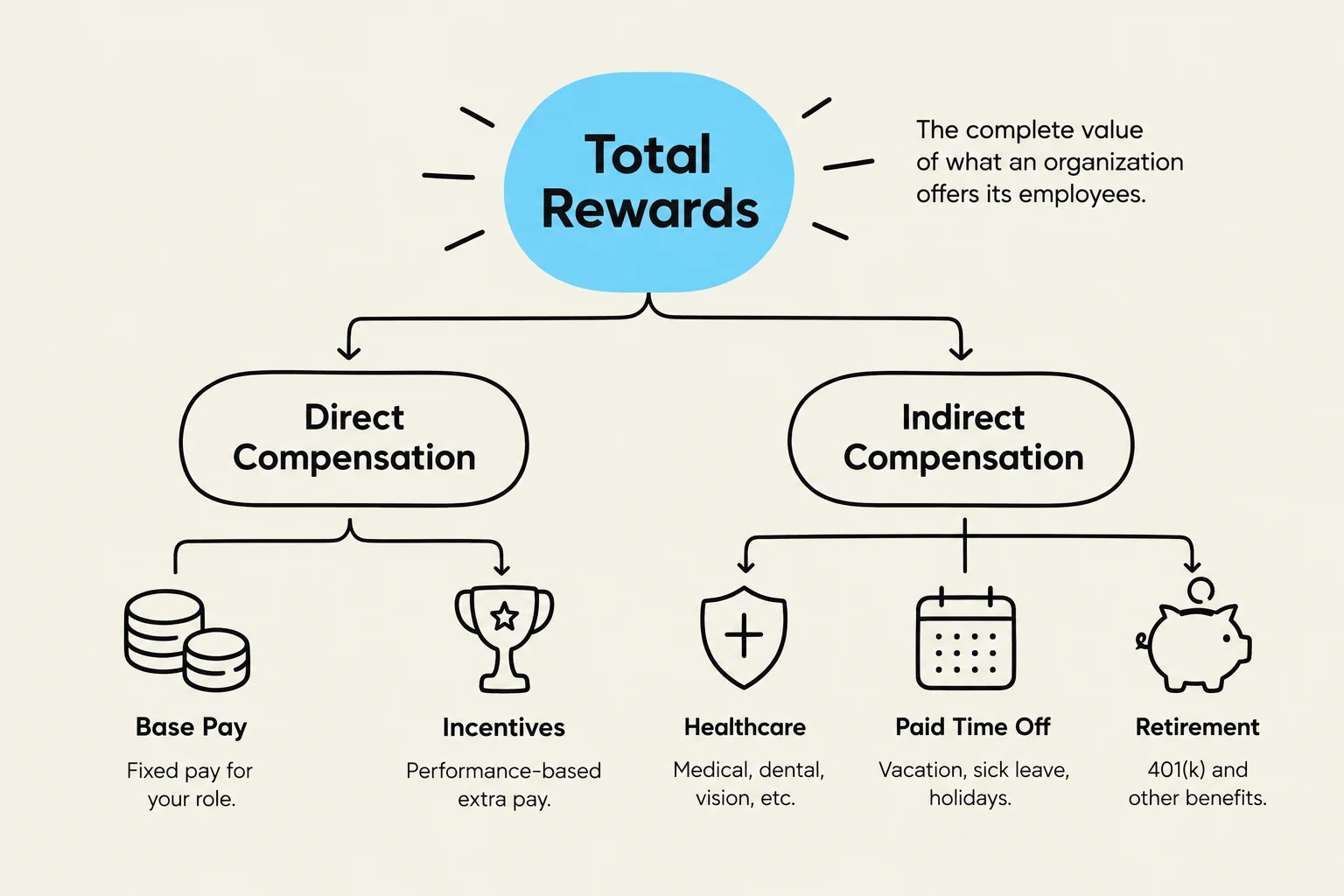
A total rewards strategy is a holistic approach to compensation that goes beyond base salary. It is generally divided into two main categories: direct and indirect compensation.
Direct Compensation: This includes pay systems such as base pay, differential pay, short-term incentives (bonuses), and long-term incentives (like stock options).
Indirect Compensation: These are benefit programs, which typically make up 25-30% of total compensation. Examples include legally required benefits, medical insurance, disability insurance, and "pay for time not worked" (such as paid leave).
The ultimate goal of a total rewards plan is to be compatible with the organization's mission, its corporate culture, and the specific needs of its workforce.
This diagram illustrates the components of total rewards offered by an organization to its employees, categorized into direct and indirect compensation.
The Influence of Organizational Culture
Organizational culture acts as a lens through which employees perceive the value of their rewards. Because different cultures prioritize different behaviors, a "one size fits all" approach rarely works.
Performance-Driven vs. Entitlement-Oriented Cultures
In a performance-driven culture, pay-for-performance is a well-established norm. Rewards are closely tied to individual or team achievements, encouraging high levels of productivity.
Conversely, an entitlement-oriented culture often promotes a "family" atmosphere where employees feel they are entitled to certain benefits, such as healthcare or disability insurance, as a standard condition of employment. In these environments, there is often less emphasis on individual contribution and more focus on the success of the organization as a whole.
Uncertainty Avoidance and Risk
Culture also dictates how much risk an employee is willing to take. In cultures with high uncertainty avoidance, employees tend to be risk-averse and may prefer higher levels of fixed pay (salary) over variable pay (bonuses or commissions).
Exam Tip: When analyzing a case study, look for whether the company rewards "longevity" (entitlement) or "results" (performance). This will tell you which culture is driving their compensation strategy.
Equity: The Foundation of Fairness
For a compensation system to be effective, it must be perceived as fair. This is known as pay equity. If employees feel the system is unfair, the organization will struggle to recruit or retain talent. Equity is viewed through two primary lenses:
Internal Equity: This refers to the fairness of pay within the organization. Employees should feel that differences in job responsibilities or performance levels result in corresponding, fair differences in rewards.
External Equity: This involves comparing the organization's pay levels to those of competitors in the same market, industry, or geographical location.
Interestingly, research suggests a significant gap in perception: approximately 50% of employees do not believe they are paid fairly compared to others in similar positions within their own companies.
Pay Strategies and the Competitive Environment
Organizations must decide how to position themselves in the labor market. This decision is influenced by the competitive environment, which includes the industry, the specific occupation, and the geographic location.
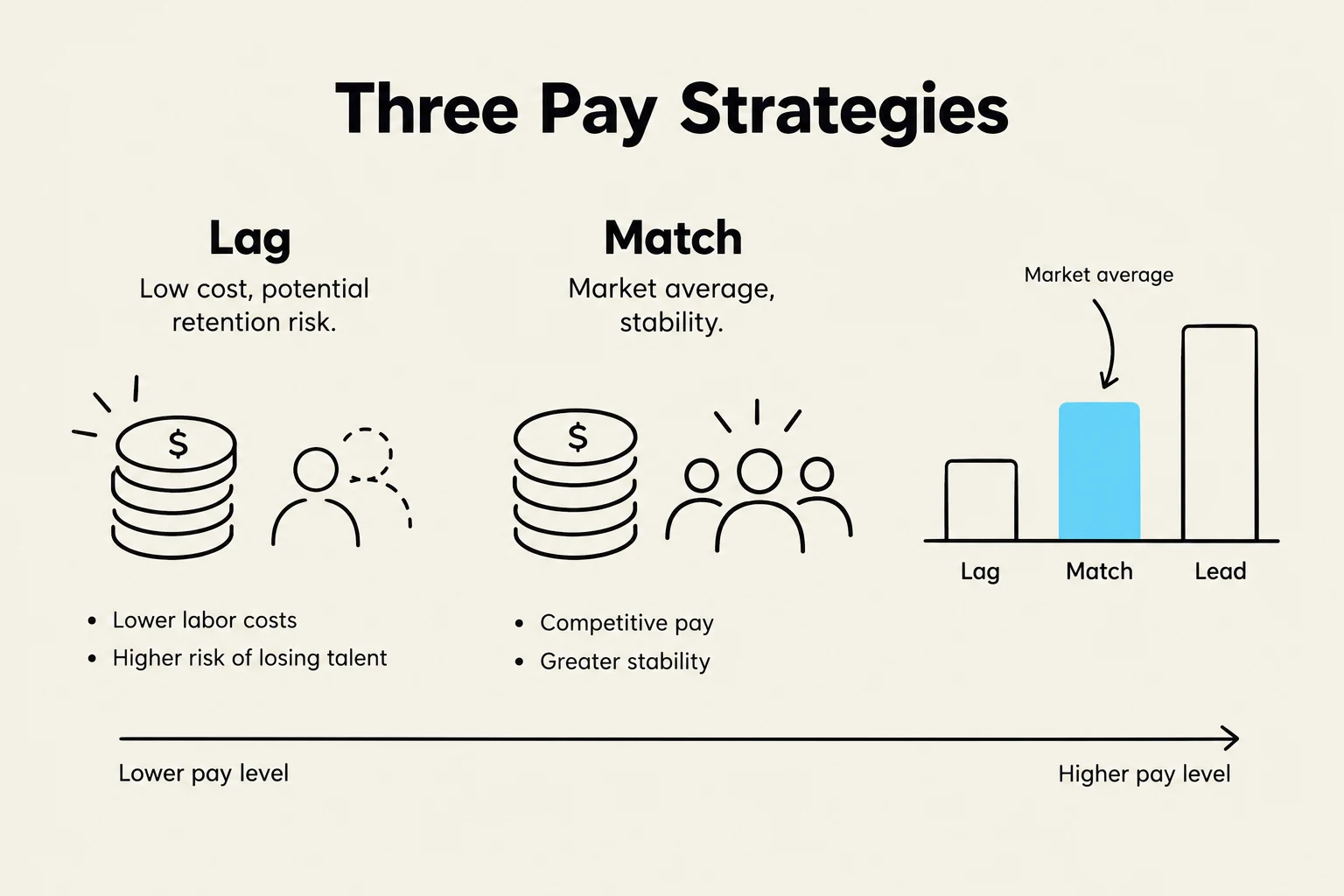
There are three common pay strategies:
Lag Market Competition: The company pays below the market rate. This is often done to control labor costs or due to economic necessity, though it may require offsetting the lower pay with other advantages.
Match Market Competition: The company offers wages and benefits comparable to competitors. This is the most common approach.
Lead Market Competition: The company offers higher wages or superior benefits to attract the highest quality talent.
This illustration outlines three pay strategies: Lag, Match, and Lead, detailing their associated costs, risks, and benefits, and their position relative to market average and pay levels.
External Pressures: PEST and the Economy
Compensation does not exist in a vacuum; it is heavily influenced by the broader business environment, often analyzed through PEST factors:
Political: Government regulations and compliance acts can mandate certain pay or benefit standards.
Economic: Inflation and labor market shifts (such as more job openings than available workers) directly impact salary budgets and employee pay expectations.
Social: Public perception and social norms can influence views on executive pay or social benefits.
Technological: The availability of Human Resource Information Systems (HRIS) allows for more sophisticated management and even outsourcing of compensation functions.
Implementation and the Employee Life Cycle
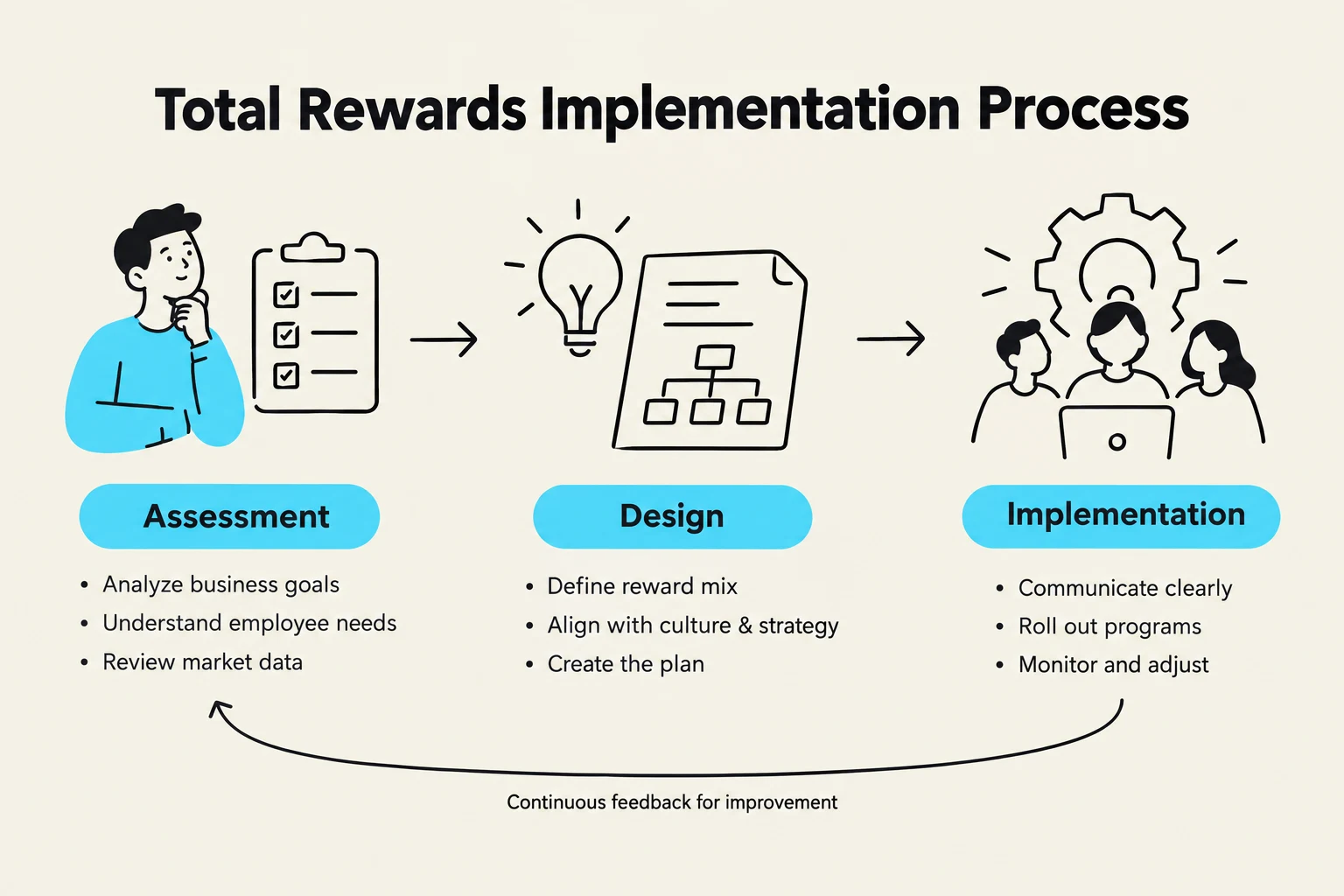
A successful total rewards strategy follows a four-step process: Assessment (reviewing current practices), Design (creating the plan), Implementation (training and rollout), and Evaluation (measuring effectiveness).
During the Employee Life Cycle (ELC)—the entire tenure of an employee within a company—compensation and benefits should be managed to align with their development and growth. As an employee's value to the company increases, their total rewards should ideally evolve accordingly.
Finally, the strategy is only as good as its communication. To ensure employee buy-in, organizations must use effective methods such as individualized statements, self-service technologies, and consistent messaging to ensure employees understand the full value of their total rewards package.
The Total Rewards Implementation Process outlines three key stages: Assessment, Design, and Implementation, with continuous feedback for improvement.
Keep reading for free.
Create an account to finish this reading and make it part of your study routine.