Understanding the Uniform Commercial Code (UCC) Article 2 for Sales
This guide explains the gap-filling provisions of UCC Article 2, which provide default rules for contracts when specific terms like price or delivery are not explicitly stated. It covers rules for delivery, payment, and contract formation, including the 'Battle of the Forms'.
In the fast-paced world of commerce, it is rarely practical for parties to negotiate every single detail of a transaction. While the "dickered" terms—such as the specific goods, quantity, and price—are usually settled, many contracts are created informally with significant gaps regarding the logistics of performance. Under the common law, such gaps might render a contract unenforceable due to indefiniteness. However, the Uniform Commercial Code (UCC) Article 2 adopts a much more flexible approach, providing "gap-filling" provisions to ensure that a contract does not fail simply because certain terms were left open.
Gap-Filling and the Intent to be Bound
The primary goal of the UCC is to uphold the parties' intent to be bound. If the parties intended to make a contract, the absence of a specific term (like price or delivery time) does not automatically void the agreement. Instead, the Code provides statutory "boilerplate" terms to fill these voids.
When a court or a party looks to fill these gaps, they do not simply invent terms out of thin air. They look to three primary sources of context:
Course of Dealing: A sequence of previous conduct between the parties that establishes a common basis of understanding.
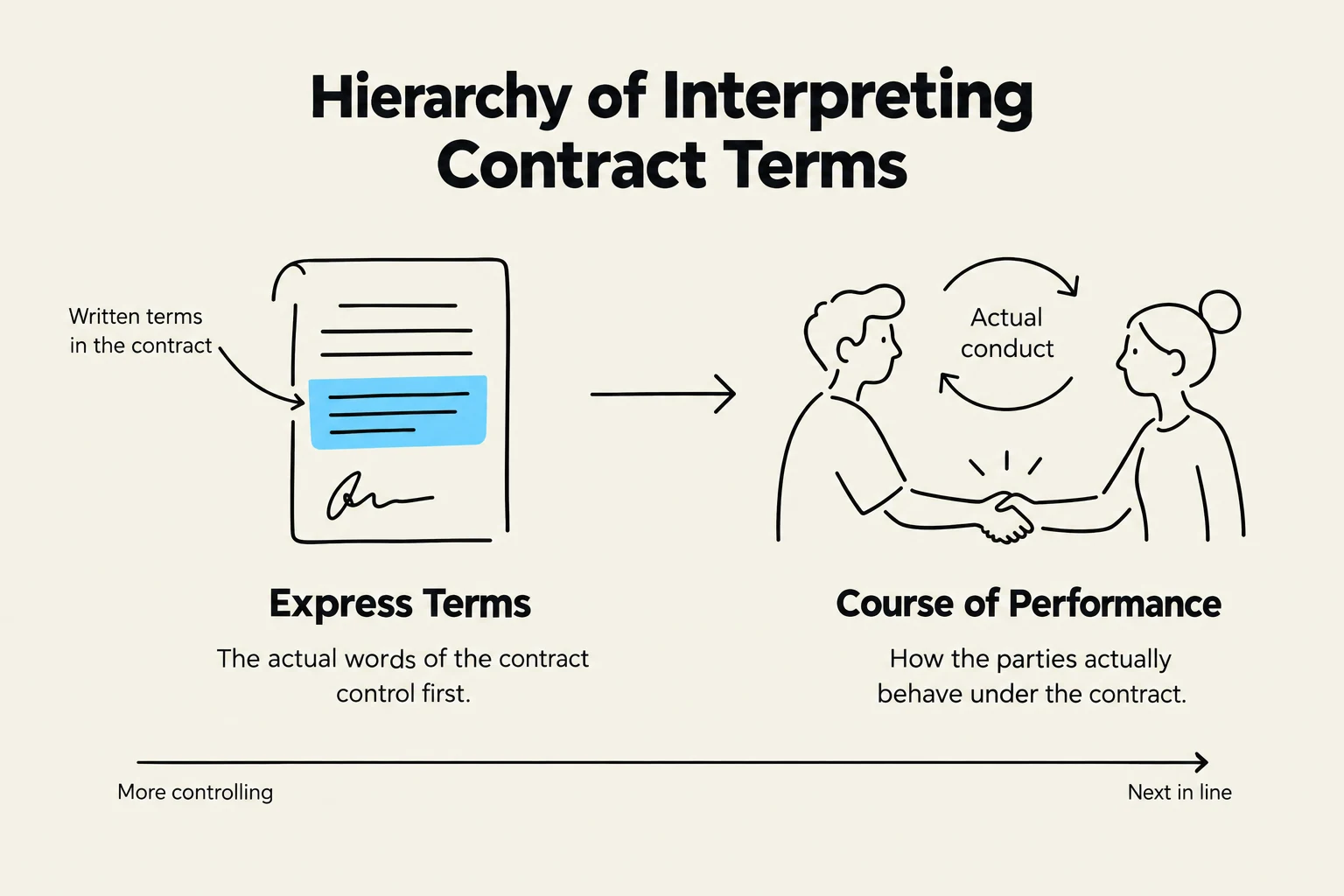
Course of Performance: How the parties have acted under the current agreement so far.
Usage of Trade: Any practice or method of dealing having such regularity of observance in a place, vocation, or trade as to justify an expectation that it will be observed with respect to the transaction in question.
Exam Tip: If a problem mentions that "the parties have done this same way for five years," they are signaling that you should use Course of Dealing to interpret the missing terms.
This diagram illustrates the hierarchy of interpreting contract terms, showing that express terms (written words) are more controlling than the course of performance (actual conduct).
Rules for Delivery and Payment
When the contract is silent on the "how, when, and where" of performance, the UCC provides default rules.
Delivery Time and Place
If no specific time is agreed upon, delivery must occur within a reasonable time. What is "reasonable" depends on the nature of the transaction and any relevant usage of trade. Furthermore, a proper tender of delivery requires the seller to deliver the goods at a reasonable hour and provide reasonable notification to the buyer.
Regarding the place of delivery, the default rule under UCC § 2-308 is the seller's place of business. If the seller has no place of business, the delivery location is the seller's residence.
Shipment vs. Destination Contracts
In many commercial transactions, parties use F.O.B. (Free On Board) terms to allocate the risk of loss during transit.
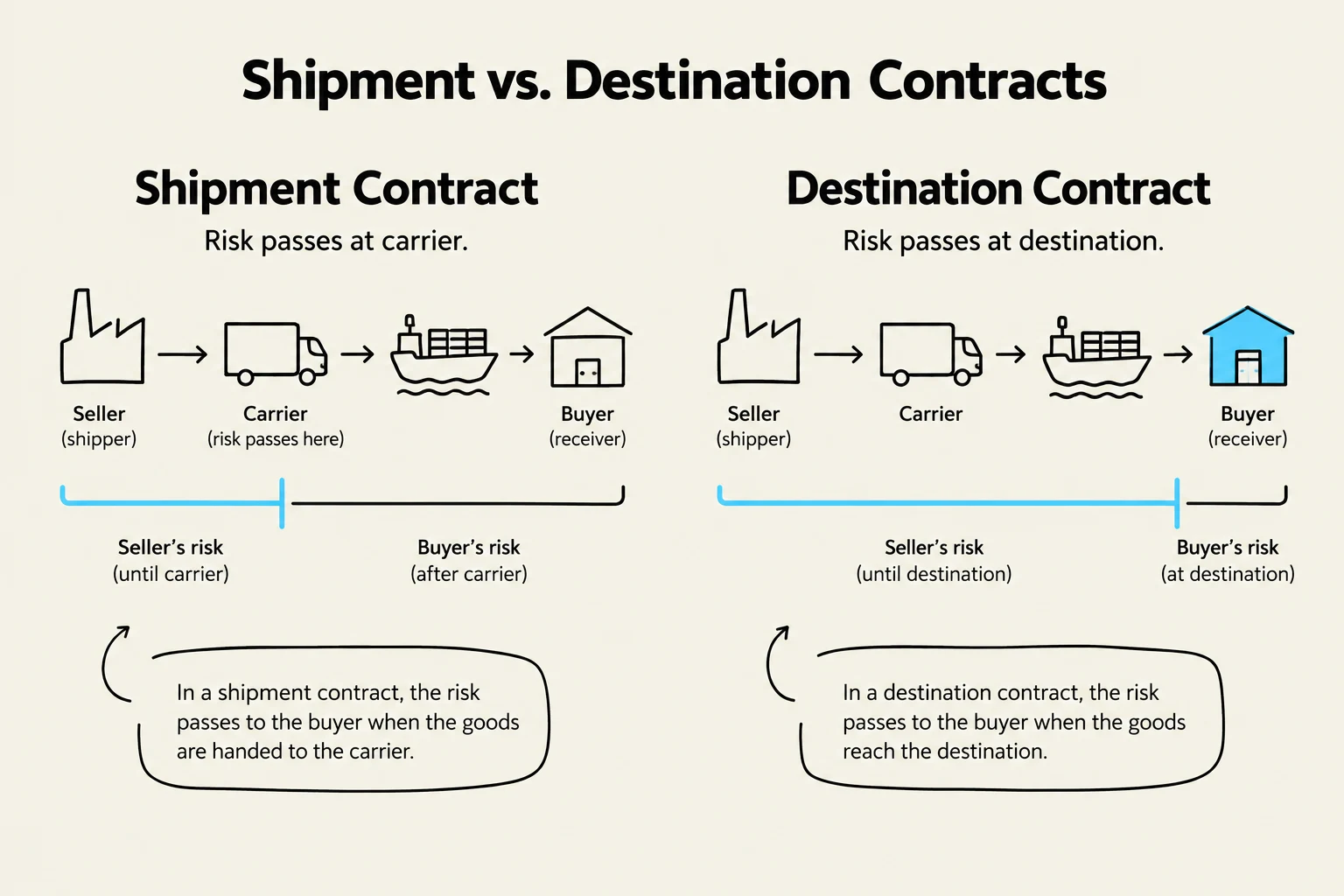
Shipment Contract (F.O.B. Seller's Location): The seller fulfills their obligation by delivering the goods to a common carrier (such as a trucking company or railroad). Once the goods are with the carrier, the risk of loss passes to the buyer.
Destination Contract (F.O.B. Buyer's Location): The seller bears the risk of loss until the goods actually reach the specified destination.
In international trade, these concepts are often expressed through Incoterms, which are standardized terms maintained by the International Chamber of Commerce to allocate risks and costs between buyers and sellers.
Payment and Documentary Sales
Unless otherwise arranged, payment is due at the time and place where the buyer receives the goods. In some large-scale or distant transactions, parties engage in a documentary sale. In this scenario, the seller does not ship the goods directly to the buyer but instead tenders a "bill of lading" (a document from the carrier) to the buyer in exchange for payment. The buyer then uses that document to claim the goods from the carrier upon arrival.
This diagram illustrates the difference between shipment and destination contracts, detailing when risk transfers from seller to buyer based on the contract type.
Contract Formation: The Interaction of § 2-206 and § 2-207
One of the most complex areas of the UCC is the "Battle of the Forms," which occurs when parties exchange standardized documents (like purchase orders and acknowledgments) that contain conflicting fine print. To resolve this, you must follow a specific two-step analytical framework.
Step 1: Formation under § 2-206 and § 2-207(1)
First, determine if a contract was even formed.
UCC § 2-206 is the "construction rule." It states that an offer is generally inviting acceptance in any reasonable manner or medium. However, the offeror is the master of the offer and can specify a particular method or timeframe for acceptance.
UCC § 2-207(1) determines if a response is an acceptance. A response is a valid acceptance even if it contains additional or different terms, provided it is a definite and seasonable expression of acceptance.
The Exception: If the response is expressly conditional on the offeror's assent to the new terms (e.g., "We only accept if you agree to our terms"), it is not an acceptance; it is a counteroffer.
Step 2: Determining the Terms under § 2-207(2)
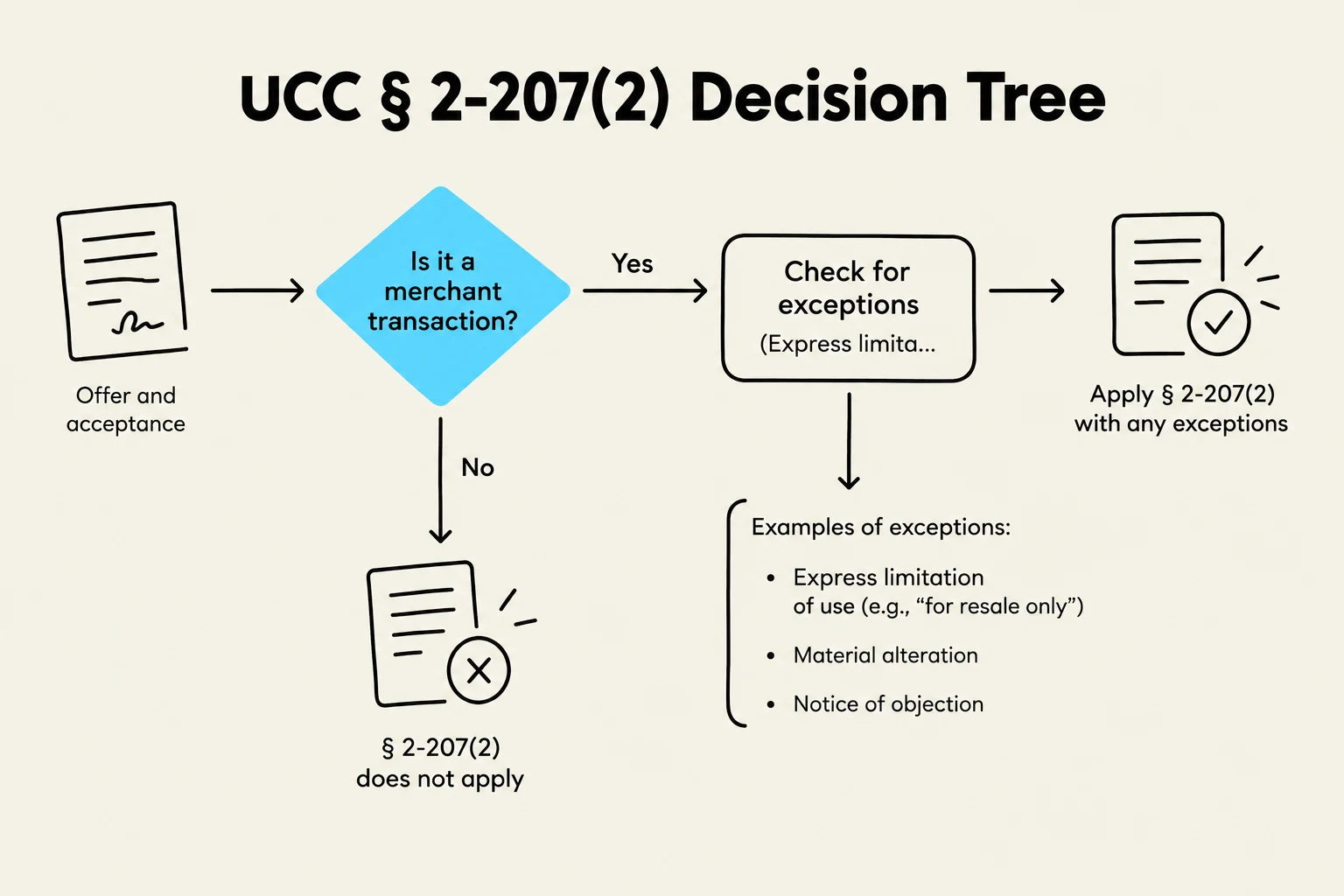
If a contract was formed in Step 1, you must then decide if the "new" terms in the acceptance actually become part of the deal. This depends heavily on whether the parties are merchants.
Between Non-Merchants: Additional terms are treated merely as proposals. They do not become part of the contract unless the other party expressly agrees to them.
Between Merchants: Additional terms automatically become part of the contract UNLESS:
The original offer expressly limits acceptance to its own terms.
The new term materially alters the bargain (e.g., a term that causes "surprise or hardship" or significantly shifts risk/remedies).
The offeror has already objected or objects within a reasonable time.
This decision tree illustrates the application of UCC § 2-207(2) to determine if a contract is formed, considering merchant transactions and exceptions.
Exam Tip: When analyzing a "Battle of the Forms" problem, always separate the questions: (1) Did a contract form? and (2) If so, what are its terms?. If the response was late or "expressly conditional," the answer to the first question is "No."
Summary Table: The § 2-207 Framework
Scenario
Result of Response
Governing Terms
Non-Merchant Transaction
Acceptance (if definite/seasonable)
Agreed terms + UCC Gap-fillers
Merchant Transaction (No exceptions)
Acceptance (if definite/seasonable)
Agreed terms + Additional terms
Merchant Transaction (Material Alteration)
Acceptance (if definite/seasonable)
Agreed terms + UCC Gap-fillers
Expressly Conditional Response
Counteroffer (No contract)
N/A (unless accepted later)
Keep reading for free.
Create an account to finish this reading and make it part of your study routine.