An exploration of the British constitution's uncodified nature, its common law foundations, parliamentary sovereignty, royal prerogative, and the shift towards legal constitutionalism. It contrasts political and legal models and discusses key constitutional statutes, treaties, and conventions.
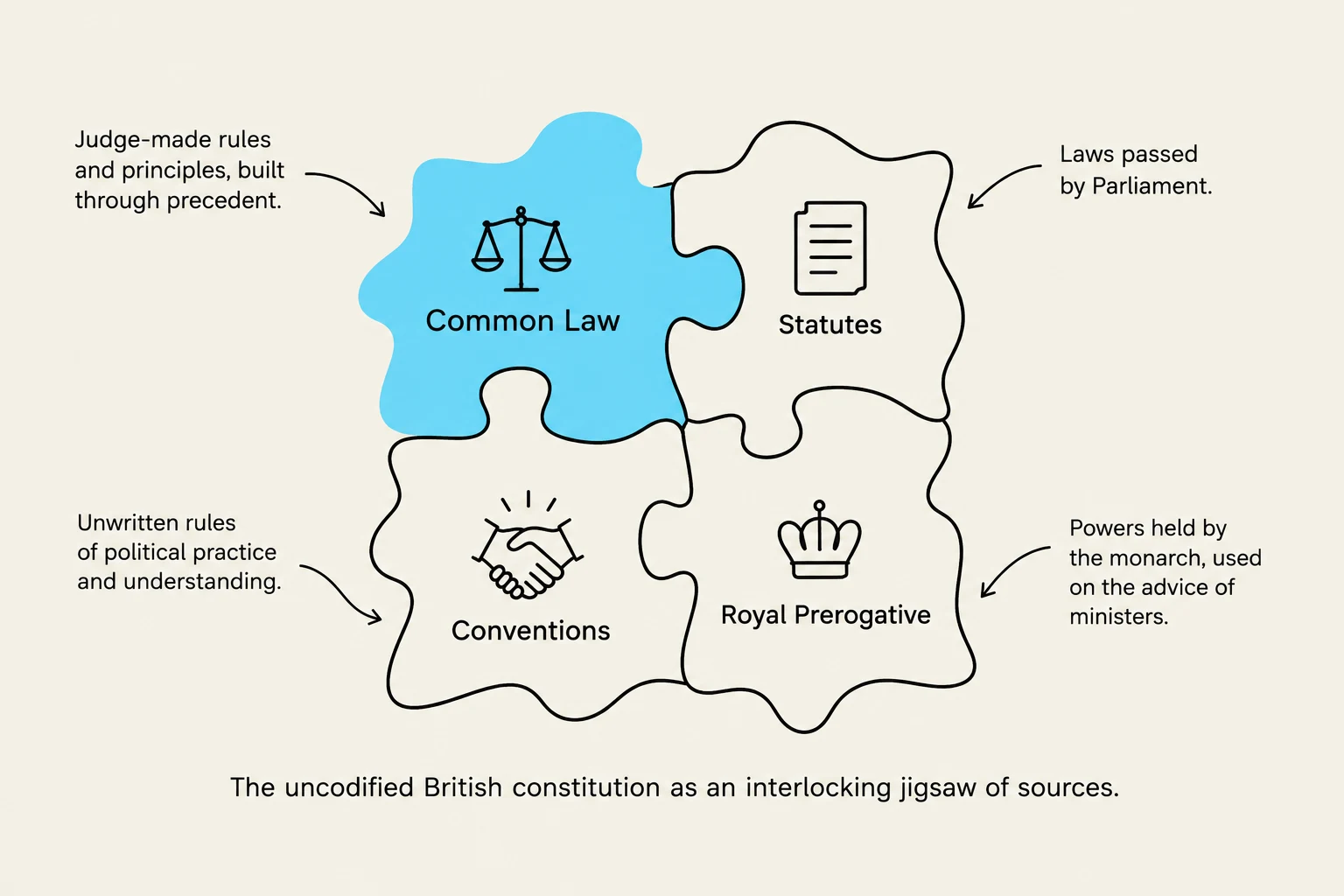
To the uninitiated, the statement "the United Kingdom has no constitution" might sound like a legal absurdity. However, as legal historians like F.W. Maitland famously observed, the British constitution is "everywhere and nowhere". It is not contained within a single, canonical document like the United States or Irish constitutions; instead, it is an uncodified "jigsaw" of various sources, principles, and historical developments. While it lacks a single starting point, it is a living, evolving framework that governs the relationship between the state and the individual.
The uncodified British constitution is depicted as an interlocking jigsaw of sources: Common Law, Statutes, Conventions, and Royal Prerogative.
The Common Law Foundation
The British constitutional framework is deeply rooted in common law—the customary law of England developed and applied by the courts. Much of what we consider "constitutional" is actually "judge-made" law.
Parliamentary Structure and Sovereignty
Parliament is itself a common law creation consisting of three constituent bodies: the King, the House of Lords, and the House of Commons. The cardinal principle of the UK system is parliamentary sovereignty (or supremacy), which A.V. Dicey famously defined as Parliament's right to "make or unmake any law whatever".
However, this sovereignty is not an absolute vacuum. In the landmark Jackson v Attorney General [2005] case, the judiciary noted that because parliamentary sovereignty is a common law construct, the courts may have the authority to determine the extent and limits of Parliament's powers.
The Executive and Royal Prerogative
Diagram illustrating the relationship between the Executive, Judiciary, and Parliamentary Processes, with judicial review acting as a check on executive prerogative powers.
The executive, known as His Majesty's Government, operates using the royal prerogative—the residual powers of the Crown. Many high-level offices are not defined by statute but exist through historical tradition; for example, the Prime Minister (officially the First Minister and Lord of the Treasury) and the Lord Chancellor are common law offices.
The courts have increasingly acted as a check on these powers. In Miller I [2017], the Supreme Court ruled that the executive could not use prerogative powers to bypass Parliament to trigger Brexit. Similarly, in Miller II [2019], the court ruled that the prorogation of Parliament was unlawful because it interfered with both parliamentary sovereignty and the principle of responsible government.
Exam Tip: When discussing the limits of executive power, always link the royal prerogative to the principle of judicial review. Use the Miller cases to demonstrate how the courts protect the legislature from executive overreach.
Constitutional Sources: Beyond the Statutes
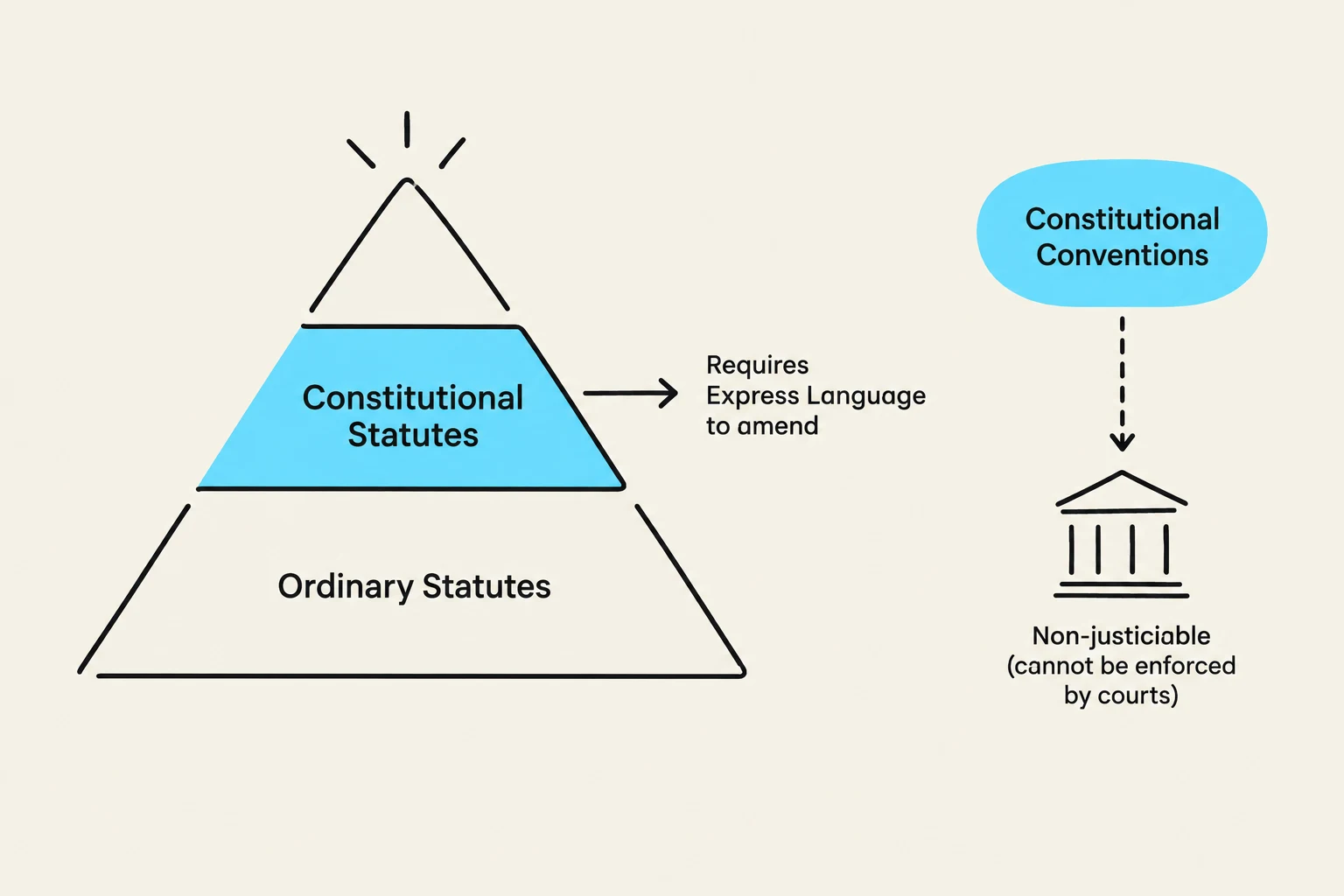
This diagram illustrates the hierarchy of statutes and constitutional conventions, showing that constitutional statutes require express language for amendment and that constitutional conventions are non-justiciable.
Because the constitution is uncodified, it draws from a diverse array of sources.
1. Constitutional Statutes
While traditional theory suggested all statutes were equal, modern law recognizes a hierarchy. In Thoburn v Sunderland City Council [2002], the court identified constitutional statutes—laws that condition the citizen-state relationship or affect fundamental rights. Unlike ordinary laws, these cannot be "impliedly repealed"; Parliament must use clear, express language to amend them.
2. Treaties and International Agreements
Treaties serve as significant constitutional pillars:
Acts of Union (1707): Established the union between England/Wales and Scotland, providing guarantees for the distinct Scottish legal system.
Irish Agreements: The 1921 settlement, the 1985 Anglo-Irish Agreement, and the 1998 Good Friday Agreement have profound implications for human rights and governance in Northern Ireland.
European Convention on Human Rights (ECHR): This influenced the Human Rights Act 1998, allowing UK courts to adjudicate convention rights domestically.
3. Unwritten Conventions
The constitution relies heavily on constitutional conventions—non-legal rules of conduct and practice. While they are essential for functionality (such as ensuring the monarch acts on the advice of ministers), they are non-justiciable, meaning they cannot be enforced by a court.
The Shift in Constitutionalism: From Political to Legal
A central theme in modern British law is the transition between different models of constitutionalism.
Model
Primary Accountability
Role of Courts
Risk
Political Constitutionalism
Elections and Parliament
Deferential
"Elective Dictatorship"
Legal Constitutionalism
The Judiciary
Enforce "Higher Law"
Judicial Supremacy
Intermediate Model (UK)
Hybrid / Evolving
Increasing Oversight
Constant Tension
The Three Models Explained
Political Constitutionalism, associated with J.A.G. Griffith, posits that the constitution is defined by political processes. Accountability is achieved through elections, and courts remain deferential to the legislature. The danger here is the "elective dictatorship," where a government with a large parliamentary majority can act with almost no check.
Legal Constitutionalism is found in systems like the US or Germany, where a "thick" supreme law is entrenched and protected by a powerful judiciary.
The UK currently occupies an intermediate status, as articulated in International Transport Roth GmbH v Home Secretary [2002]. While Parliament remains formally sovereign, judicial creativity and reforms like the Human Rights Act have "thickened" the constitution, moving it toward a model with more robust rights protection and judicial oversight.
Fundamental Principles as Law
The Supreme Court in Miller II confirmed that key constitutional principles are not just political ideas but are enforceable parts of the law. These include:
The Rule of Law: The principle that government must be exercised under the law.
The Principle of Legality: The presumption that Parliament does not intend to override fundamental rights unless it uses express, clear language (Ex p Simms).
Separation of Powers: While qualified in the UK (as the executive sits within the legislature), this was strengthened by the Constitutional Reform Act 2005.
Critical Thought: Is the UK moving toward a "controlled" constitution (where changes require special procedures) or remains "uncontrolled" (changeable by ordinary legislation)? The rise of constitutional statutes suggests the former, while the power of Parliament to pass acts like the Safety of Rwanda Act 2024 suggests the latter.
Keep reading for free.
Create an account to finish this reading and make it part of your study routine.