Understanding the U.S. Constitutional Democratic Republic
An explanation of the U.S. system as a constitutional democratic republic, detailing its separation of powers, checks and balances, and the evolution of popular rule.
The United States government is often described as a complex machine with many moving parts, designed specifically to prevent any single component from seizing total control. To understand how this machine works, one must look past simple labels like "democracy" and recognize that the American system is a constitutional democratic republic. This system is a unique intersection of three distinct concepts: it is constitutional because it operates under the rule of law to protect individual rights; it is democratic because it allows for majority influence through elections; and it is a republic because it uses deliberative institutions to moderate power and protect minority rights from the potential excesses of majority rule.
Understanding Systems of Power
To grasp the American model, we must first distinguish it from other ways of allocating power. Political scientists generally categorize systems into three types: democratic, constitutional, and free-market.
Democratic systems focus on majority rule through elections. This can empower majorities (known as majoritarianism), various interest groups (pluralism), or government officials (authority).
Constitutional systems are based on the rule of law. Instead of just following what the majority wants, a constitutional system empowers individuals through legal protections, such as freedom of expression. This is rooted in constitutionalism, the principle that there are lawful restrictions on what a government can and cannot do.
Free-market systems are economic rather than purely political. They rely on transactions between private parties, which empowers business firms (corporate power) and the wealthy (elitism).
Exam Tip: If a question asks about the primary difference between a "democratic system" and a "constitutional system," focus on the constraint. A democratic system emphasizes the will of the majority, while a constitutional system emphasizes the legal limits placed on that will to protect individuals.
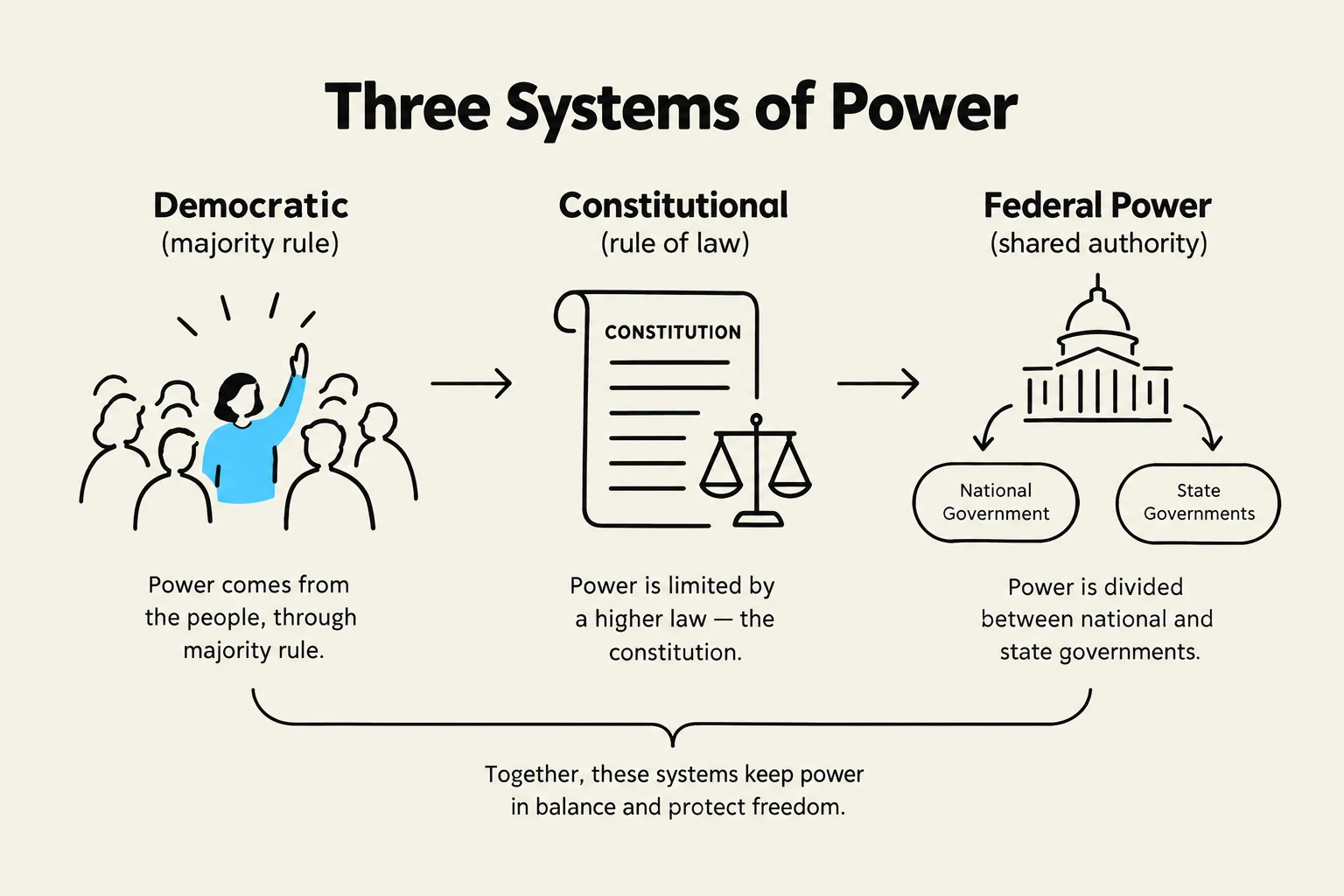
This diagram illustrates three systems of power: Democratic (majority rule), Constitutional (rule of law), and Federal Power (shared authority). It explains how power originates from the people, is limited by a constitution, and is divided between national and state governments, all working together to maintain balance and protect freedom.
The Framers' Dilemma: Republic vs. Direct Democracy
When the delegates met at the Constitutional Convention in Philadelphia, they were deeply concerned about the "tyranny of the majority". They feared that if the people were allowed to vote directly on every issue—a system known as direct democracy—an irrational or angry mob might trample on the rights of minority groups.
To solve this, they opted for a representative democracy and a republic. In a representative democracy, the people elect delegates to make decisions on their behalf. By structuring the government as a republic, the framers ensured that majority rule would be tempered by carefully designed institutions that protect minority rights.
Historically, the United States practiced limited popular rule. In the original design, the House of Representatives was the only body directly elected by the people. The President was chosen by the Electoral College, and Senators were appointed by state legislatures rather than being elected by the public.
The Evolution of Popular Power
Over time, various political movements pushed to give the electorate a more direct voice in government. This shift moved the U.S. from a system of limited popular rule toward a more robust democracy:
Jeffersonian Democracy: Argued that government should belong to all citizens, not just a small elite.
Jacksonian Democracy: Pushed for states to award electoral votes to the winner of the popular vote, increasing the weight of the individual voter.
The Progressives: This era brought significant structural changes, including the introduction of primary elections (allowing voters to choose party nominees), the direct election of senators, and the implementation of popular referendums and initiatives.
Separated Institutions Sharing Power
The most distinctive feature of the American system is the way power is distributed. Rather than simply "separating" powers into isolated silos, the framers created separated institutions sharing power. This is achieved through a system of checks and balances, where each branch of government has the constitutional authority to limit the actions of the others.
The government is divided into three distinct branches:
The Legislative Branch (Congress): Responsible for making laws. It can check the other branches by impeaching the president, overriding presidential vetoes, and confirming judicial nominees.
The Executive Branch (President): Responsible for enforcing laws. It can check Congress by vetoing legislation and can check the judiciary by nominating federal judges and issuing pardons.
The Judiciary Branch (Supreme Court and lower courts): Responsible for interpreting laws. It can check both Congress and the President by declaring acts or executive actions unconstitutional.
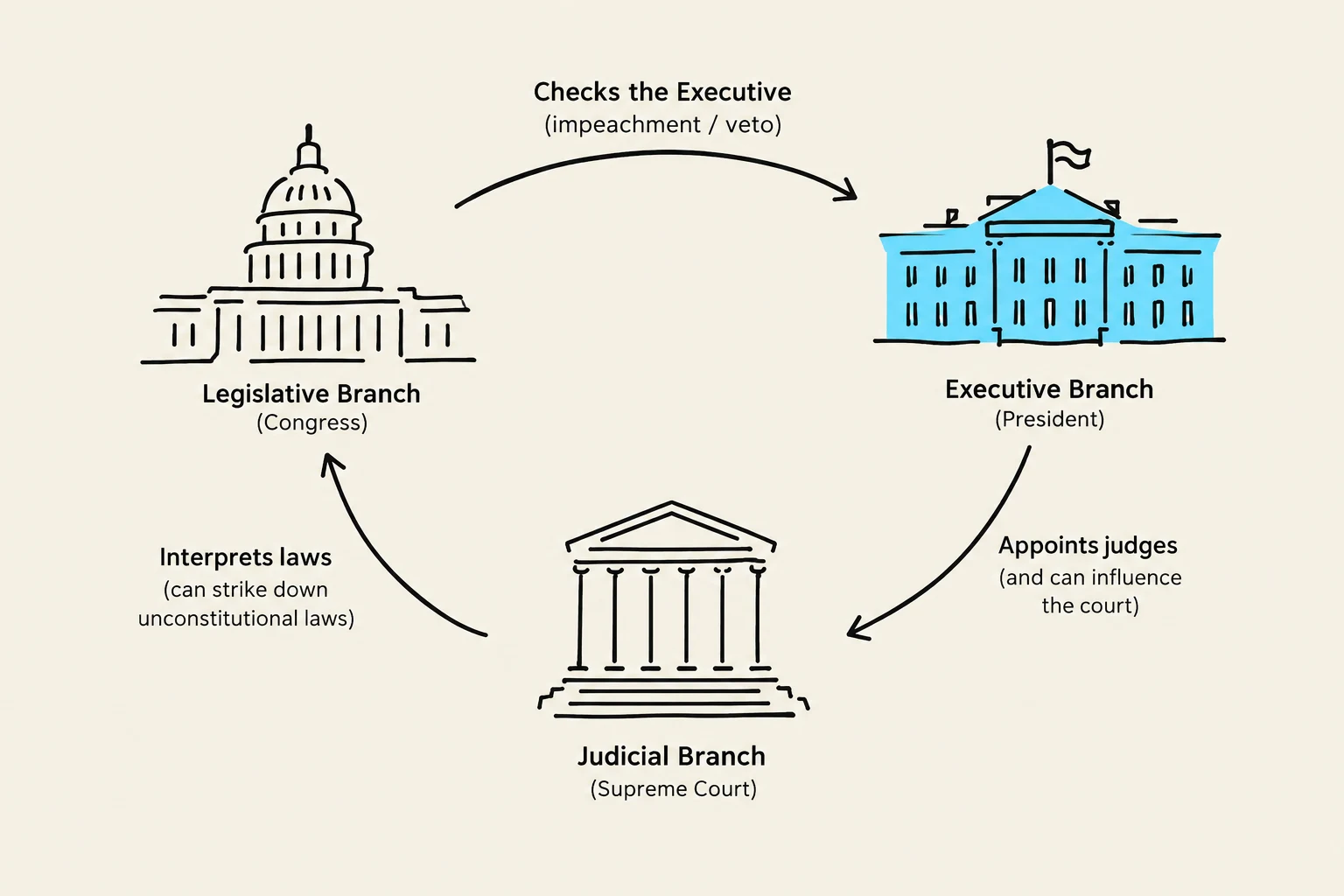
This diagram illustrates the checks and balances between the three branches of the U.S. government: the Legislative Branch (Congress), the Executive Branch (President), and the Judicial Branch (Supreme Court).
Worked Example: The Veto Process
Imagine Congress passes a law that the President believes is harmful to the country. Under the system of checks and balances, the President (Executive Branch) can use their power to veto the bill. However, the power is "shared"—if Congress believes the law is essential, they can attempt to override that veto with a two-thirds majority vote, effectively checking the President's power.
Why the System is "Slow"
Because of this design, the American system is often less direct than other democracies around the world. Several constitutional barriers prevent a single majority from quickly transforming the entire government:
Divided Branches: One party may control the Presidency while another controls Congress, leading to gridlock.
Staggered Terms of Office: Not everyone is up for election at the same time (for example, only one-third of the Senate is elected every two years), which prevents sudden, massive shifts in policy.
Separate Constituencies: Different officials represent different groups (e.g., a Senator represents an entire state, while a Representative represents a specific district), meaning they are often answering to different sets of voters.
In summary, the U.S. constitutional democratic republic is a system built on tension. It balances the need for an effective, strong government with the necessity of protecting individual liberty through limited power and shared authority.
Keep reading for free.
Create an account to finish this reading and make it part of your study routine.