Understanding the Stages and Processes of Human Memory
Explore the dynamic and constructive nature of memory, detailing the three key stages: encoding, storage, and retrieval. Learn about sensory, short-term, and long-term memory, including the biological basis and different types of memory such as explicit and implicit.
Memory is not a static recording device like a video camera; rather, it is a constructive, dynamic process of maintaining information in our brain to facilitate learning. To understand how we remember, we must view memory as a three-stage cycle: encoding (taking in information), storage (maintaining that information), and retrieval (accessing it later).
The Stages of Memory Processing
The journey of a single thought or sensation begins with encoding, the process of taking in information from our environment or our internal thoughts and feelings. Once encoded, information must undergo storage, where it is maintained for later access, and eventually retrieval, which is the act of bringing that information back to consciousness.
Sensory Memory: The Briefest Window
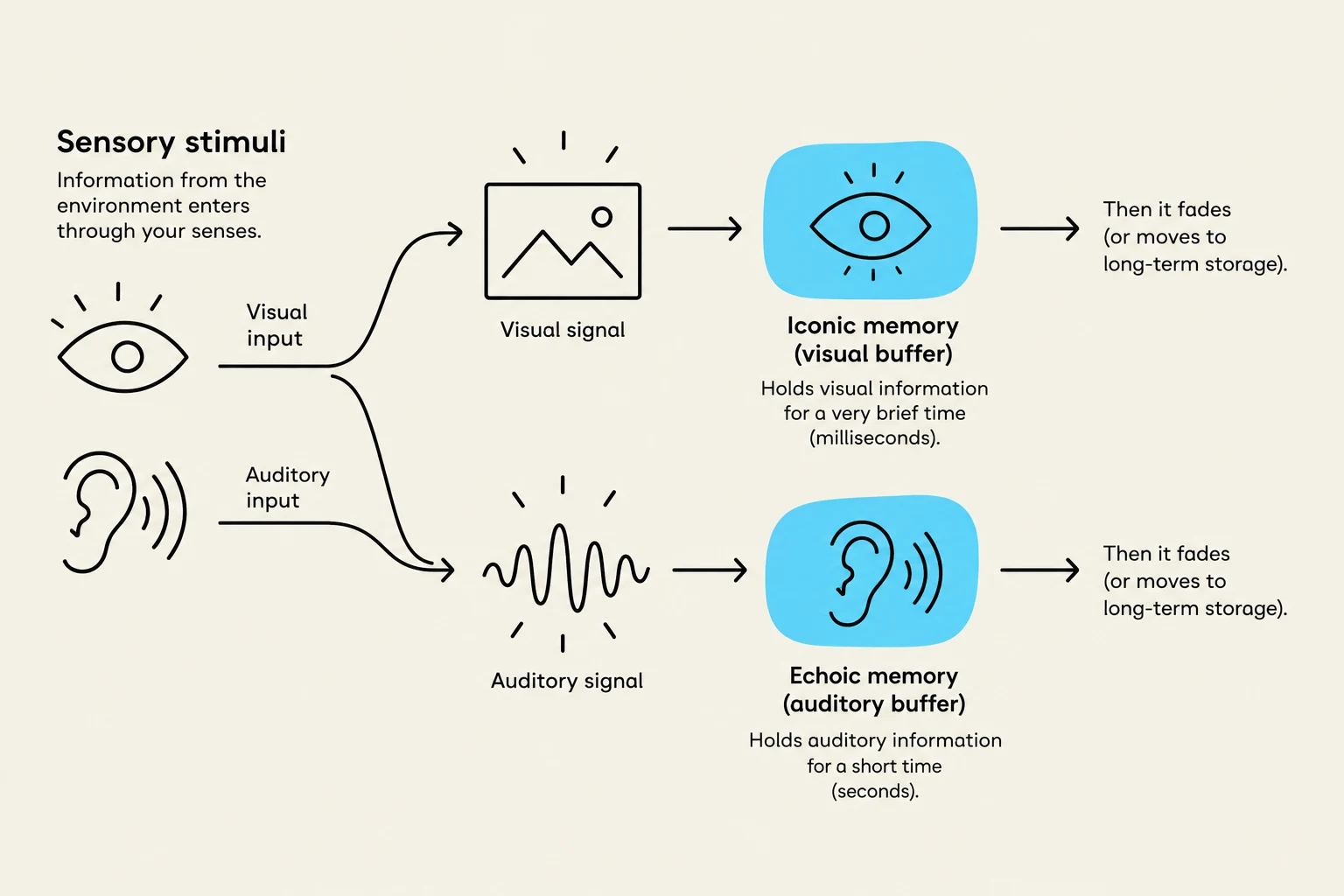
Before information reaches our conscious mind, it enters sensory memory, which holds sensory information for a very brief period—ranging from milliseconds to a few seconds. This is made possible by neural persistence, which is the activity in neurons that continues even after a stimulus has ended. This persistence allows us to perceive a continuous world rather than a series of disconnected snapshots.
Sensory memory is divided into specific modalities:
Iconic memory: Sensory memory related to vision.
Echoic memory: Sensory memory related to hearing.
This diagram illustrates the process of sensory stimuli entering the environment through our senses, being processed as visual or auditory signals, and then stored briefly in iconic (visual) or echoic (auditory) memory before fading or moving to long-term storage.
Short-Term and Working Memory
If we pay attention to sensory information, it moves into short-term memory, which holds information for a matter of seconds to less than a minute. Unlike the nearly limitless sensory memory, short-term memory has a limited capacity, but the information it holds is more meaningful.
To manage this information, we use several cognitive strategies:
Rehearsal: The mental repetition of information to keep it in memory.
Chunking: Grouping individual stimuli into related categories to increase the amount of information we can hold.
Modern psychology often refers to this active processing as working memory. Within working memory, the central executive acts as a control center, handling information and solving problems. The tools used by this central executive are known as executive functions, which include cognitive control and the ability to focus on tasks while filtering out distractions.
Long-Term Memory: The Infinite Archive
Long-term memory is the stage where information is placed for storage lasting from hours to many years. It has no defined limits in capacity or duration.
The way we recall items from a list often follows the serial position curve:
Primacy effect: A boost in memory for information studied at the beginning of a list.
Recency effect: A boost in memory for information studied at the very end of a list.
Exam Tip: If a question asks about the difference between short-term and long-term memory, remember that short-term memory is characterized by limited capacity and duration, whereas long-term memory is characterized by potentially infinite capacity and much longer duration.
The Biology and Types of Memory
Memory is deeply rooted in our brain's architecture. The hippocampus is one of the primary regions involved in successful memory formation. Damage to this area can lead to significant memory impairments:
Anterograde amnesia: The inability to transfer information from short-term to long-term memory, meaning new long-term memories cannot form.
Retrograde amnesia: The incapacity to retrieve old memories, though the ability to form new ones remains intact.
Explicit vs. Implicit Memory
Long-term memory is categorized into two distinct forms:
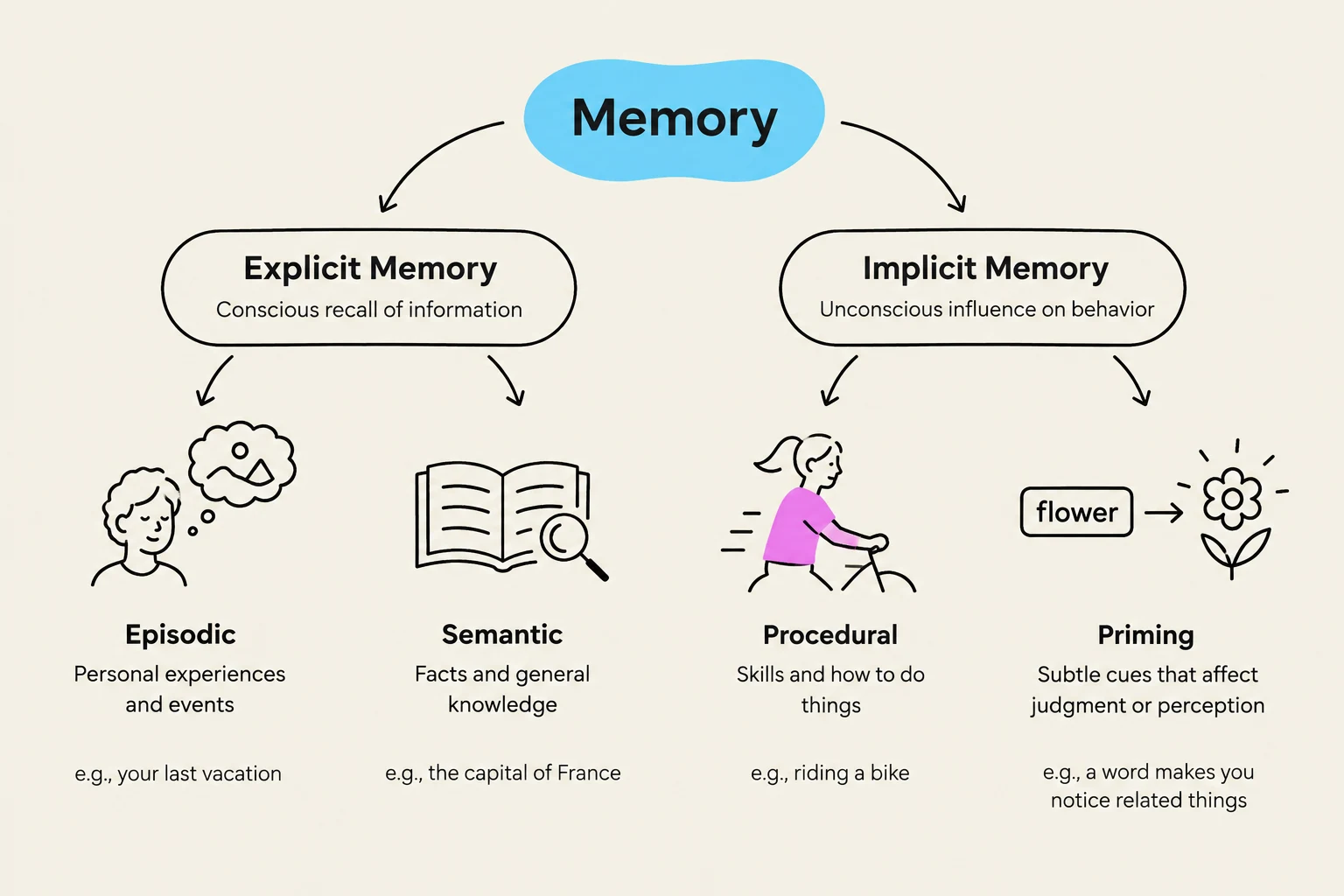
Explicit Memory (Declarative): Involves intentional and conscious remembering. This includes episodic memory (personal experiences and specific time/place) and semantic memory (facts and general knowledge about the world).
Implicit Memory (Nondeclarative): Occurs without intentional awareness. A key type is procedural memory, which relates to the acquisition of skills. Even people with certain types of amnesia often retain their procedural memory.
This diagram illustrates the two main types of memory: explicit and implicit. Explicit memory involves conscious recall of information, further divided into episodic (personal experiences) and semantic (facts and general knowledge). Implicit memory, which influences behavior unconsciously, includes procedural memory (skills) and priming (subtle cues affecting perception).
Strategies for Better Encoding
The durability of a memory depends heavily on how it is processed during the encoding stage.
Shallow encoding: Processing information based on superficial sensory characteristics.
Deep encoding: Processing information based on meaning or past experiences.
Self-referential encoding: A specific form of deep encoding where you relate information to yourself.
To enhance deep encoding, you can use mnemonics or the method of loci (a technique used by many Indigenous cultures) to create stronger mental associations.
Forgetting and the Constructive Nature of Memory
Forgetting is not always a failure; sometimes it is a byproduct of how memory works. The forgetting curve shows that forgetting is initially rapid and then levels off over time.
Forgetting can be caused by:
Trace decay theory: The weakening of a memory trace due to lack of use.
Interference theory: New and old information clashing. This includes retroactive interference (new learning disrupts old recall) and proactive interference (old learning disrupts new recall).
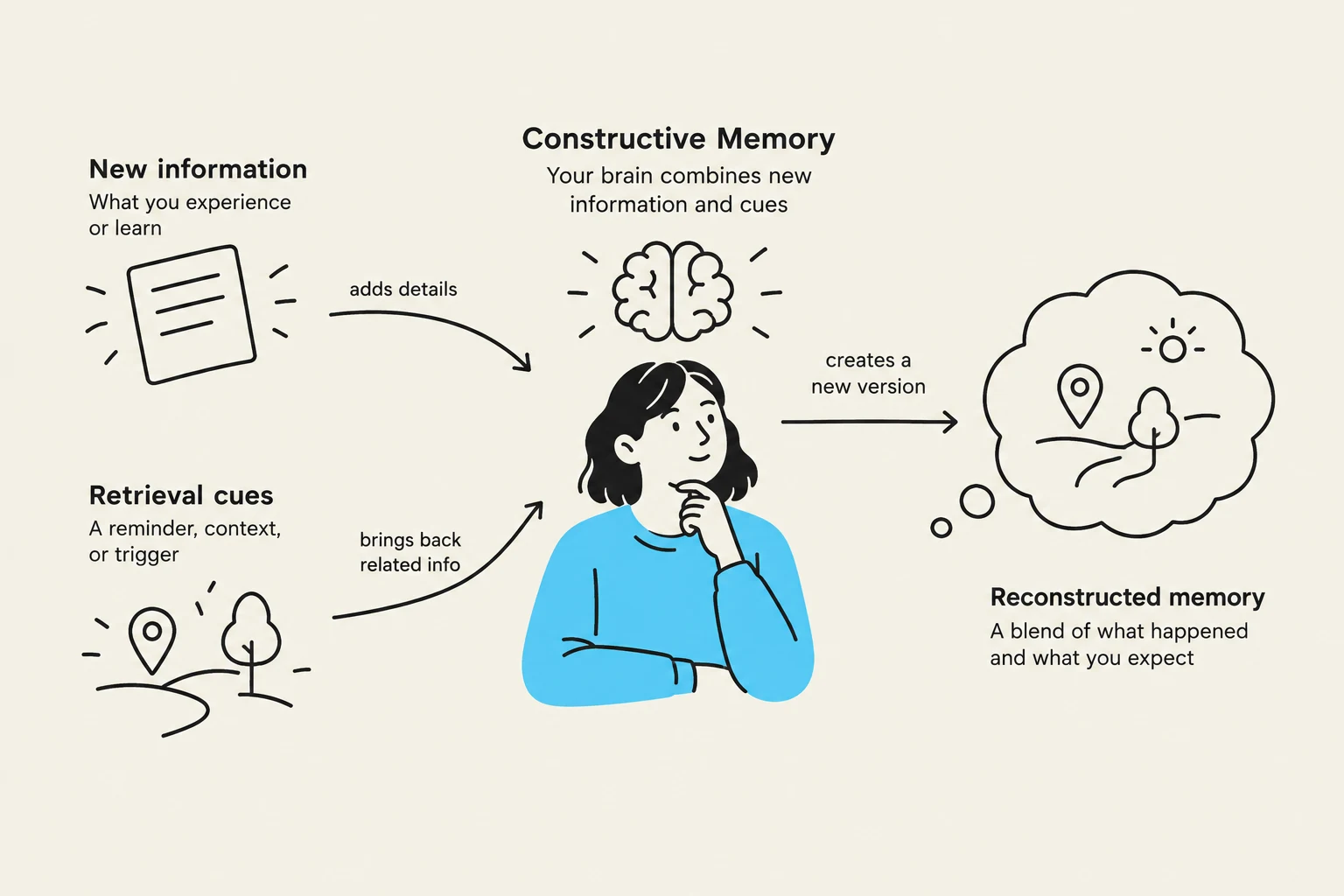
It is also vital to recognize that memory is constructive. This means we can experience false memories—retrieving events that never actually occurred. This can be influenced by the misinformation effect (receiving incorrect info after an event) or memory suggestibility (the influence of others' reports).
This diagram illustrates the concept of constructive memory, where new information and retrieval cues interact with the brain to create a reconstructed memory that is a blend of actual events and expectations.
Study Tip: To improve your memory, utilize the spacing effect—encode information over several sessions rather than "cramming" in one go.
Keep reading for free.
Create an account to finish this reading and make it part of your study routine.