Understanding the Series 63 Exam and State Securities Regulation
This guide explains the Series 63 exam, its role in state securities regulation, and the key concepts tested, including the Uniform Securities Act, NASAA's role, and federal vs. state jurisdiction under NSMIA.
For professionals entering the securities industry, obtaining the correct licenses is a critical first step toward a legal career. While many begin with federal-level exams like the Series 7, most states require an additional layer of certification to ensure that individuals understand the specific nuances of local laws. This is where the Series 63 Exam, formally known as the Uniform Securities Agent State Law Examination, becomes essential.
The Role of NASAA and the Uniform Securities Act
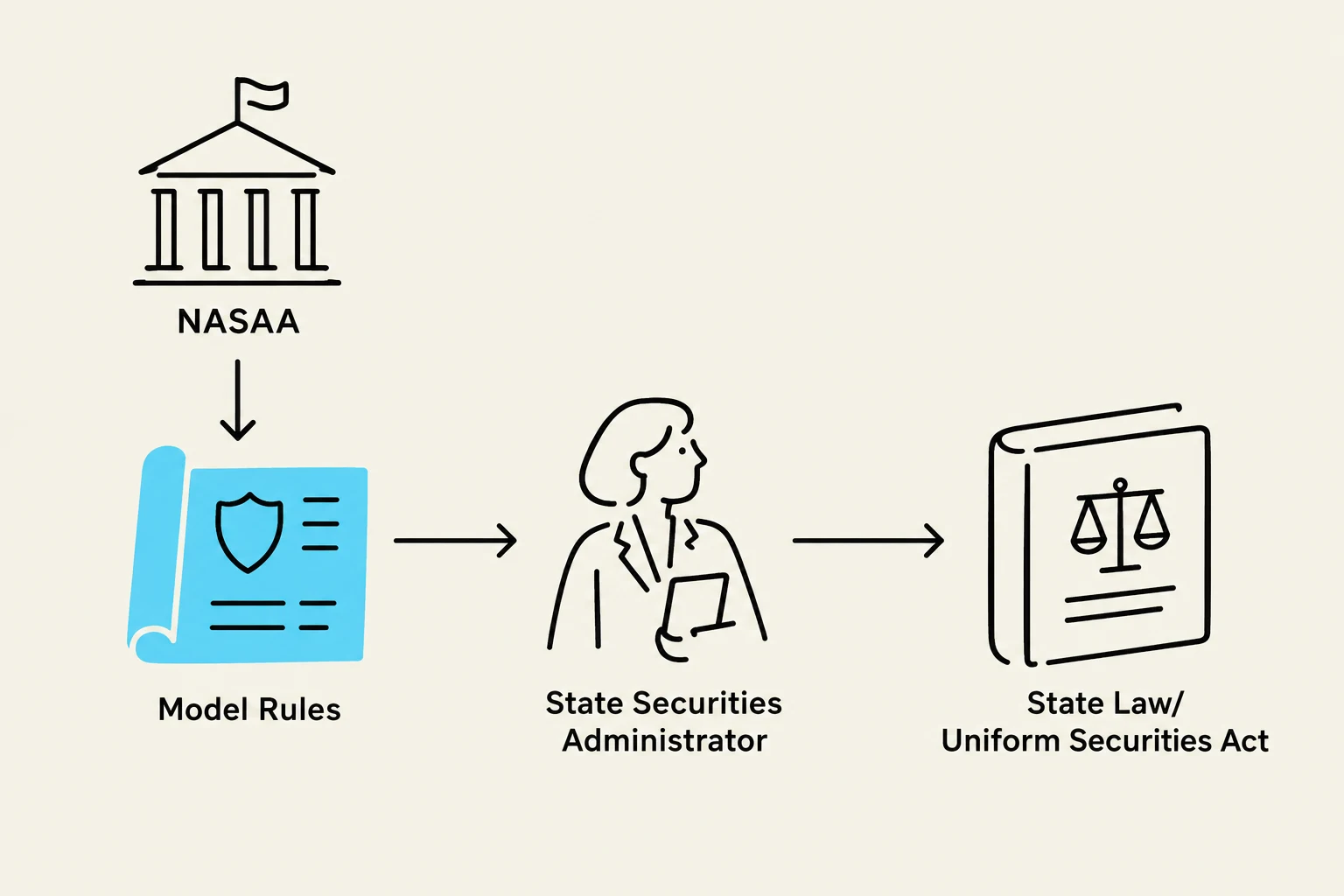
Diagram illustrating the process from NASAA Model Rules to State Securities Administrator and finally to State Law/Uniform Securities Act.
To understand the Series 63, one must first understand the organization that developed it: the North American Securities Administrators Association (NASAA). NASAA is a nonprofit association composed of state, provincial, and territorial securities regulators from the United States, Canada, and Mexico.
The primary mission of NASAA is to protect investors from fraud, support responsible capital formation, and ensure the integrity of financial markets. Because each state has its own sovereignty, regulators could easily create a confusing patchwork of conflicting rules. To prevent this, NASAA proposes Model Rules—standardized templates for regulation that can be adopted by various states to create consistency.
Exam Tip: Model Rules vs. Law
It is vital to remember that NASAA's Model Rules are not legally binding on their own. They only become law once a state’s Securities Administrator or Commissioner formally adopts them through an administrative rulemaking process.
The backbone of state-level regulation is the Uniform Securities Act (USA) of 1956. This Act serves as the model for state securities laws, which are colloquially known as "blue sky" laws. The term originated from a 1917 Supreme Court opinion describing fraudulent schemes as having no more substance than "feet of blue sky".
Federal vs. State Jurisdiction: The Impact of NSMIA
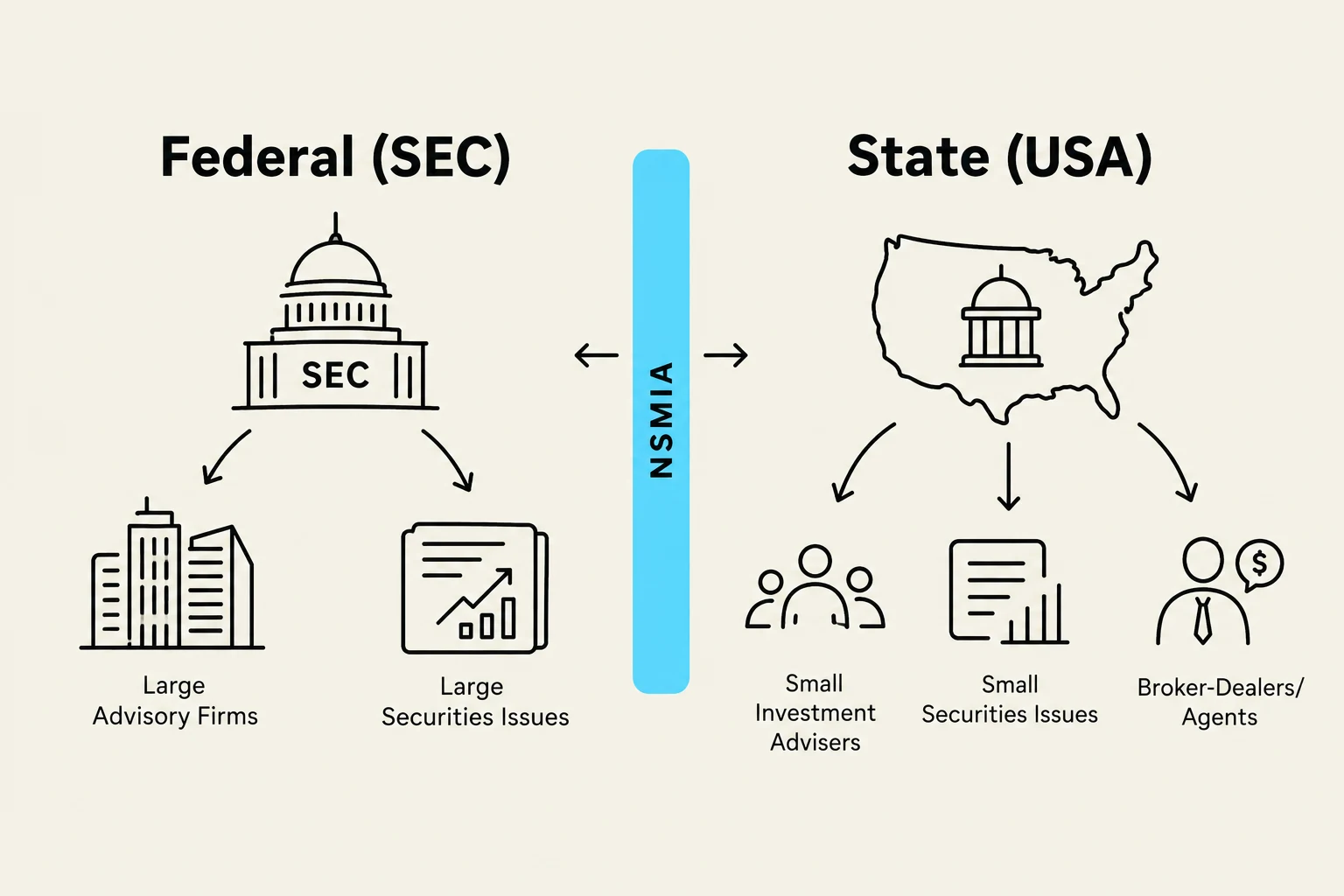
This diagram illustrates the regulatory oversight of securities in the United States, differentiating between federal regulation by the SEC and state regulation, with the NSMIA acting as a bridge.
A common challenge for students is distinguishing between what a state regulator can do and what the federal government (the SEC) controls. This distinction was clarified by the National Securities Markets Improvement Act (NSMIA) of 1996.
Before NSMIA, both the state and federal governments often attempted to regulate the same firms, creating redundant and burdensome requirements. NSMIA streamlined this by designating certain entities as federal covered.
Federal Covered Investment Advisory Firms: Large advisory firms are regulated by the SEC rather than the states.
Federal Covered Securities: Large securities issues are also under federal jurisdiction.
State Jurisdiction: State regulators retain authority over smaller investment advisers, smaller securities issues, and the registration of broker-dealers and agents.
Quick Identification Rule
If you see an Act in an exam question that includes a specific year (e.g., Securities Act of 1933 or Investment Advisers Act of 1940), it is a federal regulation. If the term "USA" is used, it refers to state regulation.
Exam Specifications and Content Areas
The Series 63 is a 65-question, multiple-choice exam. While there are 65 questions provided, 5 of these are unscored "pre-test" questions used for future exam development, meaning you are actually being graded on 60 questions. You have 1 hour and 15 minutes to complete the test, and a passing score of 72% is required.
The content is weighted across several key domains:
Content Area
Percentage of Exam
Regulation of Broker-Dealers and Agents
25%
Ethical Practices and Obligations
25%
Communications With Customers and Prospects
20%
USA Remedies and Administrative Provisions
11%
Regulation of Investment Advisers/Representatives
10%
Regulation of Securities and Issuers
9%
Key Definitions for Success
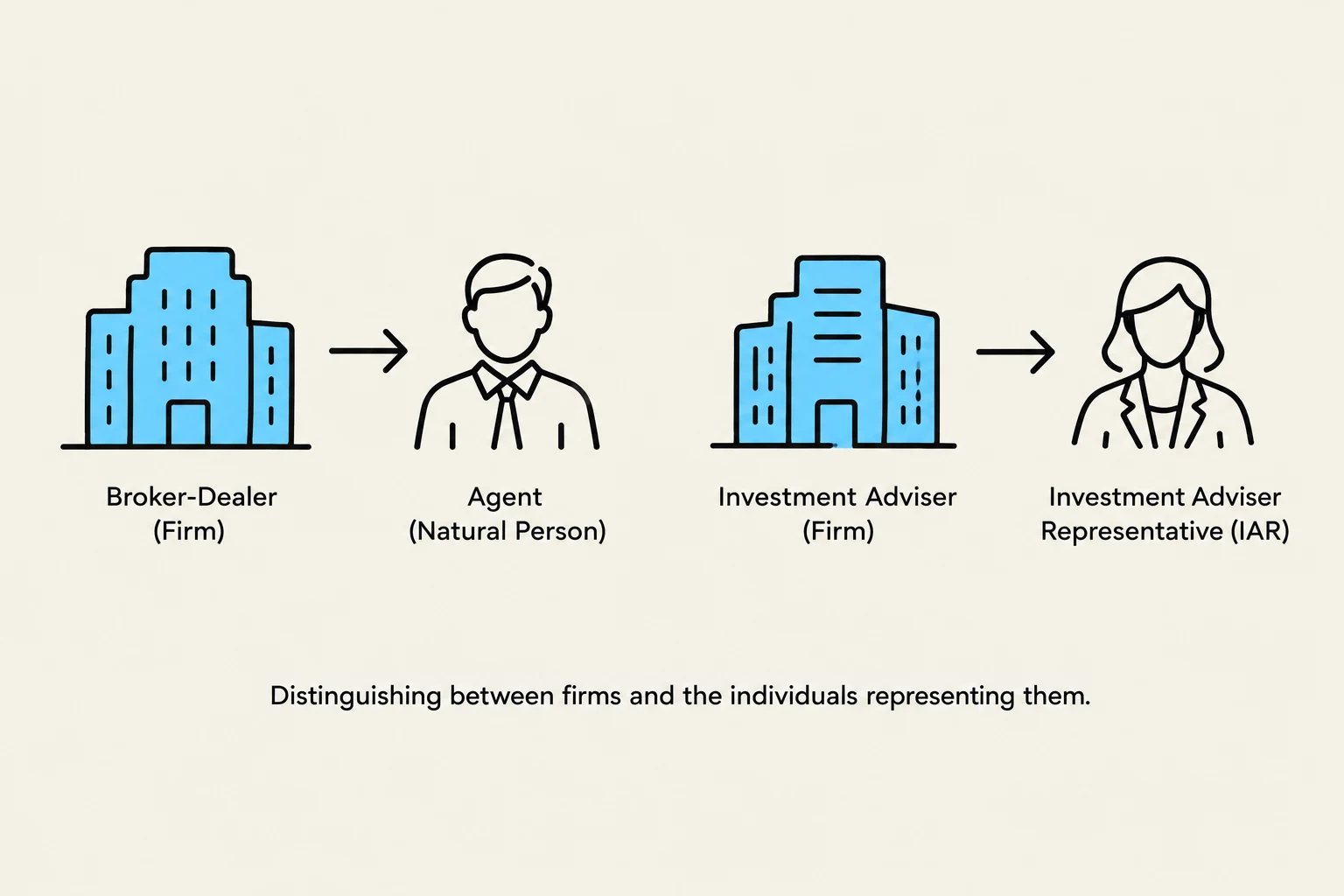
This diagram illustrates the distinction between firms (Broker-Dealer, Investment Adviser) and the natural persons (Agent, Investment Adviser Representative) who represent them.
To navigate the exam, you must master the specific definitions used under the Uniform Securities Act. Note that these definitions can sometimes differ from federal definitions.
Broker-Dealers and Agents
Broker-Dealer (BD): A business (typically a firm) that buys and sells securities for its own account or for the accounts of others.
Agent: A natural person (an individual) who represents a broker-dealer in effecting securities transactions.
Investment Advisers and Representatives
Investment Adviser (IA): Generally a firm that provides investment advice for a fee.
Investment Adviser Representative (IAR): The individual person who works for the IA and provides the advice to clients.
Securities and Issuers
Securities: The various financial instruments (stocks, bonds, etc.) subject to regulation.
Issuers: The entities (corporations, governments) that create and issue the securities.
Ethical Considerations and Penalties
A significant portion of the exam focuses on ethical behavior and the consequences of misconduct. This includes avoiding "insider trading"—using material, nonpublic information to trade for profit or avoid a loss.
While state and federal laws overlap, the severity of penalties often differs. Generally, federal penalties and dollar amounts are significantly higher than those imposed by state administrators. For example, while the USA may impose fines for fraud, the federal government can levy massive criminal fines (up to $25 million for corporations) and significant prison sentences for insider trading.
Final Study Tip
Do not assume the Series 63 is an "easy" exam just because it is an entry-level requirement. It requires rigorous preparation, particularly regarding the nuanced differences between state and federal regulatory frameworks.
Keep reading for free.
Create an account to finish this reading and make it part of your study routine.