Understanding the Scope of Practice for Healthcare Professionals
This guide explains the concept of scope of practice in healthcare, detailing the three pillars: legal authority, education, and training. It clarifies the difference between education and training, the principles of delegation and supervision, and the dangers of 'scope creep,' providing a framework for safe and compli
In the healthcare environment, every professional—from the surgeon to the medical assistant—operates within a specific set of boundaries known as the "scope of practice." Understanding these boundaries is not merely a matter of professional etiquette; it is a fundamental requirement for patient safety and legal compliance. The scope of practice defines what a healthcare professional is permitted to do based on their legal authority, their level of formal education, and their demonstrated competency through training and experience.
The Three Pillars of Scope of Practice
The scope of practice is rarely determined by a single factor. Instead, it is a composite of three distinct pillars that work together to ensure that tasks are performed by individuals who are both legally allowed and clinically capable of doing them.
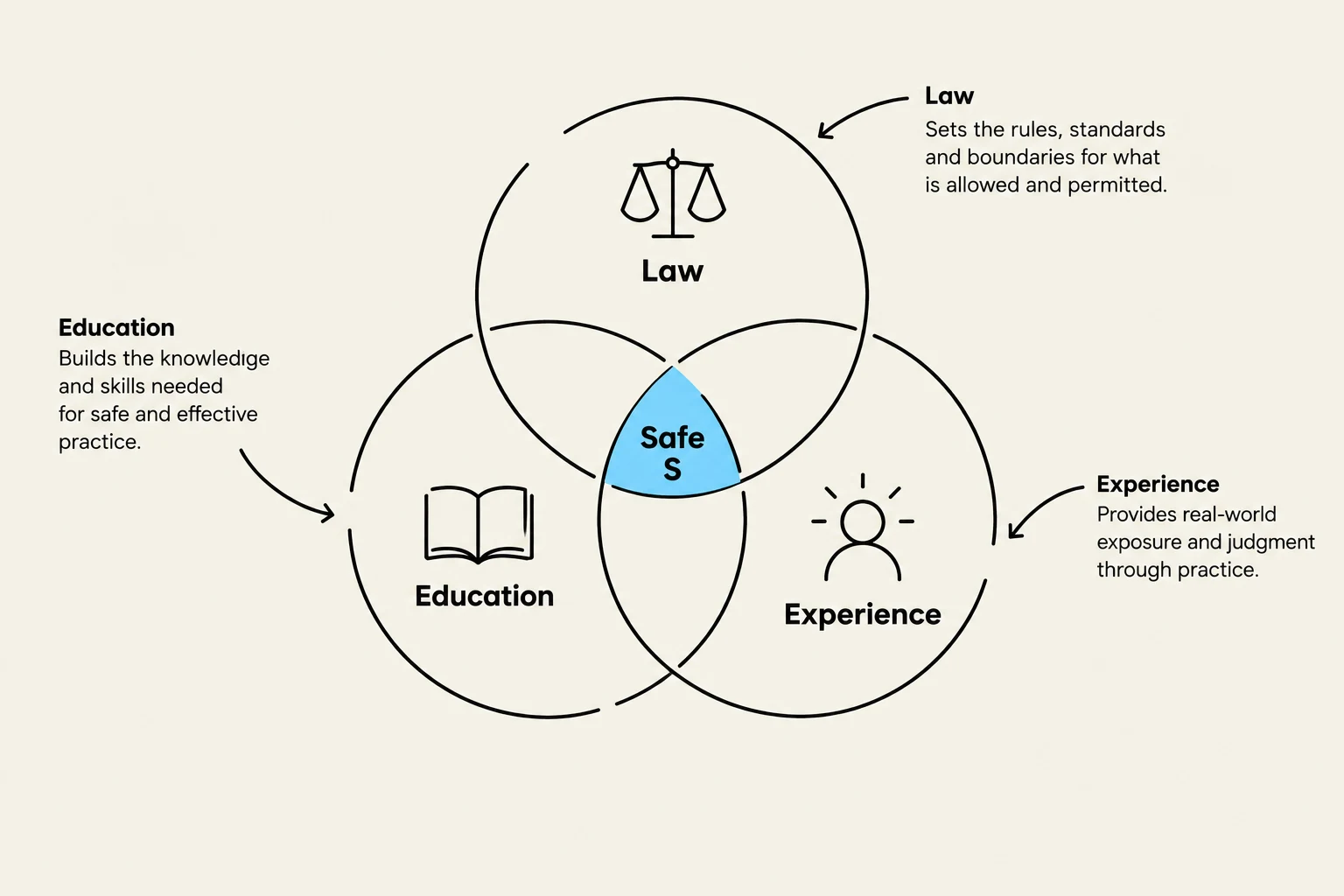
Legal Authority (The Law): This is the baseline. State laws and regulatory boards define the "ceiling" of what a specific job title can do. For example, a state's Medical Practice Act might explicitly forbid a medical assistant from diagnosing a condition, regardless of how much experience they have.
Formal Education: This provides the theoretical foundation. Education equips a professional with the "why" behind clinical procedures, ensuring they understand the underlying physiological or pharmacological principles.
Training and Experience: While education provides the theory, training provides the "how." Competency is often verified through hands-on training and repeated experience under supervision.
Exam Tip: If a question asks what determines the absolute limit of a professional's duties, look for "State Law" or "Regulatory Boards." While education and training determine competency, the law determines authority.
This Venn diagram illustrates the intersection of Law, Education, and Experience, which leads to a 'Safe S' or safe practice.
Education vs. Training: Understanding the Difference
A common point of confusion for students is the distinction between being "educated" in a subject and being "trained" to perform a task. In the context of scope of practice, these two concepts serve different roles in determining delegated duties.
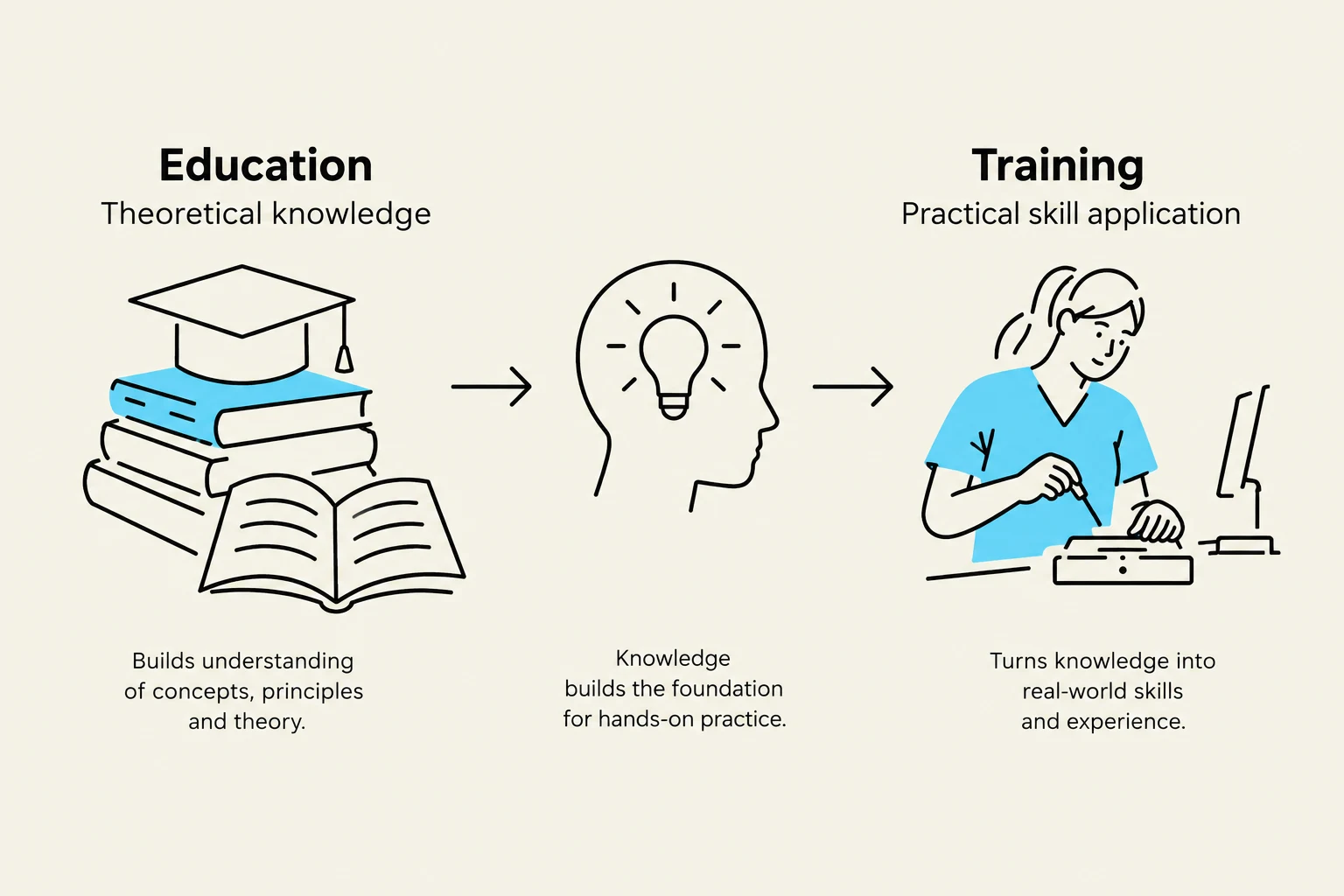
Education is typically a formal, structured process involving a curriculum, textbooks, and examinations. It is designed to provide a broad understanding of a field. For instance, a medical assistant student learns the anatomy of the cardiovascular system through lectures and study.
Training, conversely, is the practical application of that knowledge. It is often task-specific and focused on mastery of a particular skill. A student might be educated on the importance of blood pressure, but they are trained on how to correctly place a manual sphygmomanometer and interpret the Korotkoff sounds.
This diagram illustrates the process of education and training, showing how theoretical knowledge leads to practical skill application and real-world experience.
Delegation and the Role of Supervision
In a clinical setting, duties are often "delegated" from a higher-level provider (such as a physician or nurse practitioner) to a lower-level professional (such as a medical assistant). However, delegation is not a "blank check" to bypass the scope of practice.
For a task to be legally delegated, it must meet several criteria:
The task must fall within the delegatee's legal scope of practice.
The task must be appropriate for the patient's current condition.
The delegating professional must provide clear instructions and appropriate supervision.
The relationship between the delegator and the delegatee can be viewed through the lens of responsibility. While the medical assistant is responsible for performing the task correctly, the physician remains responsible for the overall clinical decision-making and the outcome of the delegated task.
The Danger of "Scope Creep"
"Scope creep" occurs when a healthcare professional begins performing tasks that exceed their legal or trained boundaries, often due to staffing shortages, pressure from supervisors, or overconfidence in their own abilities.
Consider this worked example:
A medical assistant has worked in a clinic for ten years and is highly experienced in patient care. A physician, feeling rushed, asks the assistant to adjust the dosage of a patient's medication based on a new lab result. Even though the assistant "knows" what the dose should be due to years of observation, performing this action is a violation of their scope of practice. The assistant lacks the legal authority (the law) and the formal prescriptive education (education) to make clinical adjustments.
Warning: Performing tasks outside your scope of practice can lead to immediate termination of employment, loss of certification, and significant legal liability in the event of patient harm.
This illustration outlines the scope of practice for a Medical Assistant, differentiating between common tasks within their role and tasks that fall outside their scope, which typically require a licensed provider.
Summary of Competency Assessment
To ensure that a professional is operating safely, healthcare facilities often use a competency assessment model. This model ensures that the three pillars are in alignment.
If we were to express the relationship between these factors as a conceptual formula, it might look like this:
\text{Competency} &= \text{Legal Authority} \\
&\cdot (\text{Education} + \text{Training}) \\
&\cdot \text{Experience}
\end{aligned}$$
In this model, if any factor—especially Legal Authority—is zero, the total competency for a specific task is effectively zero in the eyes of the law.
## Conclusion
Defining the scope of practice is a dynamic process that protects both the patient and the healthcare professional. By recognizing the boundaries set by law, the foundations laid by education, and the refinements provided by training, healthcare workers can contribute to a safe, efficient, and legally sound clinical environment. Always remember: when in doubt, consult your facility's policy manual or your supervising clinician.
$$$
$$$
Keep reading for free.
Create an account to finish this reading and make it part of your study routine.