Understanding the Rights of the Accused in the U.S. Legal System
An overview of constitutional protections for individuals suspected of crimes, covering due process, search and seizure, interrogation rights, trial procedures, and sentencing limitations.
When an individual is suspected of a crime, they enter a complex legal landscape governed by specific rules designed to prevent the abuse of government power. These rules are known as procedural due process—the mandatory procedures that authorities must follow before a person can be lawfully punished for an offense. Anchored in the Fifth and Fourteenth Amendments, these safeguards ensure that no person is deprived of life, liberty, or property without proper legal proceedings.
The U.S. Constitution provides a framework of protections that evolve as a suspect moves from the initial moment of suspicion through arrest, interrogation, trial, and finally, sentencing.
The Foundation: Due Process and the Bill of Rights
To understand the rights of the accused, one must first understand how these rights are applied. Originally, the Bill of Rights only applied to the federal government. However, through a process known as selective incorporation, the Supreme Court has used the Fourteenth Amendment’s due process clause to apply most of these protections to the states as well. This ensures that whether you are in a federal court or a state court, your fundamental constitutional protections remain intact.
Study Tip: Remember that "procedural due process" focuses on the methods the government uses (the "how"), whereas "substantive due process" focuses on whether the laws themselves are fair.
Phase 1: Suspicion, Search, and Seizure
The legal process often begins with the Fourth Amendment, which protects individuals against unreasonable searches and seizures. This protection is closely tied to the concept of the right to privacy, a "zone of privacy" that the government cannot lawfully invade.
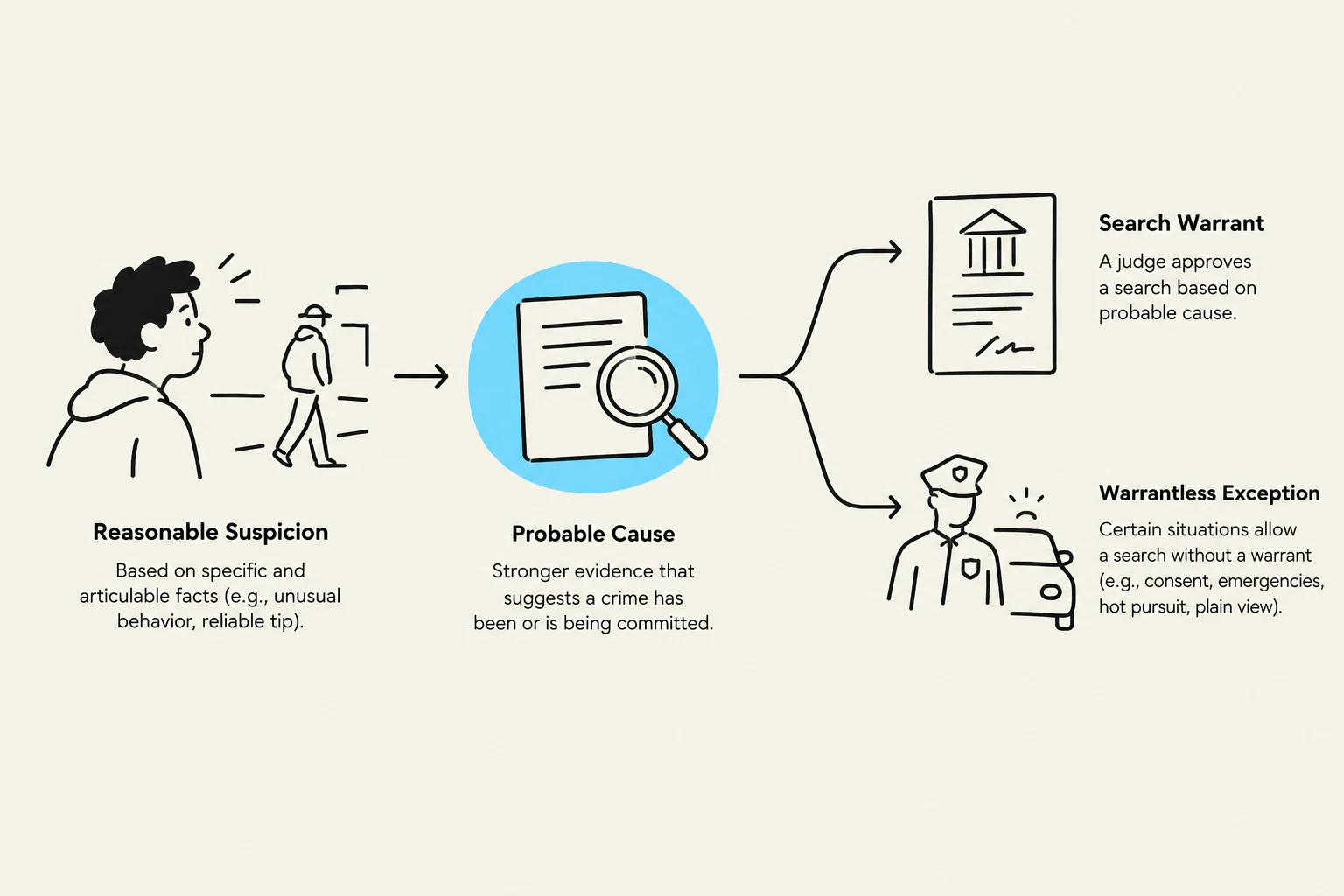
For a search or arrest to be lawful, authorities generally must have probable cause—a reasonable belief that a crime has been committed. In many cases, this requires a judge to issue a warrant. Modern legal standards have extended this requirement to include digital privacy, such as the contents of cell phones.
However, there are exceptions to the warrant requirement:
School Administrators: May search students for drugs or weapons under specific circumstances.
Police Roadblocks: Systematic, non-arbitrary checks for intoxication are permitted.
This diagram illustrates the legal standards for searches: reasonable suspicion, probable cause, search warrants, and warrantless exceptions.
Phase 2: Interrogation and the Fifth Amendment
Once a suspect is in custody, the Fifth Amendment provides a critical shield against self-incrimination. This means an individual cannot be compelled to be a witness against themselves; they have the right to remain silent.
A landmark moment in American law was the case of Miranda v. Arizona (1966). This ruling established that police must issue a "Miranda warning" before conducting a custodial interrogation. This warning informs the suspect of two essential rights:
The right to remain silent.
The right to an attorney.
Without this warning, any statements made by the suspect during interrogation may be deemed inadmissible in court.
Phase 3: The Trial and the Sixth Amendment
If a case proceeds to trial, the Sixth Amendment guarantees several procedural rights to ensure a fair outcome:
Right to Counsel: The right to be represented by an attorney.
Speedy and Open Trial: Protection against indefinite delays and secret proceedings.
Impartial Jury: The right to be judged by a fair group of peers.
Confrontation of Witnesses: The right to face and question those testifying against you.
In the landmark case Ramos v. Louisiana (2020), the Supreme Court clarified that for serious offenses, jury verdicts must be unanimous in both federal and state courts. Additionally, the Fifth Amendment protects against double jeopardy, meaning a person cannot be tried twice for the same crime if they have already been acquitted.
The Exclusionary Rule: The "Teeth" of the Constitution
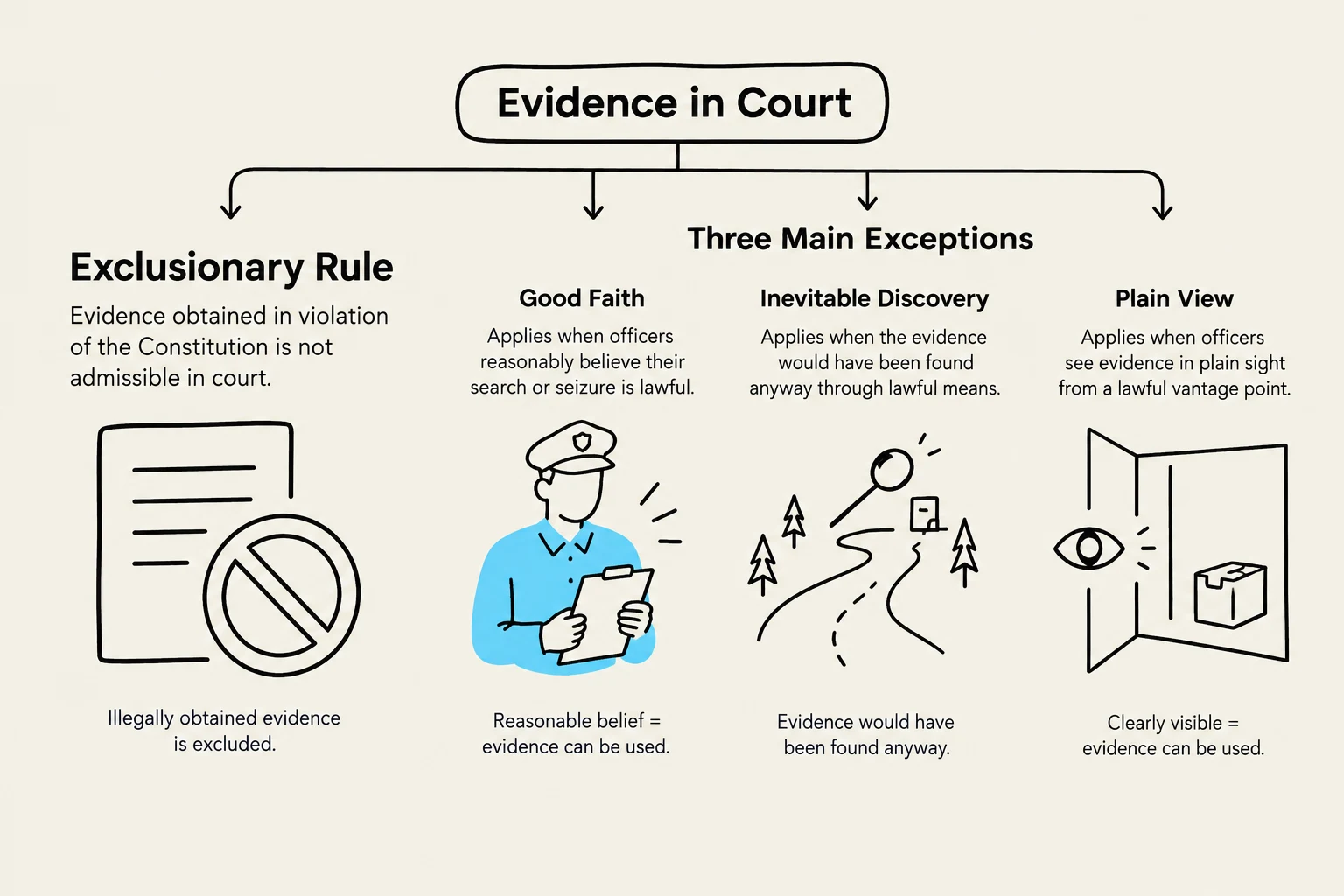
How are these rights enforced? The primary mechanism is the exclusionary rule. This rule mandates that any evidence obtained by authorities in violation of a defendant's constitutional rights cannot be used against them in court.
However, the rule is not absolute. Courts have carved out several exceptions:
Good Faith Exception: If police believed they were following proper procedures, the evidence may still be used.
Inevitable Discovery Exception: If the evidence would have been found anyway through legal means, it is admissible.
Plain View Exception: If an officer sees illegal evidence in plain sight while performing a lawful action, they may seize it.
This diagram illustrates the Exclusionary Rule and its three main exceptions in court: Good Faith, Inevitable Discovery, and Plain View.
Phase 4: Sentencing and the Eighth Amendment
Even after a conviction, the Constitution continues to offer protections during the sentencing phase. The Eighth Amendment prohibits excessive bail and cruel and unusual punishment.
While states generally have the discretion to determine their own sentencing laws, the Supreme Court has set limits to ensure punishments are not "disproportionate to the offense" or "unnecessarily cruel". For example, the Court has banned:
The death penalty for minors.
The death penalty for the mentally ill.
Life-without-parole sentences for juveniles.
Challenges and Realities in the Justice System
Despite these robust constitutional protections, the application of the law is not always uniform. Significant challenges remain in the American legal system:
Racial Profiling: The targeting of individuals from underrepresented racial groups remains a major issue, and members of these groups are statistically more likely to be victims of police violence.
Incarceration Rates: The United States has the highest per capita inmate rate in the world. More than half of those in U.S. prisons are serving time for nonviolent offenses, such as drug possession or property theft.
Uneven Application: While the judicial system acts as a protector of rights, the actual experience of justice can vary wildly based on geography, income, and race.
Exam Tip: If a question asks about the "effectiveness" of the Bill of Rights, mention the Exclusionary Rule. It is the tool that turns a theoretical right into a practical one by penalizing police misconduct.
In summary, the rights of the accused are a multi-layered defense system. From the moment of a search to the finality of a sentence, the Fifth, Sixth, and Eighth Amendments work together to ensure that the power of the state is checked by the rule of law.
Keep reading for free.
Create an account to finish this reading and make it part of your study routine.