Understanding the Principal-Agent Problem in Economics and Governance
This content explains the Principal-Agent Problem, a core concept in economics and political science. It details how conflicts of interest and information asymmetry arise when one party (the agent) acts on behalf of another (the principal). The text covers adverse selection and moral hazard, provides real-world example
In any organized society, whether it is a corporation, a government, or a simple household, tasks are rarely performed by a single individual acting in total isolation. Instead, we rely on a system of delegation. We hire managers to run companies, elect officials to run countries, and employ professionals to manage our finances. However, this delegation introduces a fundamental tension: the person being hired (the agent) does not always share the same goals or values as the person doing the hiring (the principal). This tension is known as the Principal-Agent Problem.
The Core Concept: Delegation and Divergence
At its heart, the Principal-Agent problem is a conflict of interest that arises when one party is tasked with making decisions on behalf of another. To understand this, we must define the two primary actors:
The Principal: The entity that possesses authority or ownership and seeks to achieve a specific outcome. They delegate tasks to others to achieve their goals more efficiently.
The Agent: The entity that is hired or authorized to act on behalf of the principal. They are expected to use their expertise or labor to fulfill the principal's objectives.
The problem occurs because of two critical assumptions: divergent interests and information asymmetry. First, agents are rational actors who generally seek to maximize their own utility (such as wealth, leisure, or power), which may not align perfectly with the principal's utility. Second, the agent often possesses more information about the task at hand than the principal does, making it difficult for the principal to monitor whether the agent is truly acting in their best interest.
Diagram illustrating the principal-agent relationship, showing the flow of authority and reporting.
Information Asymmetry: The Hidden Gap
The reason the Principal-Agent problem is so difficult to solve is that the principal cannot see everything the agent does. This lack of transparency is called information asymmetry.
In economic and political theory, this asymmetry manifests in two main ways:
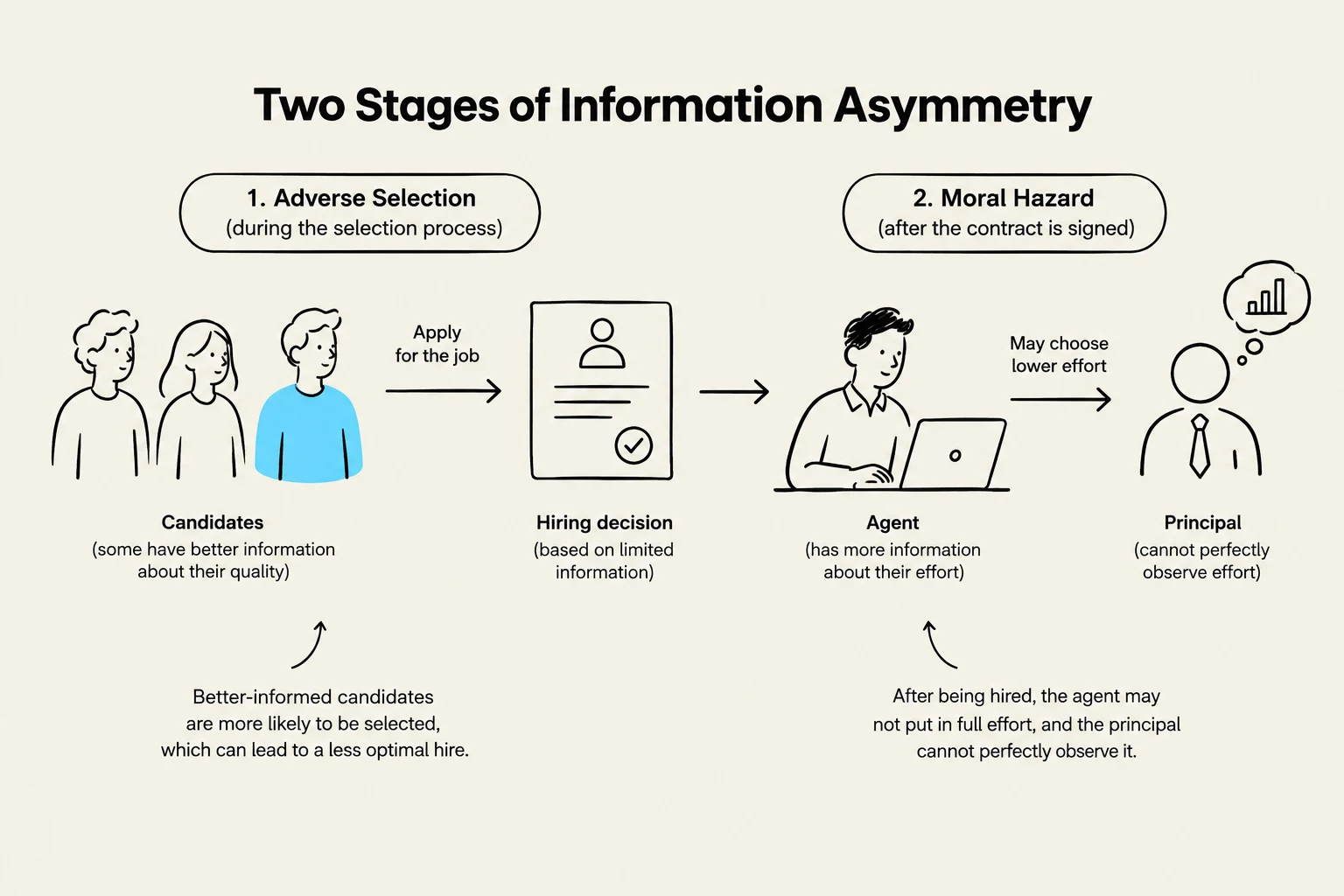
Adverse Selection (Hidden Information): This occurs before the contract is signed. The agent may have qualities or skills that they do not fully disclose to the principal. For example, a job applicant might exaggerate their expertise to secure a high-paying position.
Moral Hazard (Hidden Action): This occurs after the contract is signed. Once the agent is in their position, they may take risks or exert less effort than agreed upon because the principal cannot perfectly observe their behavior.
Exam Tip: If a question asks about a problem occurring before an agreement is made, look for "Adverse Selection." If the problem involves an agent's behavior after they have been hired, look for "Moral Hazard."
This diagram illustrates the two stages of information asymmetry: adverse selection and moral hazard, in the context of hiring and employment.
Real-World Application: The Executive Branch and Bureaucracy
A profound example of this problem can be found in the structure of modern government, specifically within the Executive Branch.
In a democratic system, the citizens (the ultimate principals) elect representatives and leaders to manage the state. These leaders, in turn, oversee a vast bureaucracy of specialized agencies and officials (the agents).
The tension arises because:
The Principal's Goal: To implement laws efficiently, serve the public interest, and manage taxpayer funds responsibly.
The Agent's Goal: Bureaucrats may prioritize their own departmental budgets, job security, or institutional influence over the actual efficiency of the service they provide.
Because a single citizen cannot monitor every government employee, the "agent" (the bureaucracy) often develops its own interests that may drift away from the "principal's" (the public's) intent. This is why oversight committees, audits, and transparency laws are essential components of a functioning government.
Mitigating the Problem: Incentives and Monitoring
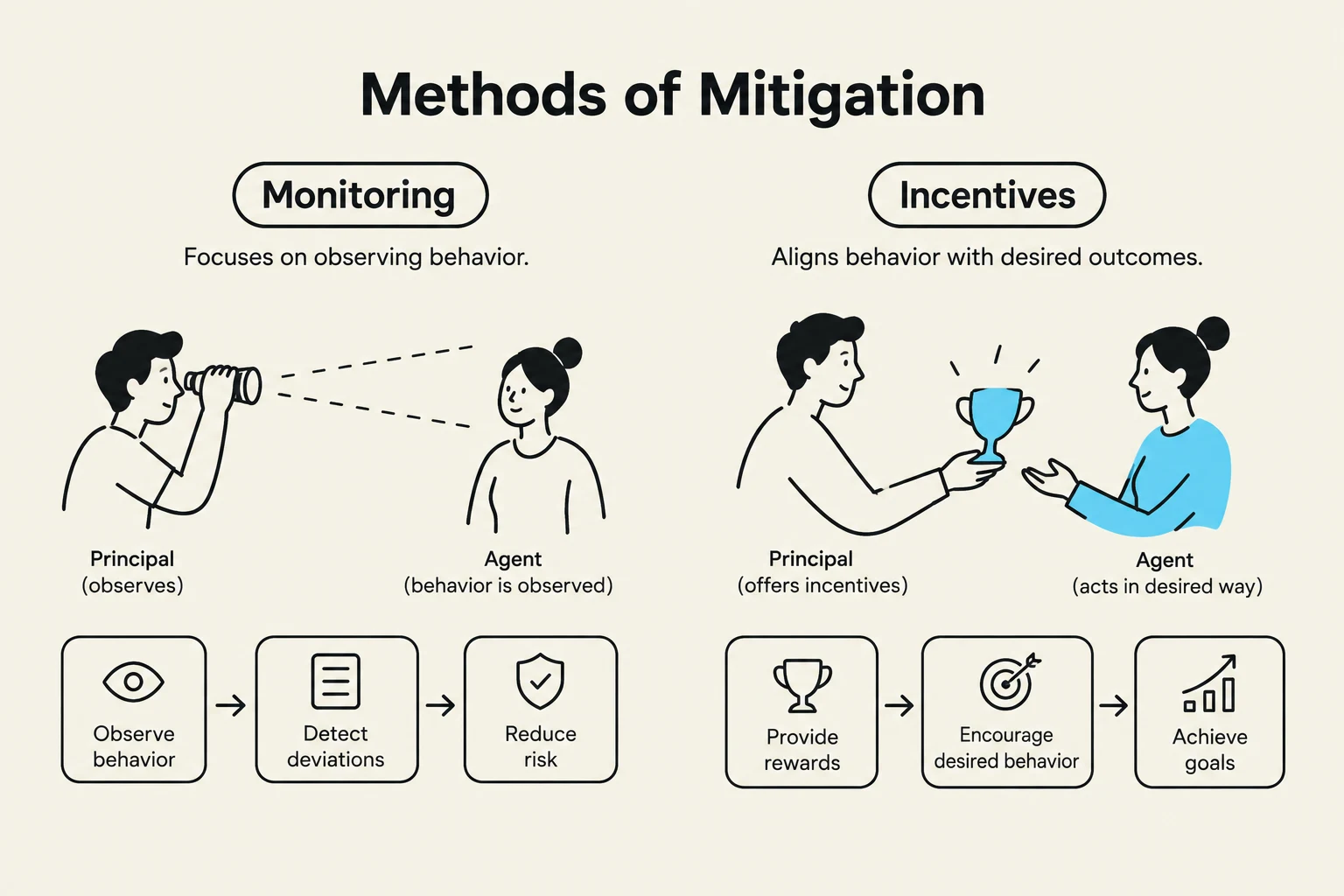
Since the problem cannot be eliminated entirely, the goal is to minimize its impact through two primary mechanisms: monitoring and incentive alignment.
1. Monitoring
The principal can attempt to reduce information asymmetry by investing in oversight. This might include:
Regular audits and performance reviews.
Strict reporting requirements.
Third-party inspections.
However, monitoring is never free. It incurs "agency costs"—the time and money spent trying to ensure the agent is behaving.
2. Incentive Alignment
A more sophisticated approach is to design contracts that make the agent's personal success dependent on the principal's success. This is often achieved through performance-based pay.
For example, in a corporate setting, instead of a flat salary, a CEO might receive stock options. If the company performs well (satisfying the principal), the CEO's wealth increases (satisfying the agent).
Mathematically, we can think of the agent's utility function Ua as a combination of their own effort/reward and the principal's objective Op:
UaGoal: Maximize Ua subject to Op being met=f(Reward,Effort)
The challenge for the principal is to find a reward structure where the agent's optimal choice of effort e\* results in the highest possible value for the principal's objective Op.
This diagram illustrates two methods of mitigation: monitoring and incentives. Monitoring involves observing behavior to detect deviations and reduce risk. Incentives align behavior with desired outcomes by providing rewards to encourage desired actions and achieve goals.
Summary Table: Principal vs. Agent
Feature
Principal
Agent
Role
Hires/Delegates
Acts/Executes
Primary Goal
Achieving a specific outcome
Maximizing personal utility
Information
Often lacks specific details
Possesses specialized knowledge
Risk
Bears the cost of agent failure
May take risks if costs are borne by principal
Understanding the Principal-Agent problem is essential for anyone studying economics, political science, or management. It provides a lens through which we can view why organizations fail, why governments struggle with efficiency, and why the design of contracts is one of the most important tasks in any professional relationship.
Keep reading for free.
Create an account to finish this reading and make it part of your study routine.