Understanding the Principal-Agent Problem: Effort vs. Outcome
Explores the core challenges in evaluating performance when outcomes are influenced by factors beyond an agent's control, such as luck. Discusses information asymmetry, the difficulties in distinguishing effort from outcome, and the extremes of incentive design in organizations.
In any organizational structure, there is a fundamental tension between what a leader wants to achieve and what a subordinate actually does. This tension is central to the study of bureaucracy and the "Principal-Agent Problem". At the heart of this problem lies a profound difficulty: how can a principal (the boss or owner) accurately judge whether an agent (the employee or bureaucrat) is working hard, or if the final result was simply a product of luck or external circumstances?
When we evaluate performance, we often conflate two very different variables: Effort (the energy and time expended by the agent) and Outcome (the measurable result produced). While it is tempting to use outcomes as a proxy for effort, this creates significant distortions in incentives and management.
The Core Conflict: Information Asymmetry
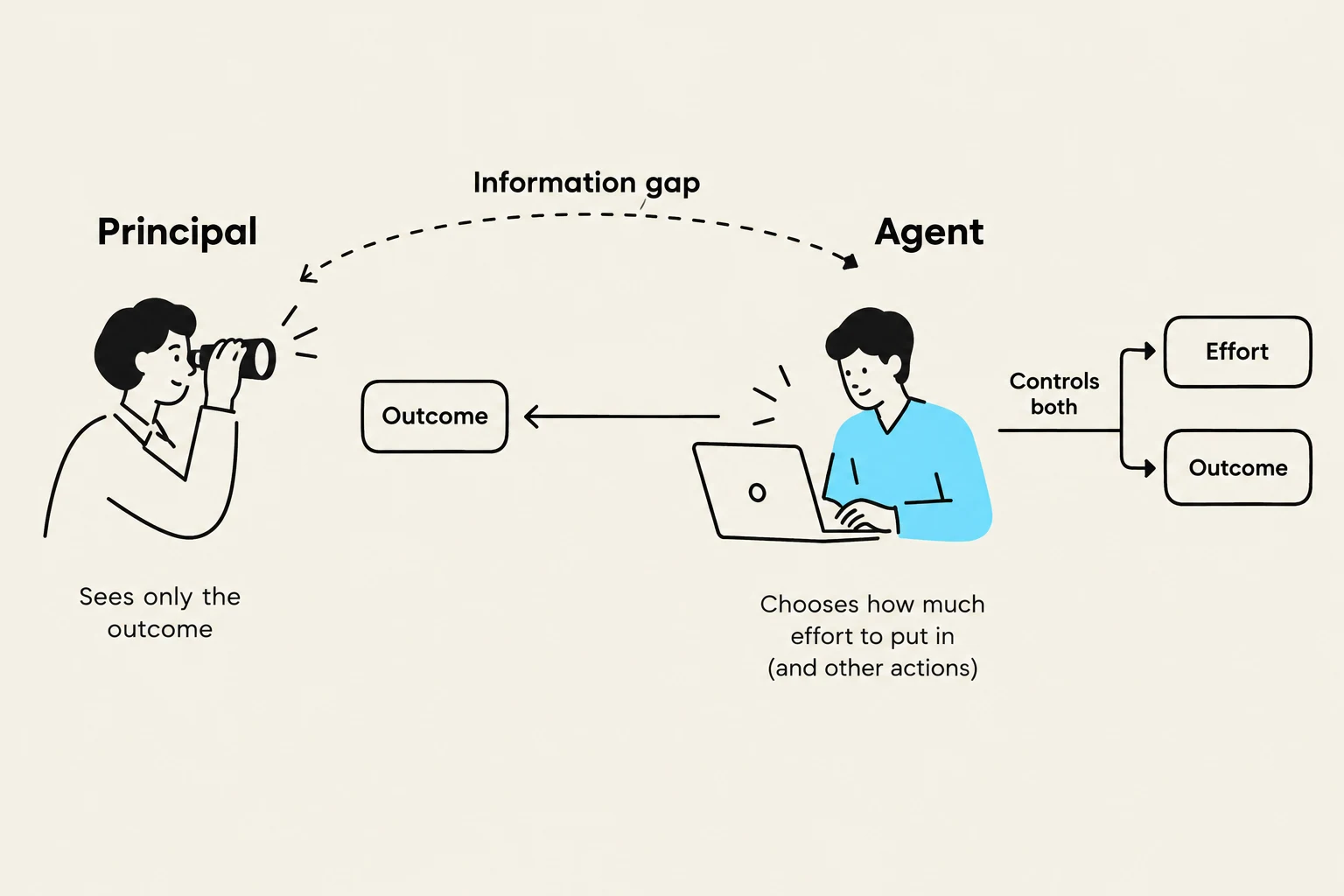
The reason distinguishing effort from outcome is so difficult is due to information asymmetry. In a professional setting, the agent usually has more information about their own actions than the principal does.
The principal can see the final report, the sales numbers, or the completed bridge, but they cannot "see" the internal mental state or the exact number of hours of focused labor the agent applied. Because the principal cannot observe effort directly, they are forced to rely on outcomes as a signal. However, outcomes are "noisy" signals because they are influenced by factors outside the agent's control.
This diagram illustrates the principal-agent problem in economics, where an information gap exists between a principal who observes only the outcome and an agent who chooses their effort and actions, influencing both effort and outcome.
The Role of Stochasticity (Luck)
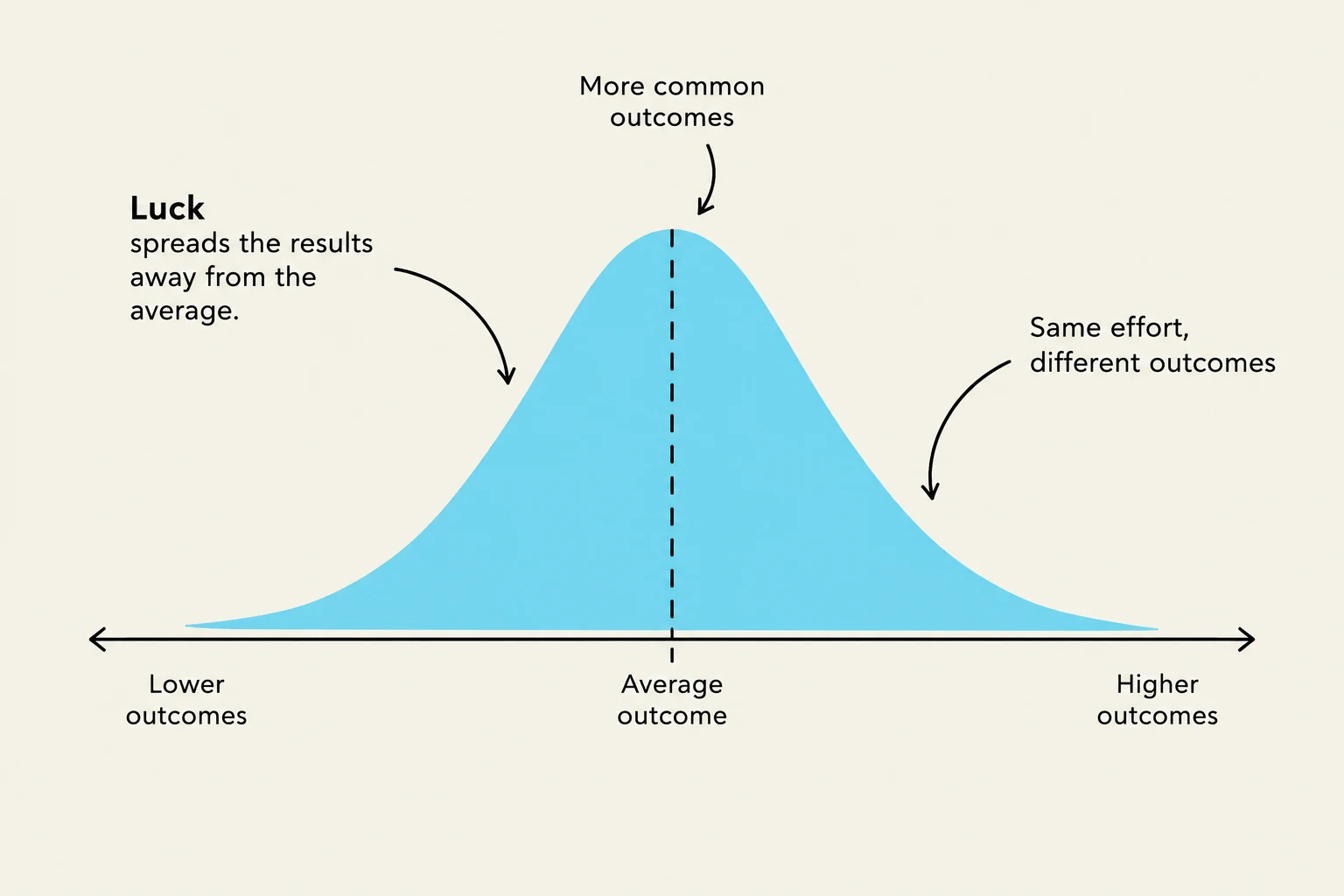
To understand why outcomes are unreliable, we can model the relationship between effort and outcome using a simple mathematical framework. Let E represent the agent's effort, L represent external luck (stochastic noise), and Y represent the observed outcome.
A simplified model might look like this:
Y=f(E)+L
In this equation, f(E) is a function representing the productive capacity of the effort, and L is a random variable representing luck.
If an agent works extremely hard (high E) but encounters a market crash or a natural disaster (negative L), the outcome Y might be very low. Conversely, an agent could be lazy (low E) but benefit from a sudden economic boom (high L), resulting in a high Y.
Exam Tip: When analyzing the Principal-Agent problem, remember that if the principal rewards based solely on Y, they are inadvertently rewarding luck and punishing diligence. This is known as "noise" in the incentive structure.
The Two Extremes of Incentive Design
Because of this difficulty, managers and policymakers often swing between two flawed extremes when designing compensation or evaluation systems.
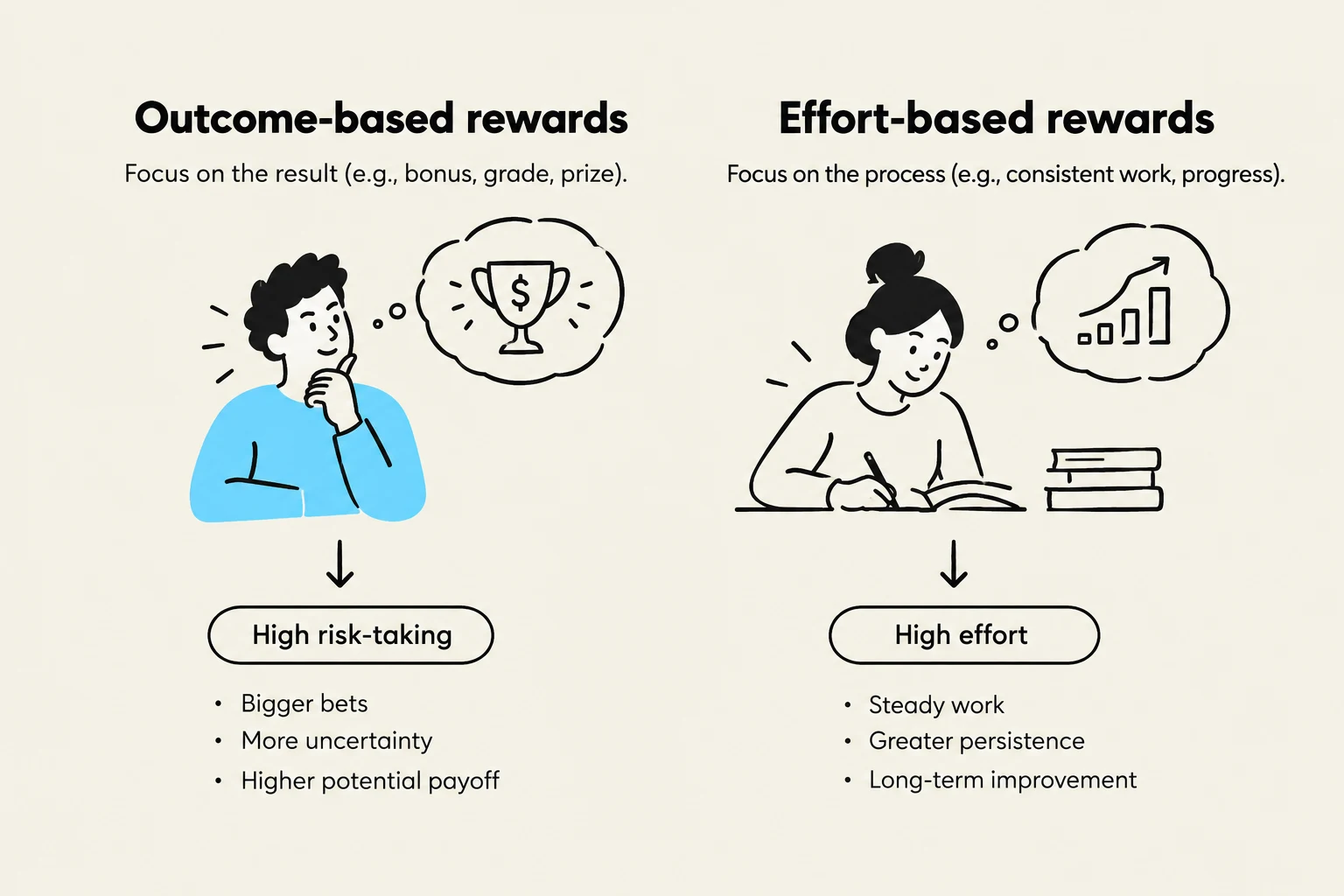
1. Rewarding Pure Outcome (The High-Stakes Model)
In this model, the principal says: "I don't care how you do it; just hit the target." This is common in commission-based sales or high-level executive bonuses.
Pros: It aligns the agent's goals directly with the organization's goals.
Cons: It encourages extreme risk-taking. If an agent's pay depends entirely on a successful outcome, they may take "gambles" that have a high probability of failure but a massive payoff if they succeed, potentially endangering the entire organization.
2. Rewarding Pure Effort (The Bureaucratic Model)
In this model, the principal attempts to monitor the process itself—checking clock-in times, counting lines of code, or reviewing step-by-step procedures.
Pros: It reduces the impact of luck and encourages steady, predictable work.
Cons: It leads to "red tape" and inefficiency. Agents may focus on "looking busy" (performing tasks that satisfy the monitoring criteria) rather than performing tasks that actually produce value. This is a hallmark of inefficient bureaucracy.
This illustration contrasts outcome-based rewards, which encourage high risk-taking for potential high payoffs, with effort-based rewards, which promote steady work and long-term improvement.
Worked Example: The Software Developer
Consider a software development team within a large corporation. The Principal is the CTO, and the Agent is the Lead Developer.
Scenario A: Outcome-Based Evaluation
The CTO tells the developer: "The app must have zero crashes during the holiday sale, or you lose your bonus."
The Problem: The developer might write perfect code (High Effort), but a sudden surge in traffic that exceeds server capacity (High Luck/External Factor) causes a crash. The developer is punished for something they could not control.
Scenario B: Effort-Based Evaluation
The CTO tells the developer: "You must spend 40 hours a week writing code and attend every daily stand-up meeting."
The Problem: The developer might spend 40 hours writing beautiful, elegant code (High Effort), but that code might be for a feature that no customer actually wants (Low Outcome). The developer is rewarded for "work" that provides zero value to the company.
Finding the Balance
The goal of efficient organizational design is to minimize the "agency costs" that arise from this tension. This is often achieved through a combination of:
Performance Metrics that are "Controllable": Choosing outcomes that are more likely to be influenced by the agent than by external luck.
Hybrid Compensation: Using a base salary (to reward effort/stability) combined with performance bonuses (to reward outcomes).
Information Reduction: Implementing better reporting systems so the principal can observe the "process" more clearly without becoming a micro-manager.
A bell curve illustrating how luck can spread results away from the average, with more common outcomes near the average and less common outcomes at the extremes. It also shows that the same effort can lead to different outcomes.
In conclusion, the difficulty of distinguishing effort from outcome is not just a management headache; it is a fundamental mathematical and structural challenge in any system where one person's work is judged by another. Understanding this distinction is the first step toward creating fairer, more efficient, and more productive organizations.
Keep reading for free.
Create an account to finish this reading and make it part of your study routine.