Gait is defined as a person's style of walking, a complex process that entails a perpetual gain and loss of balance. This continuous movement is controlled by the coordinated effort of concentric and eccentric muscle work. To study gait effectively, clinicians and researchers break down this movement into specific cycles and phases to analyze stability, efficiency, and pathology.
The Gait Cycle and Its Divisions
The Gait Cycle (also known as a stride) is the period of activity that occurs from the moment one foot contacts the ground until that same foot contacts the ground again.
The cycle is divided into two primary phases:
Stance Phase: This begins when the reference foot contacts the floor and ends when that same foot lifts off the ground. It comprises approximately $60%$ of the total gait cycle ($30%$ per lower extremity).
Swing Phase: This begins when the reference foot lifts off the ground and ends when the foot contacts the floor again. It comprises approximately $40%$ of the cycle ($20%$ per lower extremity).
Support States
During the gait cycle, the body moves through different states of support:
Single Limb Support: The portion of the cycle where only one foot is in contact with the ground. Each limb spends approximately $40%$ of the cycle in single support, totaling $80%$ for the entire cycle.
Double Limb Support: The period when both feet are in contact with the ground. This occurs twice per cycle: once when the right foot is in front and once when the left foot is in front. Specifically, it happens between the heel-off/toe-off of one extremity and the heel-strike/foot-flat of the other.
Nonsupport: A state where neither extremity is in contact with the floor. Note that this state does not occur during normal walking.
Exam Tip: Remember that while "Stance" and "Swing" are the two main phases, "Single Limb Support" accounts for the vast majority ($80%$) of the total gait cycle.
Terminology: Traditional vs. Rancho Los Amigos
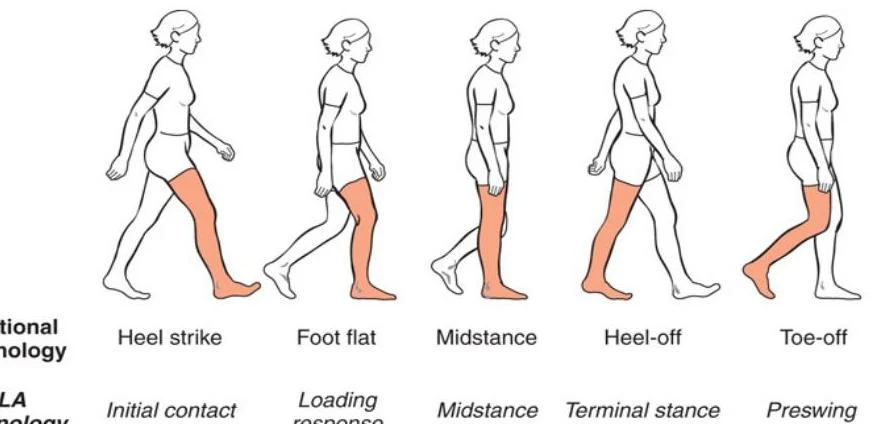
When studying gait, you will encounter two sets of names for the various stages. The Traditional terms often signify a static point in time. However, researchers at Rancho Los Amigos (RLA) developed a newer terminology to reflect that gait is a continuous movement from one position to another. While many clinicians use these terms interchangeably, the RLA terms are designed to describe a "phase" of movement.
Traditional Term
Rancho Los Amigos (RLA)
Stance Phase
Heel Strike
Initial Contact
Foot Flat
Loading Response
Midstance
Midstance
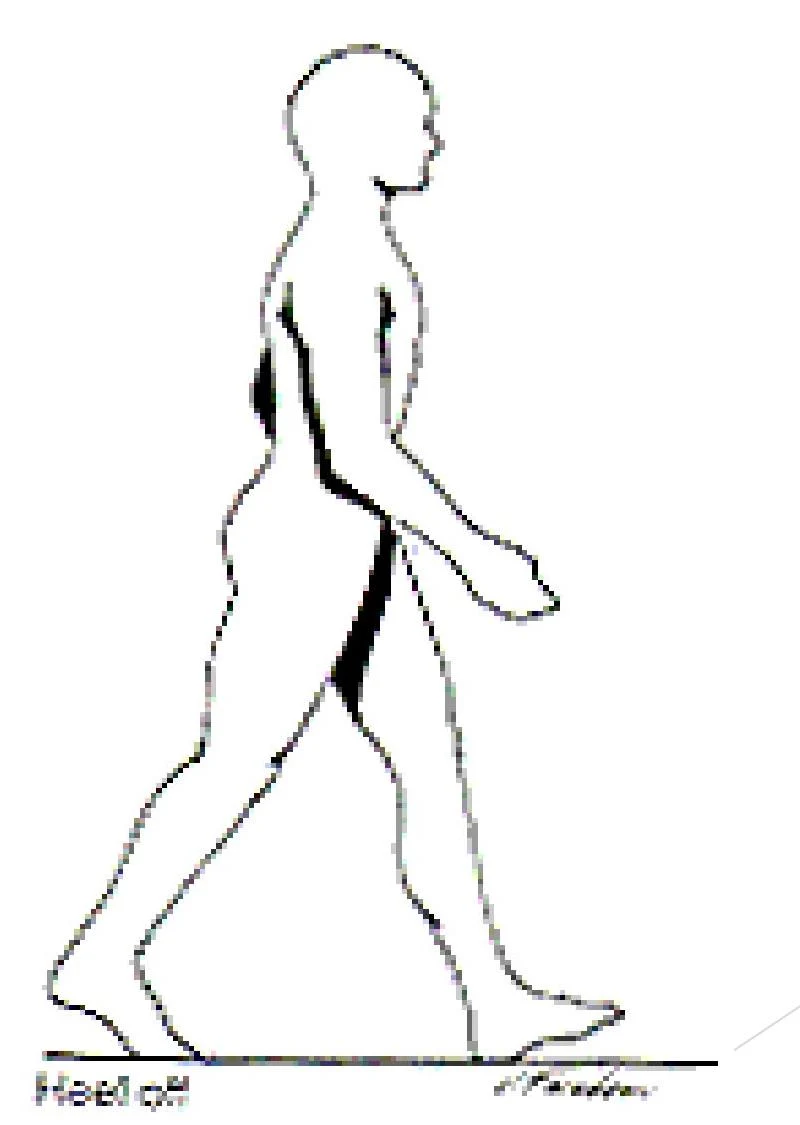
Heel-off
Terminal Stance
Toe-off
Preswing
Swing Phase
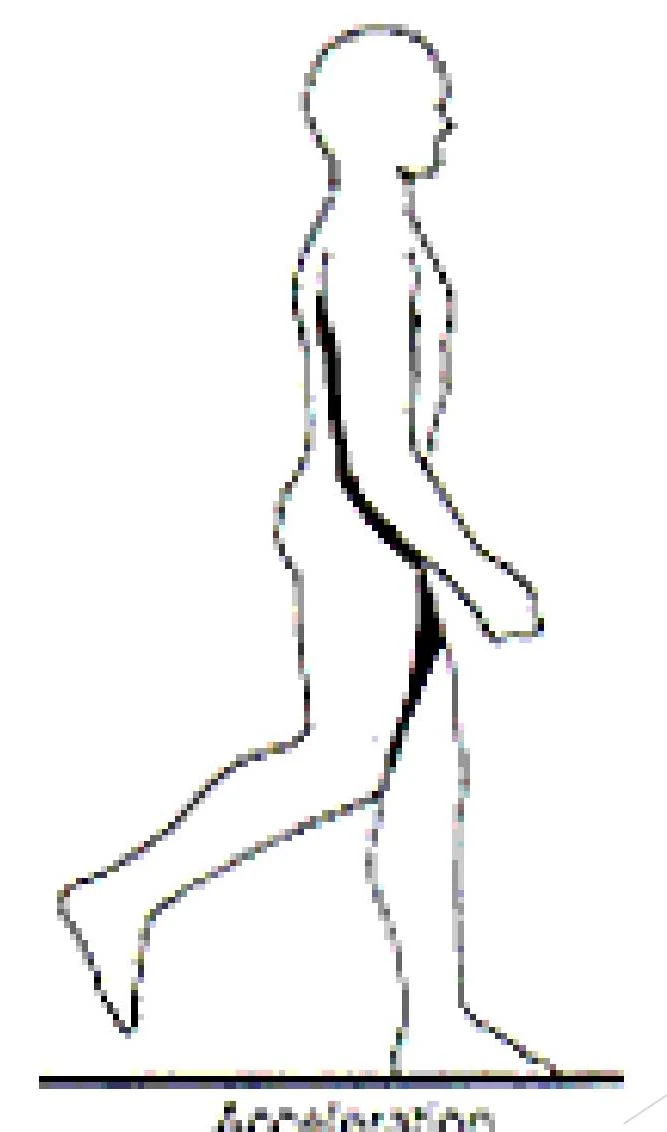
Acceleration
Initial Swing
Midswing
Midswing
Deceleration
Terminal Swing
Diagram illustrating the phases of the gait cycle, including heel strike, foot flat, midstance, heel-off, and toe-off.
Detailed Analysis of the Stance Phase
The stance phase is where the body manages weight bearing and propulsion.
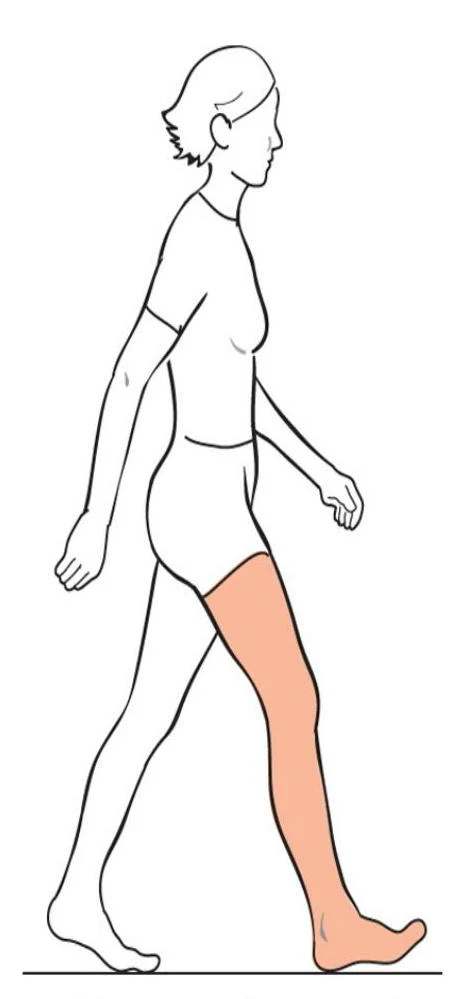
Initial Contact (Heel Strike)
At this moment, the ankle is in a midposition, the hip is flexed, and the knee is extended before beginning to flex. The trunk is rotated toward the forward leg, and the opposite upper extremity (UE) is forward. At this stage, the opposite lower extremity (LE) is in the "Heel-Off" phase.
Diagram illustrating the gait cycle of a person, with the right leg highlighted.
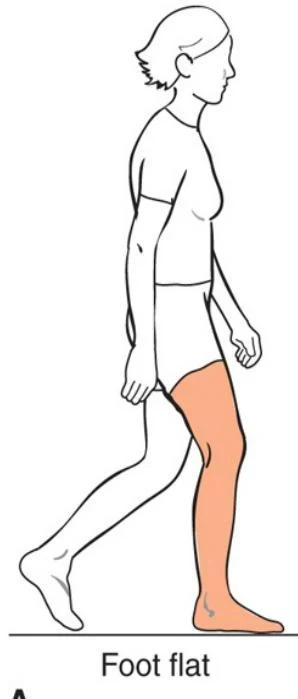
Loading Response (Foot Flat)
As the weight shifts onto the limb, the ankle undergoes plantarflexion, and both the knee and hip move into flexion. The opposite UE is returning toward a neutral position, and the opposite LE is in "Toe-Off".
Illustration depicting the 'foot flat' phase of walking.
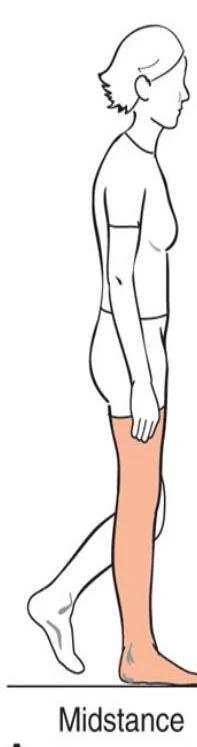
Midstance
During midstance, the body weight is entirely supported by the stance leg. The ankle performs dorsiflexion, the knee is extended, and the hip is at 0∘ extension. The pelvis and trunk maintain neutral rotation, and the UEs are parallel to the trunk.
Illustration of the midstance phase of walking.
Terminal Stance (Heel-off)
As the heel rises, the ankle plantarflexes toward 0∘. The hip moves into hyperextension, and the trunk begins to rotate opposite the heel-off leg. The same-side UE begins to swing forward.
Diagram illustrating the heel-off phase of human gait.
Preswing (Toe-off)
The foot leaves the ground as the ankle and knee move into flexion. The hip also moves toward flexion, and the trunk rotates away from the toe-off leg. During this phase, the weight has shifted to the opposite LE, which is currently in "Foot-flat".
Diagram illustrating the 'toe off' phase of human locomotion.
Detailed Analysis of the Swing Phase
The swing phase is responsible for advancing the limb forward to prepare for the next step.
Initial Swing (Acceleration)
As the limb clears the ground, the ankle begins to dorsiflex, and both the knee and hip flex. The trunk is rotated toward the stance leg but is beginning to move toward neutral. The same-side UE is forward but moving toward neutral.
A diagram illustrating human locomotion, depicting the process of acceleration.
Midswing
The limb passes the stance leg while the ankle is in a neutral position, and the knee and hip remain flexed. The trunk is in neutral rotation, and the UEs are parallel to the trunk. At this point, the body weight is completely on the contralateral (opposite) limb.
Terminal Swing (Deceleration)
In preparation for contact, the knee extends toward 0∘ while the ankle and hip remain neutral/flexed. The trunk rotates toward the swing leg, and the opposite UE moves forward. The opposite LE is currently in "Heel-off".
Determinants of Gait: Upper Extremities and Trunk
Gait is not just a lower extremity movement; the upper extremities (UE) and trunk play vital roles in balance and momentum.
Reciprocal Motion: The UEs follow a reciprocal swinging motion where the opposite arm and leg move forward simultaneously.
Neutral Position: The UEs meet at the sides (neutral) during both Midstance and Midswing.
Trunk Rotation: The forward-moving UE is always opposite to the direction of trunk rotation. For example, if the left arm is moving forward, the trunk is rotated to the right (and the pelvis to the left).
Key Gait Metrics
To quantify walking ability, clinicians use several specific measurements:
Stride Length: The total linear distance traveled during one full gait cycle.
Step Length: The linear distance between the heel strike of one foot and the heel strike of the opposite foot.
Cadence: The number of steps taken per unit of time, typically measured in steps per minute (average: 70−130 steps/min).
Walking Velocity: The speed of ambulation, calculated as:
Velocity=TimeDistance
Width of Walking Base: The distance from the center of the posterior aspect of one heel to the center of the posterior aspect of the opposite heel.
Keep reading for free.
Create an account to finish this reading and make it part of your study routine.