Understanding the pH Scale: Acidity, Alkalinity, and Chemical Measurement
Explore the pH scale, its logarithmic nature, and how it quantifies the acidity or basicity of solutions. Learn about acidic, neutral, and basic categories, the mathematical formula for pH, and practical examples.
Have you ever wondered why lemon juice makes your mouth pucker while soap feels slippery between your fingers? The answer lies in the chemistry of hydrogen ions. To understand how substances interact with our bodies, our environment, and even our food, we must master the concept of the pH scale. This scale provides a standardized way to measure how acidic or basic (alkaline) a liquid solution is, allowing scientists to quantify the concentration of hydrogen ions present in a substance.
The Fundamentals of pH
At its core, pH stands for "potential of Hydrogen." It is a logarithmic scale used to specify the acidity or basicity of an aqueous solution. The scale typically ranges from 0 to 14, though in extreme laboratory conditions, it can occasionally extend beyond these bounds.
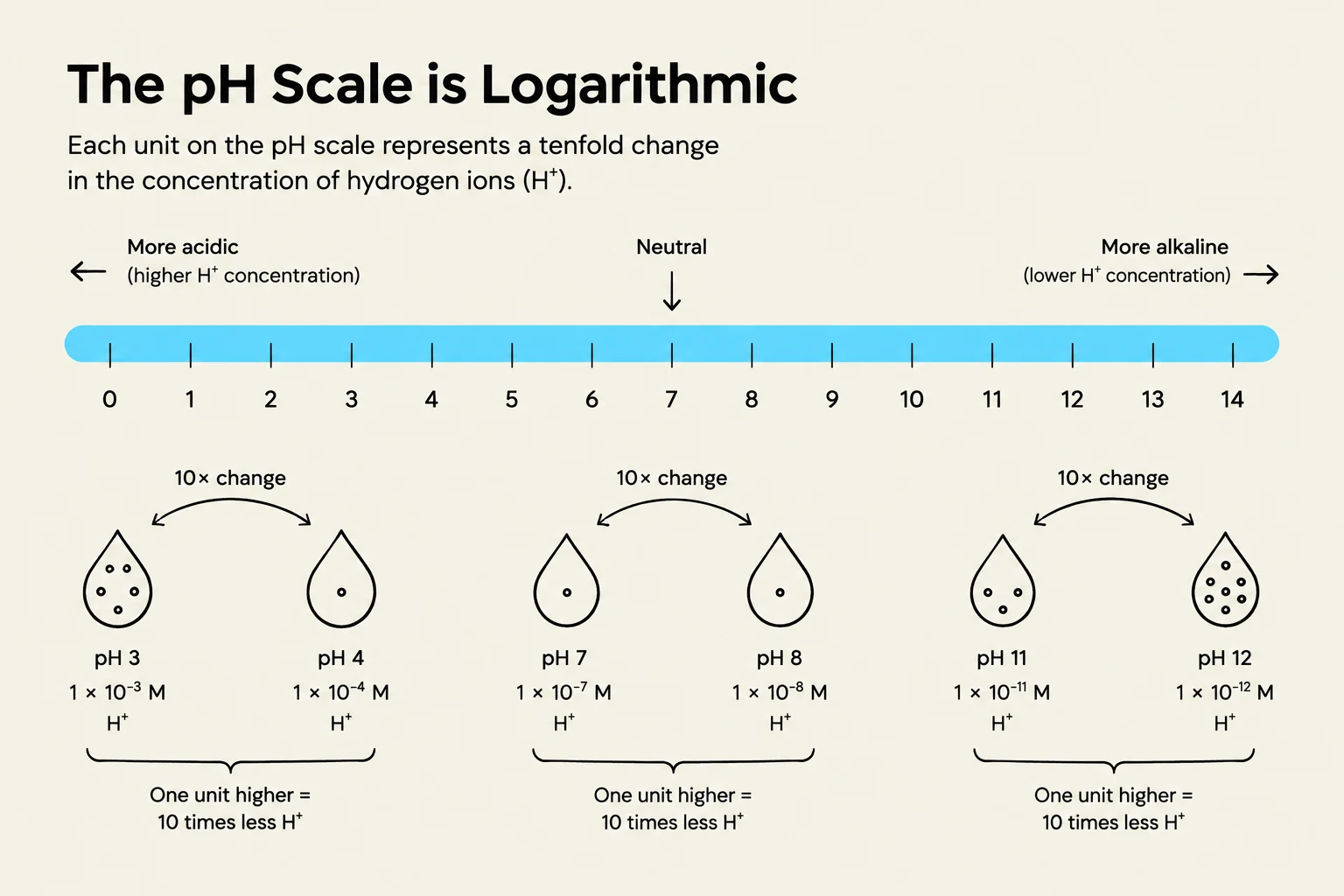
The concentration of hydrogen ions, denoted as [H+], determines where a substance falls on this scale. Because the scale is logarithmic, each whole number change on the pH scale represents a tenfold change in acidity or basicity. For example, a solution with a pH of 4 is ten times more acidic than a solution with a pH of 5, and one hundred times more acidic than a solution with a pH of 6.
The pH scale illustrates the logarithmic relationship between pH values and hydrogen ion concentration, with each unit representing a tenfold change.
Exam Tip: When calculating changes in pH, remember that it is a negative logarithm. If a question asks how much more acidic a pH 3 solution is compared to a pH 5 solution, don't just subtract; calculate 10(5−3)=102=100.
Categorizing Solutions: Acidic, Neutral, and Basic
To make sense of the numbers, we divide the pH scale into three distinct categories: acidic, neutral, and basic.
1. Acidic Solutions (pH < 7)
An acidic solution is characterized by a high concentration of hydrogen ions [H+]. Acids are substances that can donate protons to other substances. Common examples include gastric acid in the stomach, vinegar (acetic acid), and citrus fruits. The lower the pH value, the stronger the acid.
2. Neutral Solutions (pH = 7)
A neutral solution is one where the concentration of hydrogen ions [H+] is exactly equal to the concentration of hydroxide ions $[OH^-]$. Pure water at 25∘C is the classic example of a neutral substance. In a neutral environment, the solution is neither corrosive like an acid nor slippery like a base.
3. Basic or Alkaline Solutions (pH > 7)
Basic solutions, often called alkaline solutions, have a higher concentration of hydroxide ions $[OH^-]$ and a lower concentration of hydrogen ions [H+]. Bases are substances that can accept protons. Common examples include baking soda, ammonia, and various cleaning agents. As the pH value increases toward 14, the basicity of the solution increases.
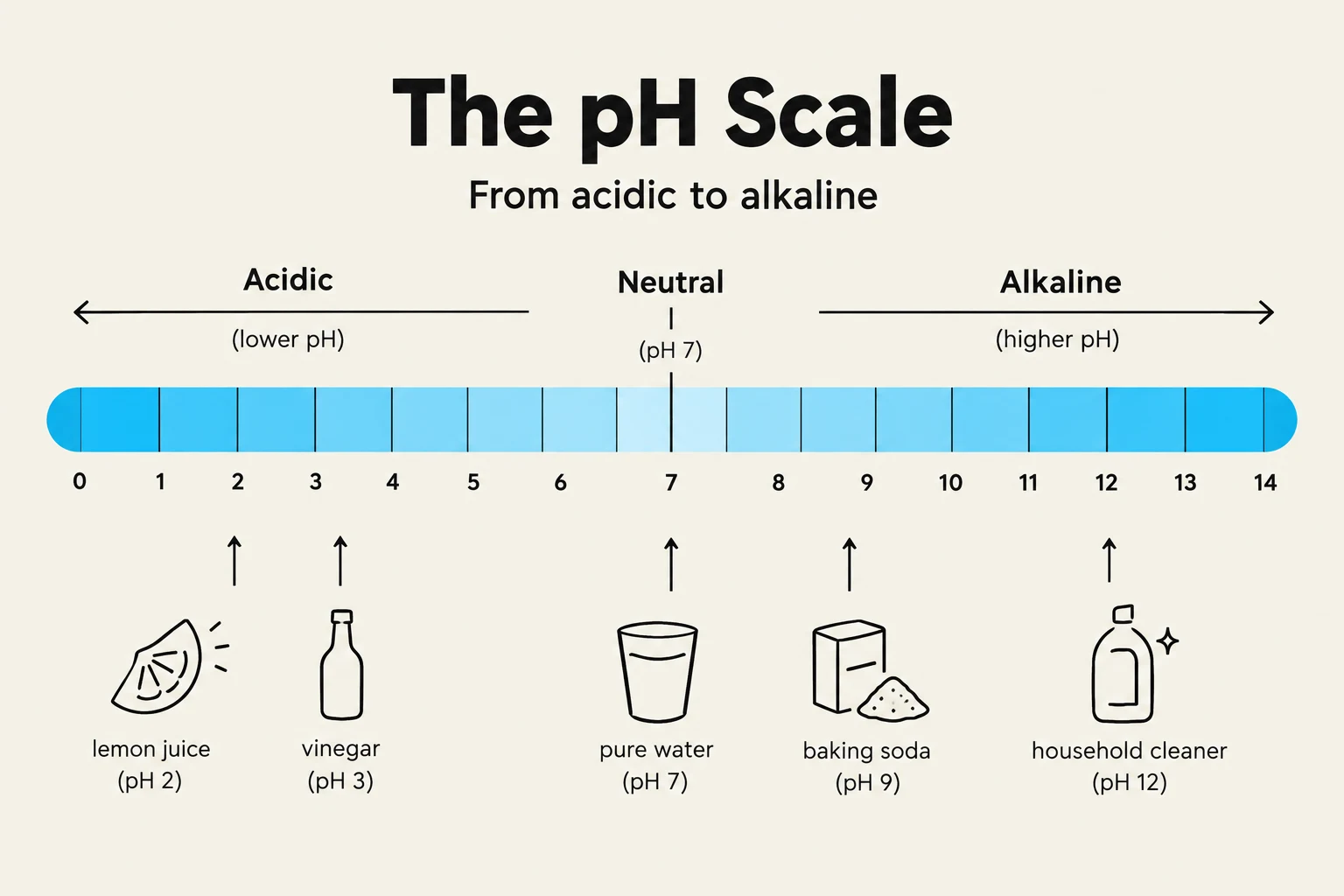
The pH scale illustrates the range from acidic (lower pH) to alkaline (higher pH), with neutral at pH 7. Examples include lemon juice (pH 2), vinegar (pH 3), pure water (pH 7), baking soda (pH 9), and household cleaner (pH 12).
The Mathematical Relationship
While we often use pH indicators like litmus paper for quick tests, the precise measurement of pH involves a specific mathematical formula. The pH is defined as the negative base-10 logarithm of the molar concentration of hydrogen ions:
pH=−log10[H+]
Conversely, if you know the pH and need to find the concentration of hydrogen ions, you can use the following relationship:
[H+]=10−pH
Worked Example: Finding Concentration
Suppose you are analyzing a sample of lemon juice and determine its pH to be 2.0. To find the concentration of hydrogen ions in moles per liter (M), you would set up the equation as follows:
[H+][H+]=10−2.0=0.01 M
This tells us that there are 0.01 moles of hydrogen ions for every liter of lemon juice.
Summary Table of pH Characteristics
To help visualize the differences, refer to the table below:
Solution Type
pH Range
[H+] Concentration
Common Example
Strongly Acidic
0 – 3
Very High
Battery Acid
Weakly Acidic
4 – 6
Moderate
Coffee / Milk
Neutral
7
Equal to $[OH^-]$
Pure Water
Weakly Basic
8 – 10
Low
Baking Soda
Strongly Basic
11 – 14
Very Low
Bleach
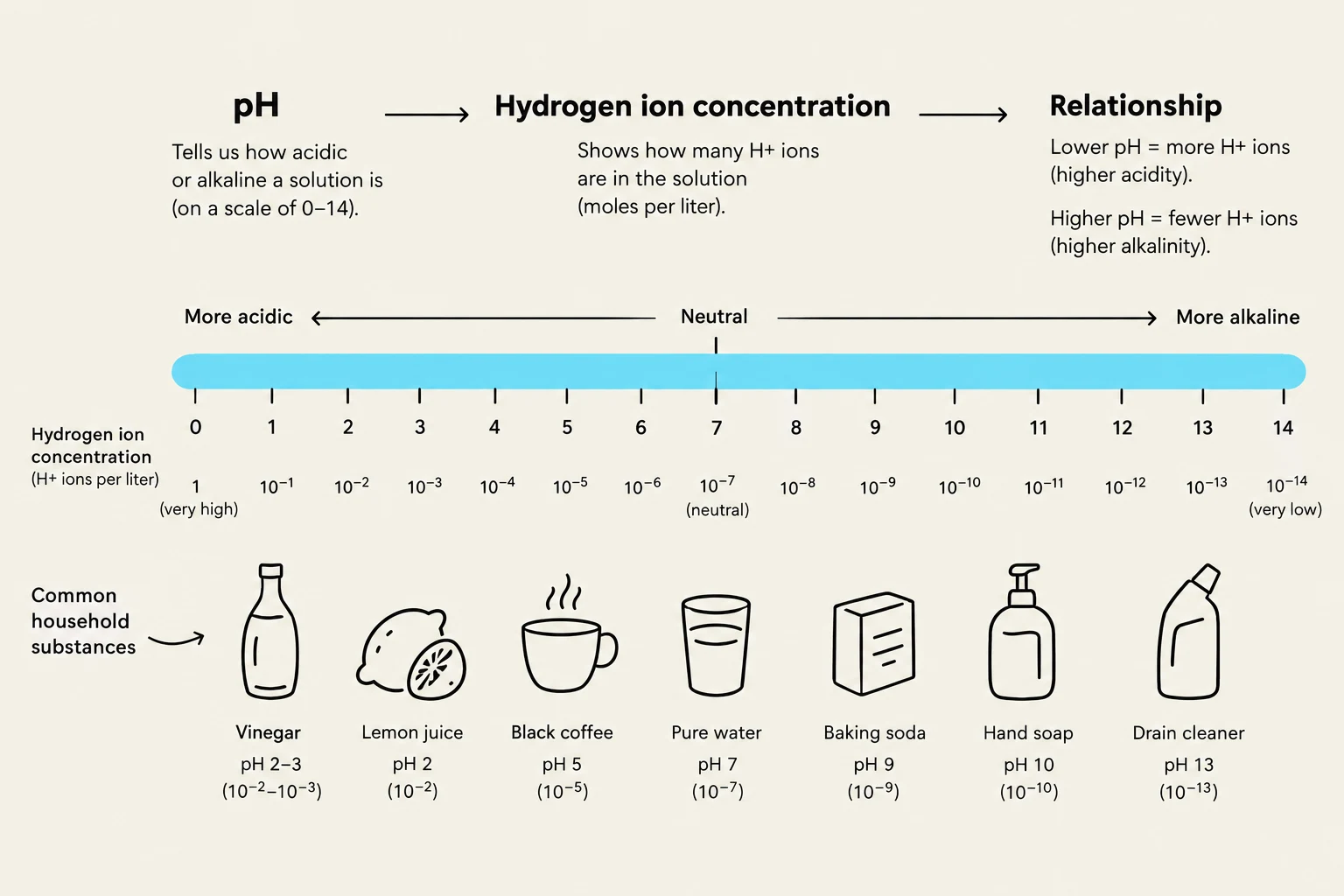
This diagram illustrates the pH scale, ranging from 0 to 14, indicating acidity, neutrality, and alkalinity. It correlates pH values with hydrogen ion concentration and provides examples of common household substances with their respective pH levels.
Understanding these concepts is vital for fields ranging from medicine (monitoring blood pH) to environmental science (measuring ocean acidification). By mastering the pH scale, you gain a fundamental tool for interpreting the chemical world around you.
Keep reading for free.
Create an account to finish this reading and make it part of your study routine.