Understanding the Objective Test and the Reasonable Bystander Standard in Law
This article explains the objective test in law, contrasting it with the subjective test. It details the 'reasonable bystander' standard, its application in criminal law, and provides a mathematical representation of risk assessment. Includes a summary table comparing subjective and objective approaches.
In the realm of law, determining whether an individual's conduct was negligent or reckless often requires moving away from what the person was actually thinking and toward what a hypothetical person would have thought. This is known as the Objective Test. Rather than peering into the subjective mind of the defendant to see if they felt they were being careful, the law asks: "Would a reasonable person, standing in the same circumstances, have recognized the risk?"
This article explores the mechanics of the objective test, the concept of the "reasonable bystander," and how this standard functions to maintain public safety and legal consistency.
The Core Concept: Subjective vs. Objective
To understand the objective test, one must first distinguish it from its counterpart: the subjective test.
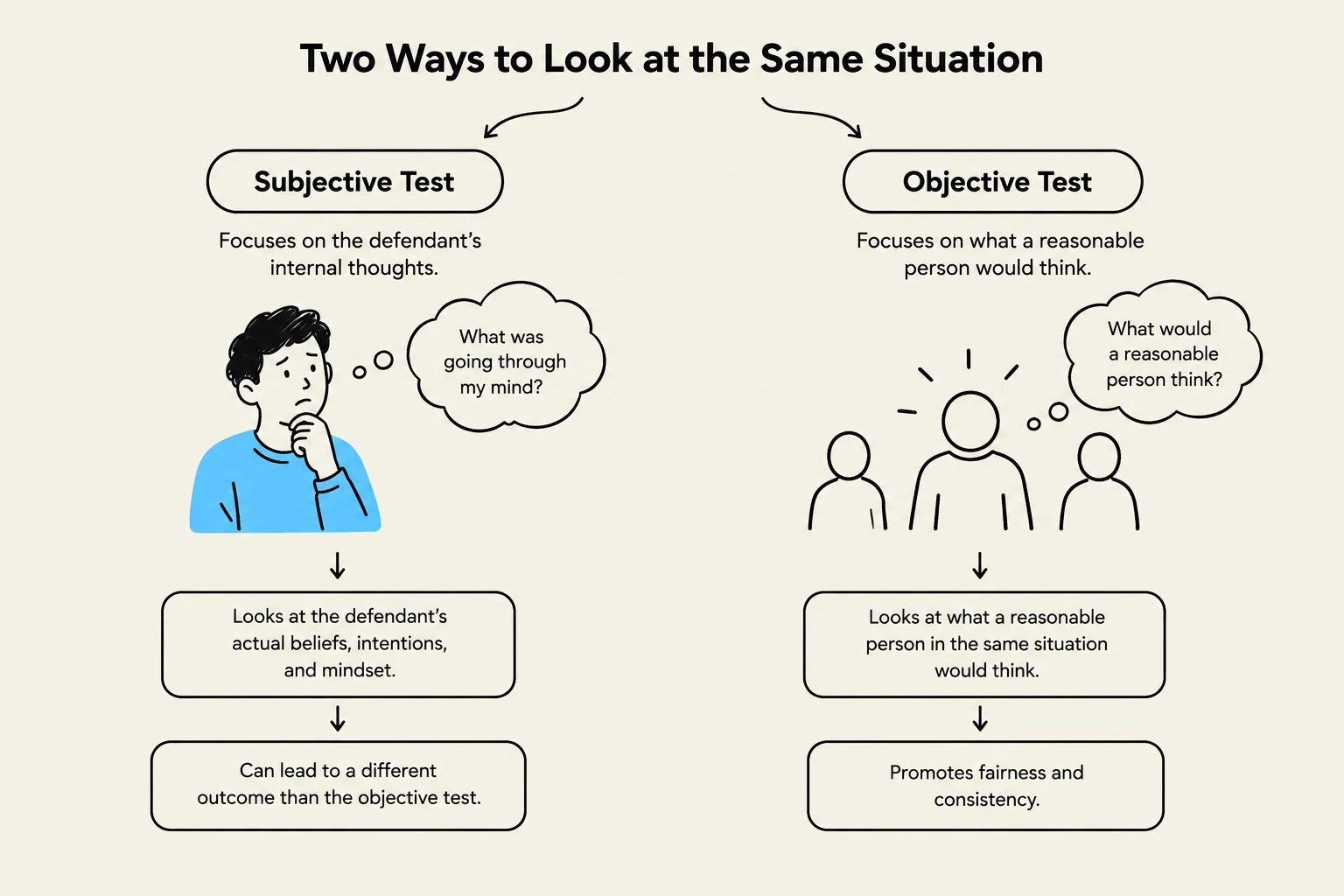
A subjective test focuses on the defendant's actual state of mind. If a defendant genuinely believed their actions were safe, even if they were being foolish, a subjective test might find them not liable because they lacked the "intent" or "awareness" of the danger.
Conversely, the objective test ignores the defendant's personal idiosyncrasies, fears, or lack of foresight. Instead, it imposes a standard of conduct based on what is expected of a person of ordinary prudence. It asks whether the risk was "obvious" to an ordinary person.
Exam Tip: When analyzing a problem question, always identify which test the specific charge requires. Negligence is almost always an objective inquiry, whereas certain types of specific intent crimes may require a subjective analysis of the defendant's actual knowledge.
This diagram illustrates two contrasting approaches to evaluating a situation: the subjective test, which considers the individual's internal thoughts and mindset, and the objective test, which focuses on how a reasonable person would perceive the situation, promoting fairness and consistency.
The 'Reasonable Bystander' Standard
The "reasonable bystander" (often referred to as the "reasonable person") serves as the yardstick for the objective test. This is not a real person, but a legal fiction—a composite of the qualities of prudence, caution, and common sense that society expects from its members.
The standard is designed to be "reasonable," not "perfect." The law does not require individuals to be clairvoyants or to anticipate every conceivable freak accident. Instead, it asks if the risk was one that an ordinary, sensible person would have perceived in that specific context.
Key Characteristics of the Standard:
Ordinary Prudence: The person is not a hero or a genius, but someone who exercises standard care.
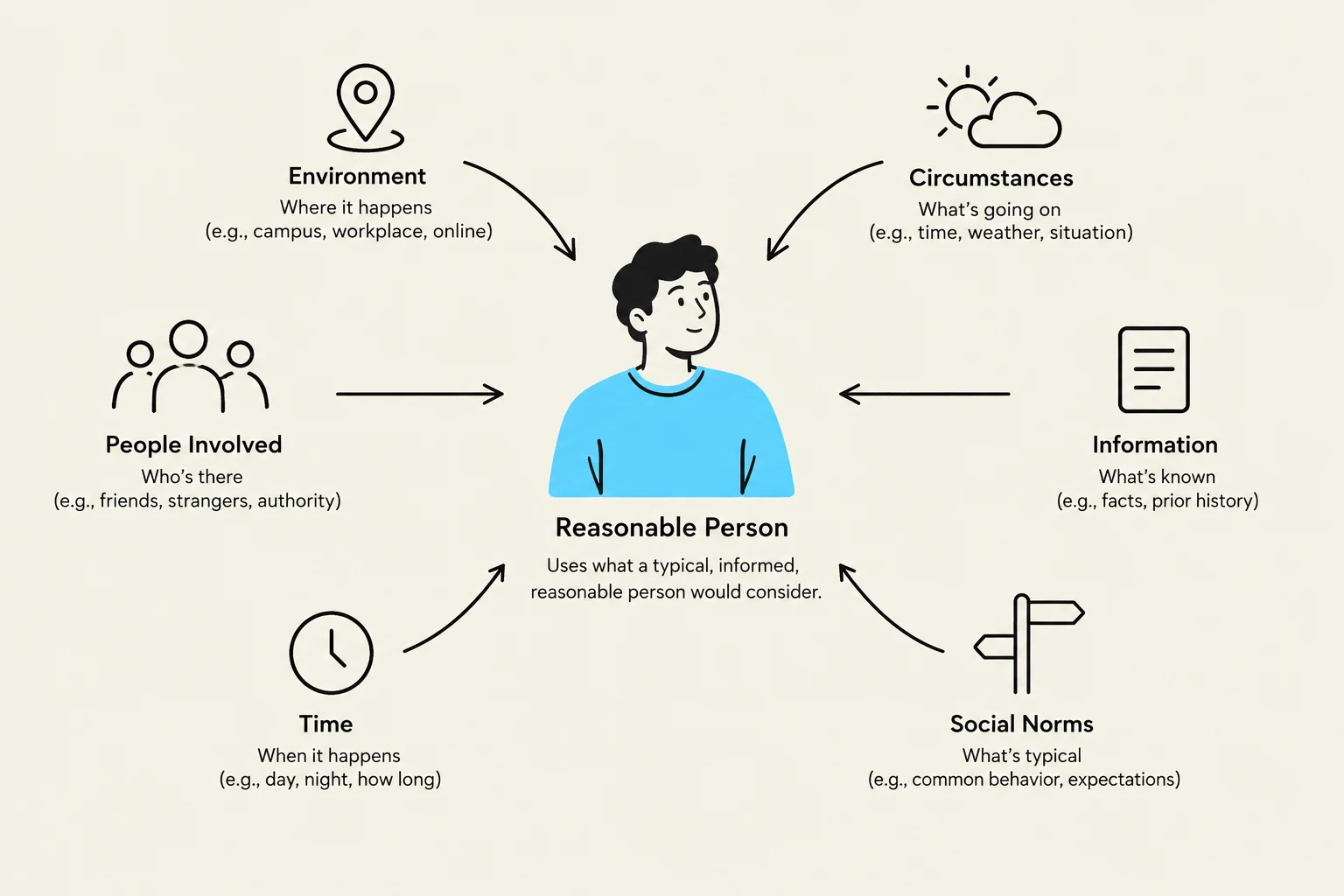
Context-Dependent: The "bystander" is placed in the same circumstances as the defendant. If the defendant is driving in a heavy storm, the reasonable bystander is also driving in a heavy storm, not in clear sunlight.
Obviousness of Risk: A central question is whether the danger was "obvious." If a risk is so subtle that only an expert would notice it, the objective test may not find the defendant liable.
This diagram illustrates the factors that contribute to the concept of a 'Reasonable Person' in legal and ethical contexts, including environment, circumstances, people involved, time, information, and social norms.
Application in Criminal Law: Recklessness
The objective test plays a critical role in defining various degrees of fault, particularly in cases involving criminal damage or negligence. While some definitions of recklessness require the defendant to personally foresee a risk (a subjective element), the objective standard is often used to determine if that risk was so manifest that any reasonable person would have seen it.
In discussions regarding criminal damage, the tension between subjective awareness and objective obviousness is a frequent point of legal debate. For instance, if a person performs an action that carries a high probability of harm, the court may look at whether the risk was so obvious that the defendant's claim of "I didn't realize it was dangerous" is legally insufficient.
Worked Example: The Unsecured Construction Site
Scenario:
An individual leaves a heavy metal tool on the edge of a high-rise balcony. They claim they didn't think the wind would pick up and blow it off.
Applying the Test:
Subjective View: The individual did not foresee the wind; therefore, they did not "intend" for the tool to fall.
Objective View: Would a reasonable bystander, seeing a heavy object on a high ledge, recognize the risk of it falling due to wind or vibration?
Conclusion: If the answer is "yes," the individual may be held liable under an objective standard of negligence or recklessness, regardless of their personal lack of foresight.
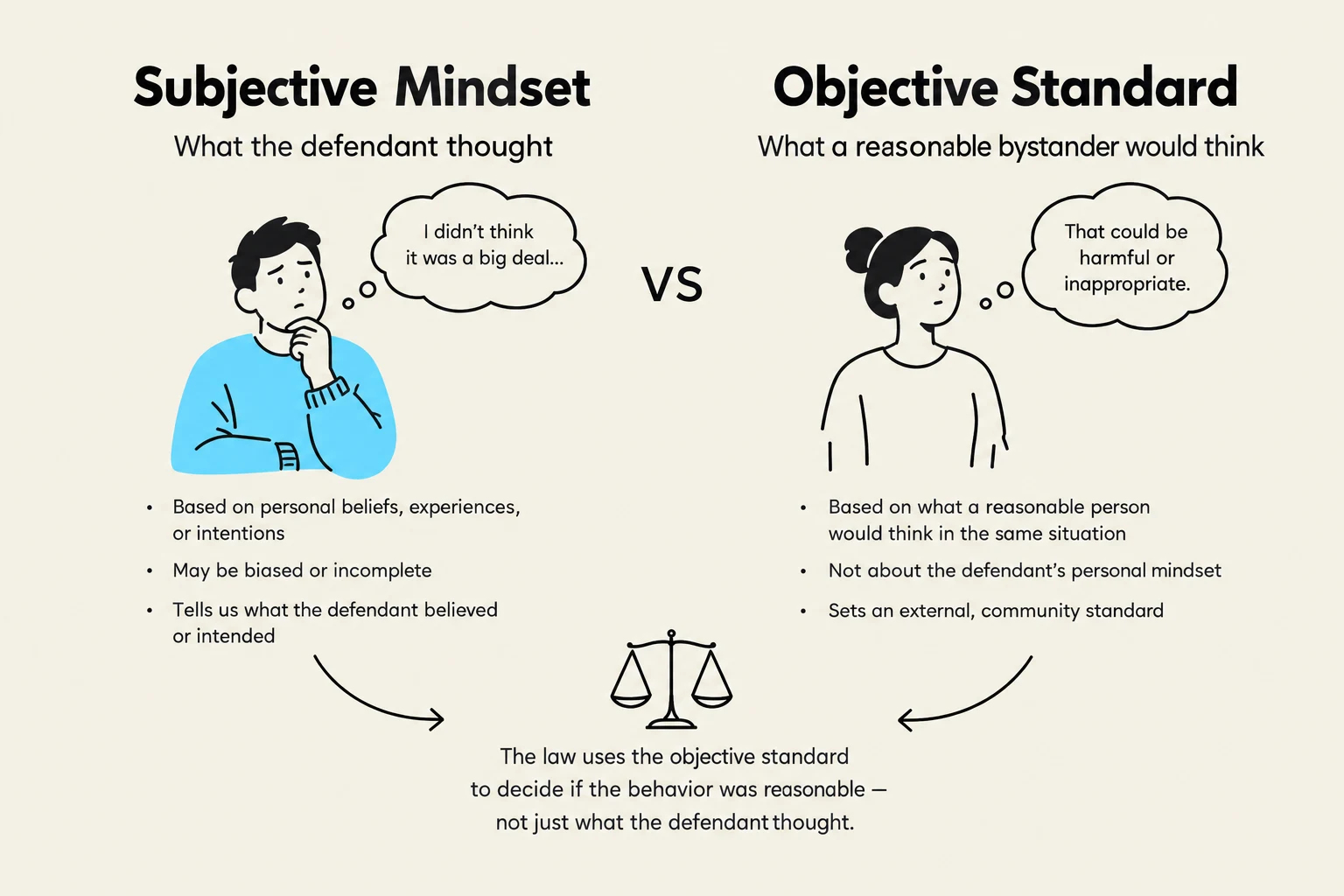
This illustration contrasts the subjective mindset of a defendant with the objective standard used in law to determine reasonableness. The subjective mindset reflects personal beliefs and intentions, which may be biased. The objective standard, conversely, considers what a reasonable bystander would think in the same situation, representing an external community standard.
Mathematical Representation of Risk
While law is a social science, we can conceptualize the objective test through the lens of probability and expected harm. The "reasonableness" of an action can be viewed as a function of the perceived risk (P) and the magnitude of the potential harm (H).
A reasonable person is expected to take precautions when the expected harm (E) exceeds a certain threshold of social acceptability. We can express the expected harm as:
E=P⋅H
In an objective test, the court determines if the defendant's failure to act was a breach of duty by assessing whether:
Pobvious⋅H>Threshold of Reasonableness
Where Pobvious is the probability of the event occurring as perceived by an ordinary person. If the product of the obvious risk and the harm is high, the objective standard demands preventative action.
Summary Table: Subjective vs. Objective
Feature
Subjective Test
Objective Test
Focus
The Defendant's actual mind
The "Reasonable Person"
Question
"Did this person see the risk?"
"Would a reasonable person see the risk?"
Goal
Determining true intent/knowledge
Maintaining societal standards of care
Common Use
Specific intent crimes (e.g., Murder)
Negligence and many regulatory offenses
By utilizing the objective test, the legal system ensures that individuals are held to a consistent standard of behavior. It prevents people from escaping liability simply by claiming ignorance of obvious dangers, thereby fostering a safer and more predictable society.
Keep reading for free.
Create an account to finish this reading and make it part of your study routine.