Explore the external forces that influence marketing decisions, including culture, the microenvironment (company, suppliers, intermediaries, competitors, publics), and the macroenvironment (natural, technological, political, legal). Learn about reactive and proactive strategic responses to these forces.
In the world of business, no company operates in a vacuum. Every decision a marketing manager makes—from the price of a product to the way an advertisement is filmed—is influenced by a complex web of external forces known as the marketing environment. Understanding these forces is not just about survival; it is about understanding the very fabric of human society and how it dictates what people want, how they spend, and what they value.
The Foundation: Culture and Customer Behavior
At the deepest level of the marketing environment lies culture. Culture consists of the institutions and forces that affect a society's values, beliefs, perceptions, preferences, and behaviors.
Marketers generally distinguish between two types of cultural elements:
Core Beliefs and Values: These are highly persistent and are passed down from generation to generation. Because they are so deeply ingrained, they are very difficult to change.
Secondary Beliefs and Values: These are more open to change and can evolve over time as society progresses.
Why does this matter to a business? Because culture shapes customer behavior. It dictates how individuals perceive themselves, how they relate to others, and their fundamental attitudes toward organizations, society, and nature. These cultural shifts eventually manifest as changes in lifestyle preferences. For example, a cultural shift toward health consciousness will eventually change the types of food people buy and the way they view fast-food advertisements.
Study Tip: When analyzing a brand, look beyond the product. Ask yourself: "What cultural value is this brand tapping into?" (e.g., sustainability, authenticity, or convenience).
Navigating the Microenvironment and Macroenvironment
To manage these influences, marketers divide the environment into two distinct layers: the microenvironment and the macroenvironment.
The Microenvironment: The Immediate Circle
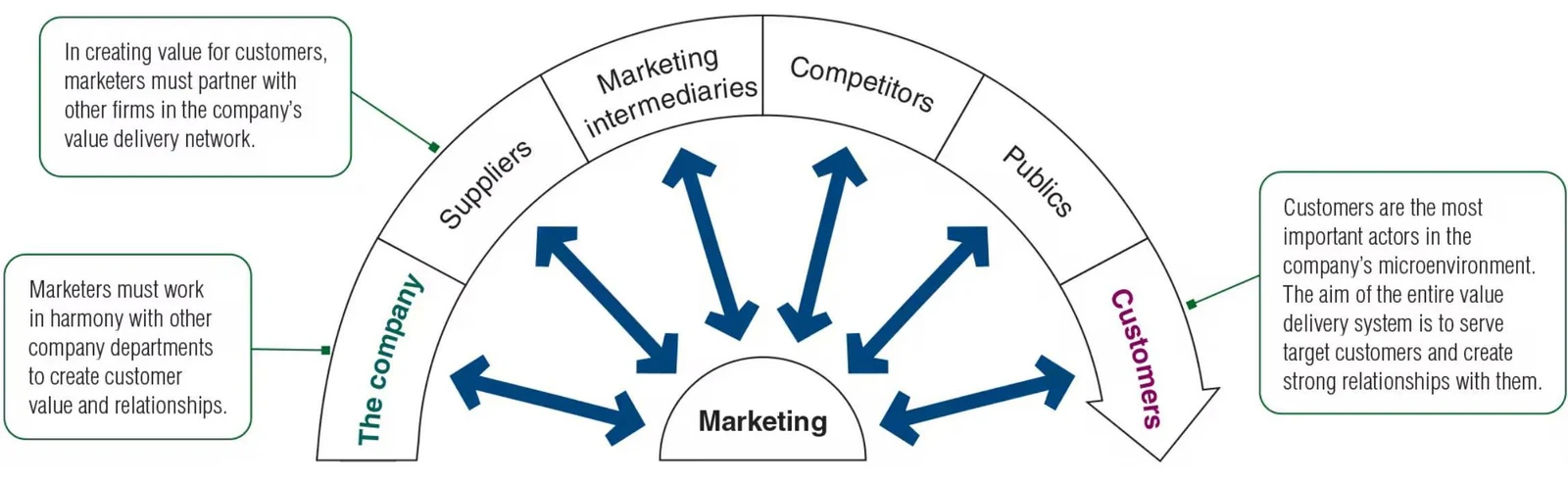
The microenvironment consists of actors close to the company that directly affect its ability to serve its customers. While many actors are involved, customers are the most important component. The entire goal of a company's value delivery system is to serve these target customers and build strong relationships with them.
This diagram illustrates the microenvironment of a company's marketing efforts, showing key actors such as suppliers, marketing intermediaries, competitors, publics, and customers, all interacting with the company's marketing function.
Other key actors in the microenvironment include:
The Company: All internal departments (Finance, R&D, Purchasing, etc.) must work in harmony to create customer value.
Suppliers: They provide the resources needed to produce offerings. Problems like shortages or price hikes can seriously disrupt marketing.
Marketing Intermediaries: These include resellers (wholesalers/retailers), physical distribution firms, marketing services agencies, and financial intermediaries.
Competitors: Marketers must position their offerings strongly against competitors to gain a strategic advantage.
Publics: Any group that has an interest in or impact on the organization, such as media publics or local community groups.
The Macroenvironment: The Larger Societal Forces
The macroenvironment consists of the larger societal forces that affect the entire microenvironment. These are often categorized into several key areas:
Natural Changes: This involves the physical environment and natural resources. Increasing concern for the environment has led to the "green movement," where companies like Patagonia focus on products that do less harm to the planet.
Technological Changes: New technologies, such as the Internet of Things (IoT) or Artificial Intelligence (AI), create entirely new markets and opportunities.
Political and Legal Forces: These include laws, government agencies, and pressure groups that limit or influence organizations. For instance, the Children's Online Privacy Protection Act (COPPA) regulates how companies collect data from children.
Strategic Responses: Reactive vs. Proactive
Once a company understands these environmental forces, it must decide how to respond. There are two primary strategic stances:
Reactive Companies
Reactive companies take a passive approach. They view the marketing environment as an uncontrollable element and do not attempt to change it. Instead, they wait for changes to happen and then adapt to them.
Example: A company only switches to sustainable packaging after customers begin demanding it and sales start to drop.
Proactive Companies
Proactive firms take an aggressive stance. They do not just accept the environment; they attempt to influence, shape, or change it. Proactive companies aim to predict marketplace shifts and address needs before they become mainstream.
Example: A company anticipates growing environmental concerns and develops sustainable packaging before its competitors do, thereby seizing a competitive advantage.
Proactive firms may use various tactics to influence the environment, such as:
Influencing legislation to favor their industry or protect consumers.
Using social media to shape public opinion on social issues.
Engaging in brand activism or cause-related marketing to align with evolving societal values.
Exam Insight: While proactive companies cannot control every force (like a sudden economic recession or a natural disaster), the proactive approach is generally viewed as the superior method for creating opportunity and mitigating risk.
Keep reading for free.
Create an account to finish this reading and make it part of your study routine.