Understanding the Immune System: Deficiencies, Hypersensitivities, and Autoimmunity
An overview of the immune system's functions, including how it defends against pathogens, its role in hypersensitivity reactions and autoimmune disorders, and its implications in transplantation and cancer immunology. Covers immunodeficiencies, immunoglobulins, and different types of hypersensitivities.
The immune system is a sophisticated defense network designed to distinguish between "self" and "non-self." While this system is essential for survival, it can sometimes fail through deficiency, overreact to harmless substances (hypersensitivity), or mistakenly attack the body's own tissues (autoimmunity). Understanding these deviations from normal immune function is critical to modern medicine, particularly in the fields of organ transplantation and oncology.
Immunodeficiencies: When the Defense Fails
An immunodeficiency occurs when the immune system's ability to fight infectious diseases is compromised or entirely absent. These deficiencies are categorized into two main types: inherited and acquired.
Inherited Immunodeficiencies
Inherited immunodeficiencies are present from birth and arise from genetic mutations that affect specific components of the immune response. Because the immune system relies on a complex web of cells, proteins, and signaling molecules, a mutation in any one of these can impair overall function.
A particularly devastating example is Severe Combined Immunodeficiency (SCID). SCID is extremely deadly because it affects both T cells and B cells, effectively stripping the body of its primary adaptive immune defenses. Treatment often requires intensive interventions such as bone marrow transplants or gene therapy.
Acquired Immunodeficiencies
Acquired immunodeficiencies develop during a person's lifetime. These are often caused by viruses that suppress immune function. The most well-known example is HIV (Human Immunodeficiency Virus), which is transmitted through blood and reproductive fluids.
HIV specifically targets and kills helper T cells, which are essential for coordinating the entire immune response. While drugs can target the proteins necessary for viral replication to reduce the amount of virus in the blood, they do not eliminate the virus entirely.
Study Tip: Remember the distinction—Inherited = Genetic/Birth; Acquired = Environmental/Life-acquired.
The Role of Immunoglobulins
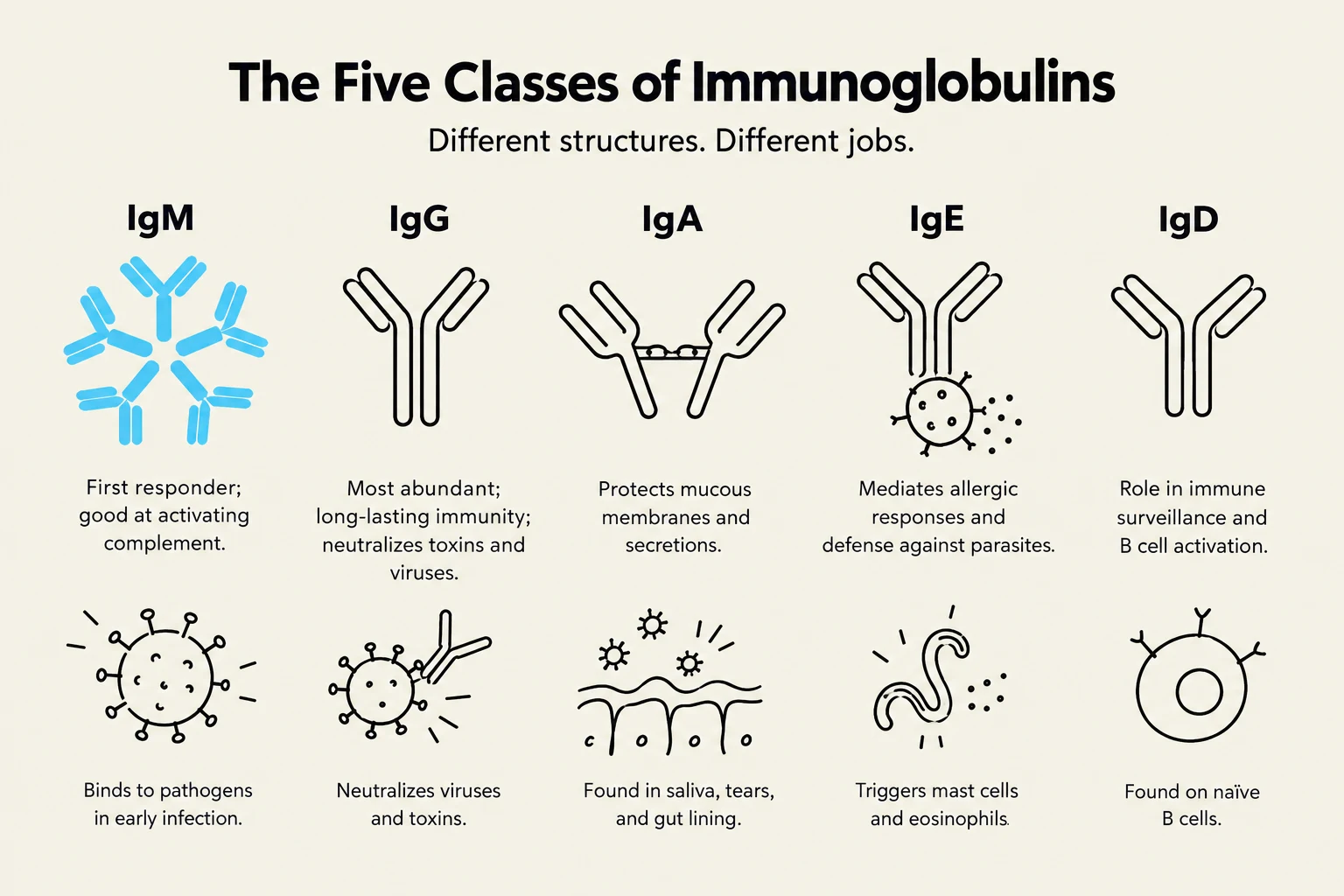
To understand hypersensitivity and autoimmunity, one must first understand immunoglobulins (antibodies). These are proteins produced by B cells that identify and neutralize pathogens. There are five primary classes:
IgM: A large pentamer (five-unit structure) produced first during a primary immune response. It is highly effective at activating the complement system to fight bacteria.
IgG: The most abundant antibody in the late primary response. Crucially, IgG can cross the placenta to provide passive immunity to a fetus.
IgA: Found in exocrine gland secretions such as mucus, tears, saliva, and mother's milk. It is the only antibody that leaves the body's interior to protect mucosal surfaces.
IgE: Found in the smallest amounts, but highly significant in allergic reactions. It triggers mast cells, leading to symptoms of allergy and anaphylaxis.
IgD: Functions primarily as a B cell surface receptor to assist in immune surveillance.
The five classes of immunoglobulins (IgM, IgG, IgA, IgE, and IgD) are illustrated with their respective structures and functions in the immune system.
Hypersensitivities: Overactive Immune Responses
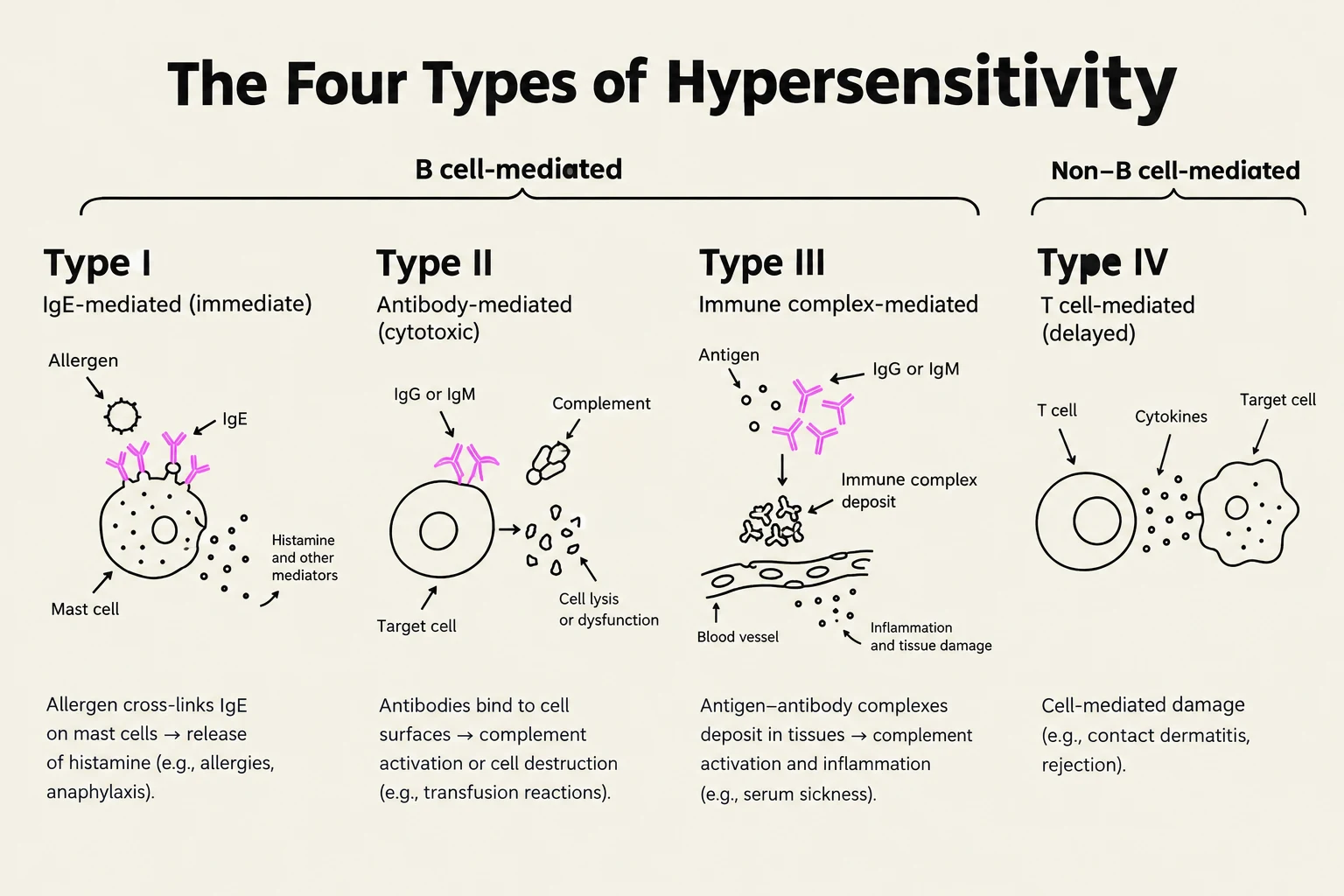
Hypersensitivity refers to an immune response that is "sensitive beyond normal levels," causing inflammation or damage in response to nonpathogenic environmental substances (allergies). These are classified into four distinct types:
Type I (Immediate): Mediated by IgE. When an allergen binds to IgE on sensitized mast cells, it triggers a rapid release of chemicals. This can lead to anaphylactic shock, which can be fatal within 20–30 minutes.
Type II (Cytotoxic): Mediated by IgG. Antibodies bind to antigens on specific cell surfaces, causing cell lysis (destruction). A classic example is a mismatched blood transfusion where red blood cells are destroyed.
Type III (Immune Complex): Caused by soluble antigens (like DNA) binding with antibodies to form antigen-antibody complexes. These complexes accumulate and deposit in tissues like joints or kidneys, causing inflammation.
Type IV (Delayed): Unlike the first three, this is exclusively mediated by T cells rather than B cells/antibodies. It involves a cellular immune response that typically shows a delay of 24 to 72 hours, such as the reaction seen in a TB skin test or poison ivy.
Diagram illustrating the four types of hypersensitivity reactions: Type I (IgE-mediated), Type II (Antibody-mediated), Type III (Immune complex-mediated), and Type IV (T cell-mediated).
Autoimmunity: Attacking the Self
Autoimmune disorders occur when the immune system loses "tolerance" and begins attacking the body's own antigens. These responses can be localized or affect many body systems.
Disease
Autoantigen
Primary Symptom
Rheumatoid Arthritis
Joint capsule antigens
Chronic inflammation of joints
Systemic Lupus Erythematosus
Nuclear DNA and proteins
Damage to many body systems
Diabetes Mellitus Type I
Beta cells of pancreas
Low insulin; glucose regulation issues
Hashimoto's Thyroiditis
Thyroid-stimulating hormone receptor
Hypothyroidism
Note: In Graves' disease, antibodies mimic the hormone to stimulate the receptor (hyperthyroidism), whereas in Hashimoto's, they block the receptor (hypothyroidism).
Transplantation and Cancer Immunology
Transplantation and Tissue Typing
Successful organ transplantation requires matching the donor to the recipient to prevent rejection.
Blood Typing: Red blood cells are typed based on ABO and Rh surface antigens. A mismatch can lead to severe immune reactions.
Tissue Typing: This involves determining the Major Histocompatibility Complex (MHC) molecules in the donor's tissue. Because there are many different MHC proteins, tissue transplantation is much more complex than blood transfusions. Family members are often the best candidates because they are more likely to have MHC matches.
A specific complication involving Rh antigens is Erythroblastosis Fetalis. This occurs when an Rh-negative mother carries an Rh-positive fetus. If fetal blood enters the mother's system during the first birth, she develops anti-Rh antibodies. In a subsequent pregnancy, these antibodies can cross the placenta and attack the red blood cells of the fetus. This can be prevented by administering RhoGAM to the mother during the first pregnancy.
This diagram illustrates the process of erythroblastosis fetalis, a condition where an Rh-negative mother develops antibodies against Rh-positive fetal red blood cells, leading to fetal anemia.
Immune Responses Against Cancer
The immune system plays a dual role in cancer. While some cancers are triggered by viruses (such as Hepatitis B causing liver cancer or HPV causing cervical cancer), a healthy immune system can often identify and destroy these cells.
However, some cancers mutate so rapidly that they "escape" immune detection. Modern medical research focuses on enhancing the immune response through methods like cancer vaccines to help the body recognize these elusive malignant cells.
Keep reading for free.
Create an account to finish this reading and make it part of your study routine.