This content explains the core principles of the economic way of thinking, including the distinction between positive and normative economics, the tradeoff between efficiency and equity, and the difference between correlation and causation.
To the casual observer, economists often seem like a group of people who can never quite agree on anything. You might hear one expert arguing that a clean environment should be our highest priority, while another insists that rapid economic growth is the most vital goal. This perceived lack of consensus has led to the famous quip by George Bernard Shaw: "If you took all the economists in the world and laid them end to end, they would never reach a conclusion".
However, this perception is somewhat misleading. Economists actually agree on a vast array of fundamental principles, such as the benefits of free trade or the utility of government deficit spending during a recession. When they do disagree, it is rarely because they are using different math; rather, it is because they are approaching the problem from different philosophical or analytical angles. Understanding the "economic way of thinking" requires us to distinguish between how we describe the world and how we believe the world should be.
Positive vs. Normative Economics
One of the primary reasons for professional disagreement is the distinction between positive economics and normative economics.
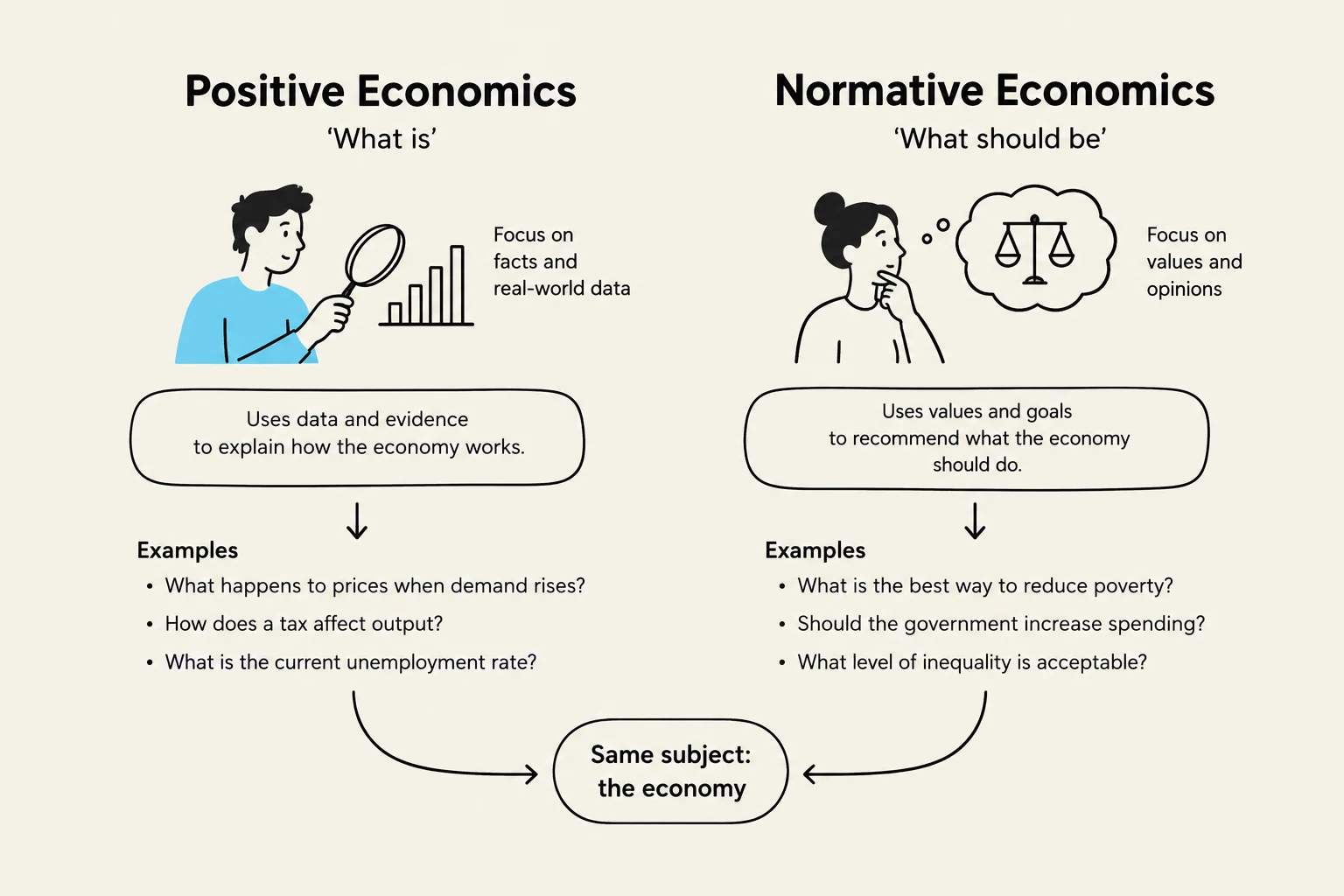
Positive economics is concerned with the facts and the "what is" of the economy. It involves descriptive statements that can be tested, proven, or disproven using data. For example, a positive statement would be: "An increase in the minimum wage will lead to a 2% increase in unemployment." This is a claim about cause and effect that can be analyzed through empirical evidence.
Normative economics, on the other hand, is concerned with "what ought to be." These are value judgments and opinions that cannot be proven true or false by data alone. A normative statement would be: "The government should increase the minimum wage to reduce poverty." Whether this is "right" depends on an individual's personal values and social priorities.
Exam Tip: If a statement contains words like "should," "ought," "better," or "worse," it is likely a normative statement. If it describes a relationship that can be measured with data, it is positive.
This diagram illustrates the distinction between positive economics, which focuses on objective analysis of economic phenomena, and normative economics, which deals with value judgments and policy recommendations.
The Tradeoff Between Efficiency and Equity
Even when economists agree on the positive facts of a situation, they may disagree on the best policy due to the fundamental tradeoff between efficiency and equity.
Efficiency refers to how well society uses its scarce resources to maximize the production of goods and services. An efficient economy is one where no one can be made better off without making someone else worse off.
Equity refers to how the "economic pie" is distributed among members of society—the fairness of the outcome.
An economist focused on efficiency might argue against high taxes on the wealthy because those taxes could discourage investment and slow down overall economic growth. Conversely, an economist focused on equity might argue that those same taxes are necessary to fund social programs and reduce the gap between the rich and the poor. Because there is no mathematical formula to determine the "perfect" balance between these two goals, disagreement is inevitable.
This illustration depicts the economic concepts of efficiency and equity, highlighting the challenge of balancing total output with fair distribution of benefits.
Correlation versus Causation in Economic Indicators
A critical skill in the economic way of thinking is the ability to distinguish between correlation and causation.
Correlation occurs when two variables move together in a predictable pattern. Causation occurs when a change in one variable is the direct reason for the change in the other. In economics, many "unusual indicators" show strong correlations, but they do not necessarily imply that one causes the other.
Unusual Economic Indicators
Economists and market analysts often track strange data points that seem to predict the future of the economy. While these can be fascinating, they often fall into the trap of correlation without causation:
The Super Bowl Indicator: This suggests that if a team from the National Football Conference (NFC) wins the Super Bowl, the stock market will be higher by December; if an American Football League (AFL) team wins, the market will dip. Despite an 80% accuracy rate over 50 years, there is no logical reason why a football game would cause the stock market to move.
The Boston Snow Index: This predicts a rising economy if it snows in Boston on Christmas Day. While it has been correct 73% of the time, its creator views it as a "spoof" rather than a scientific tool.
The Marriage Indicator: Some studies show that an increase in marriages often precedes an economic rise, typically with a one-year lag.
The Diaper Rash Indicator: During recessions, families may cut back on spending, leading to fewer diaper purchases. An unintended consequence of using fewer diapers (or perhaps lower-quality ones) might be an increase in diaper rash, making sales of ointments a potential indicator of economic distress.
The Champagne Index: Because champagne is a symbol of celebration, its sales often plummet during economic downturns when people have less to celebrate.
While these indicators might offer interesting patterns, a disciplined economist knows that just because two things happen at the same time does not mean one caused the other.
Summary Note: To think like an economist, always ask: "Is this a statement of fact (positive) or a statement of value (normative)?" and "Is this variable actually causing the change, or are they just moving together by coincidence?"
Keep reading for free.
Create an account to finish this reading and make it part of your study routine.