Understanding the Divide: A Comparison of Civil and Criminal Law
This content explains the fundamental differences between civil and criminal law, including their aims, actors, remedies, and standards of proof. It also covers substantive and procedural law and provides a worked example of their overlap.
In any organized society, law serves as a system of rules that enables people to function efficiently and harmoniously. These rules are not merely suggestions; they are normative, institutionalized, and coercive, meaning they are enforced by the state through various institutions like the courts. To understand how these rules are applied, one must distinguish between the two primary branches of the legal system: Civil Law and Criminal Law. While they may occasionally overlap in a single incident, they serve fundamentally different purposes, involve different actors, and operate under different standards of proof.
The Foundations: Substantive and Procedural Law
Before diving into the specific branches, it is essential to understand the two layers that govern all legal activity: substantive law and procedural law.
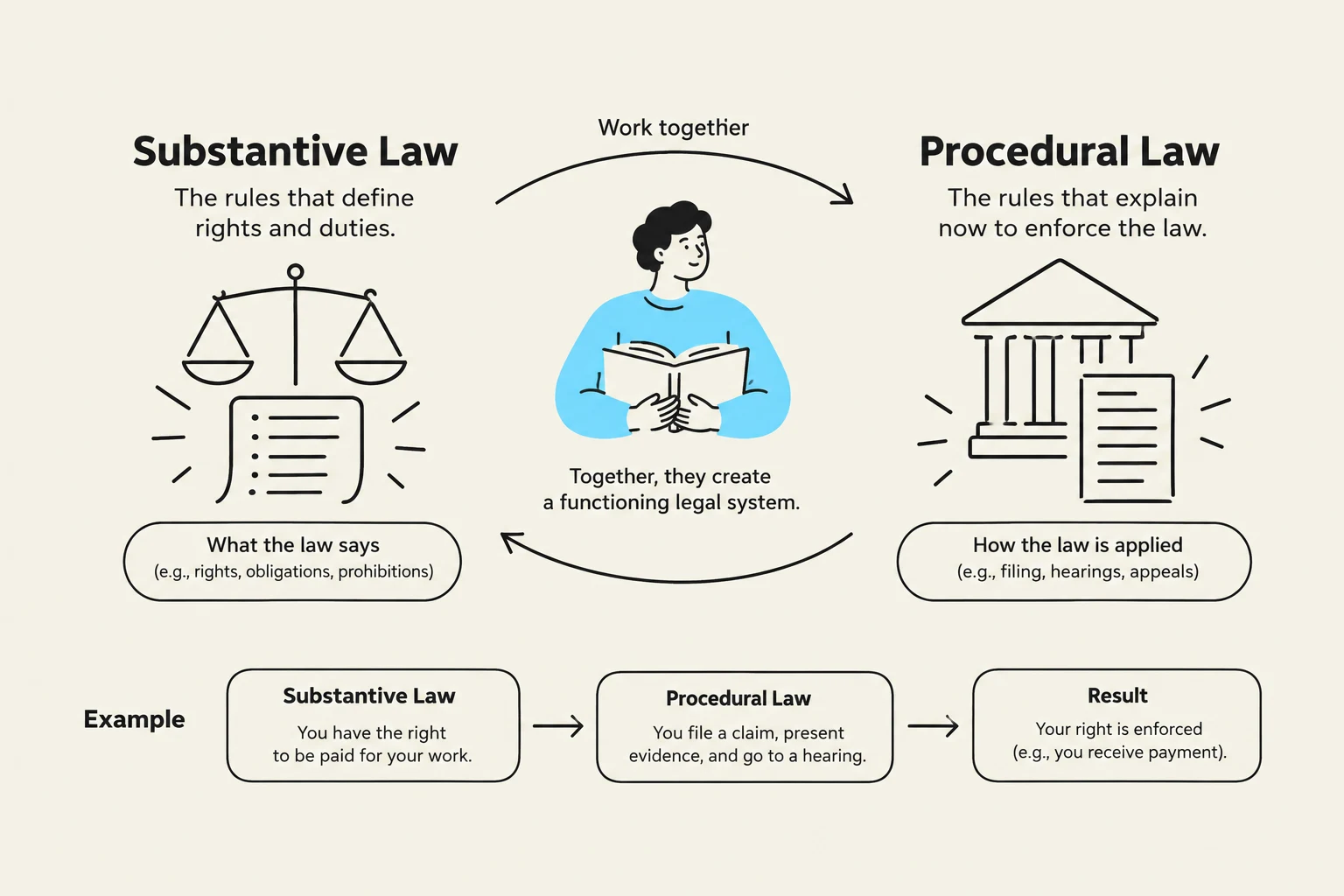
Substantive law refers to the actual rules that define our rights and duties. It is the "what" of the law—the specific rules that define what constitutes a crime or a tort and what the associated punishments or consequences are.
Procedural law, on the other hand, is the "how." It consists of the rules that govern the mechanics of a legal case, ensuring that the substantive law is administered fairly and through due process.
This diagram illustrates the relationship between substantive law, which defines rights and duties, and procedural law, which outlines how to enforce those rights and duties, to create a functioning legal system. An example demonstrates how a right to be paid for work is enforced through legal procedures.
Criminal Law: Protecting Society
Criminal law is a branch of public law, which regulates the interaction between citizens and the state. It deals with conduct that is perceived as threatening, harmful, or dangerous to the health, safety, or moral welfare of the community. Because a crime is viewed as a wrong against society as a whole, the state takes the lead in addressing it.
Actors and Aims
In a criminal case, the primary actor is the State (often referred to as "The People" or "The Crown"), which prosecutes the accused. The primary aims of criminal law are:
Punishment: Penalizing the offender for their wrongdoing.
Rehabilitation: Helping the offender reintegrate into society.
Deterrence: Discouraging the offender and others from committing similar acts.
Remedies and Procedure
The "remedies" in criminal law are not meant to compensate a victim, but to penalize the offender. These may include imprisonment, fines, probation, or community service. The procedure typically involves a summons or indictment, and for serious offenses, a trial by jury.
Exam Tip: Remember that in criminal law, the "victim" is technically the state or society, even if a specific individual was harmed. This is why the state is the prosecutor.
Civil Law: Resolving Private Disputes
Civil law is a branch of private law, focusing on the rights and duties that individuals and companies owe to one another. Unlike criminal law, which seeks to punish, civil law seeks to resolve disputes and restore the injured party to their original position.
Areas of Civil Law
Civil law covers a vast range of human interactions, including:
Contract Law: Disputes arising from broken agreements.
Tort Law: A major area involving civil wrongs, such as:
Negligence: Failure to take reasonable care.
Trespass: Unlawful interference with person, land, or goods.
Defamation: Harming a person's reputation.
Nuisance: Unreasonable interference with a person's use or enjoyment of land.
Actors and Aims
The actors in civil law are private individuals or companies (though the state can also be a party). The primary aim is compensation—ensuring the person who suffered a loss is made whole.
Remedies and Procedure
Common civil remedies include:
Damages: Monetary compensation paid to the plaintiff.
Injunctions: A court order requiring a party to do or refrain from doing a specific act.
Declarations: A formal statement by the court regarding the rights of the parties.
This diagram illustrates the key differences between civil law and criminal law, covering their aims, actors, and remedies.
The Standard of Proof: A Critical Distinction
One of the most important differences between these two systems is the "burden of proof"—how much evidence is required to win a case.
Proof Beyond Reasonable Doubt: This is the high standard used in criminal law. Because a person's liberty (imprisonment) is at stake, the prosecution must prove the defendant's guilt so clearly that there is no reasonable doubt remaining in the mind of the jury or judge.
Balance of Probabilities: This is the lower standard used in civil law. To be found "liable," a plaintiff only needs to prove that their version of events is more likely than not to be true.
Summary Comparison Table
Feature
Criminal Law
Civil Law
Nature of Wrong
Against society/state
Between individuals/entities
Primary Actor
The State
Private parties (Plaintiff/Defendant)
Primary Aim
Punishment/Deterrence
Compensation
Standard of Proof
Beyond reasonable doubt
Balance of probabilities
Typical Remedy
Prison, fines, community service
Damages, injunctions
The Overlap: A Worked Example
It is possible for a single act to trigger both criminal and civil proceedings. Consider a case where a driver hits a pedestrian due to extreme recklessness:
The Criminal Case: The State prosecutes the driver for an "offence against the person" (e.g., dangerous driving). The aim is to punish the driver with a fine or prison sentence.
The Civil Case: The pedestrian (the plaintiff) sues the driver (the defendant) for the tort of negligence. The aim is to obtain damages (money) to pay for medical bills and suffering.
In this scenario, the driver could be acquitted in the criminal court (because the state failed to prove guilt "beyond reasonable doubt") but still be found liable in the civil court (because the pedestrian proved the driver was at fault on a "balance of probabilities").
Keep reading for free.
Create an account to finish this reading and make it part of your study routine.